

AI researcher • developer • engineer • DMs always open
Bali, Indonesia
- Tweets 6,185
- Following 413
- Followers 10,769
- Likes 14,351


the cheapest 300-agent system might spend most of the day running exactly 1 agent.
because 300 agents are useful for bursts.
not for waiting.
your K3 employee can handle the normal loop:
check state
→ run routing → use tools → update memory → wait
then only escalate when the workload crosses a threshold.
one task becomes:
1 K3 core
→ 8 workstreams
→ 50–300 temporary agents
→ verified result
→ compressed state
→ swarm shuts down
that changes the economics completely.
you don’t maintain a 300-agent workforce.
you maintain one persistent employee with access to burst compute.
full architecture below ↓


14
9
54
2,524
Jev Engineering is like reviewing 300 employees without handing each one the company handbook again.
Imagine 300 people all worked from the same brief.
They come back with 300 reports.
You don’t reread the entire brief from page one before checking every report.
You keep the rules in front of you and judge what changed.
That’s basically what this run does.
The first pass clears most of the work and leaves 29 questions.
The second leaves 4.
The third clears the room.
The agents can be massively parallel.
The reviewer doesn’t have to be massively repetitive.
That distinction is why Jev Engineering starts to matter much more once the swarm gets large.


15
9
118
5,986
Jev Engineering is basically a QA gate for agent swarms.
and make every agent up to 193x faster and 444x cheaper in tests.
300 K3 results hit the desk at once.
Jev doesn’t rewrite them.
it doesn’t “think harder” about every answer.
it gives each one a verdict:
keep or requeue
round 1 leaves 29 problems.
round 2 leaves 4.
round 3 leaves none.
so the swarm never needs one giant cleanup pass at the end.
quality control happens continuously:
work
→ verdict
→ isolate failures
→ retry only failures
→ close
that’s what i like about Jev Engineering.
the reviewer doesn’t become another agent doing the work.
it stays a decision layer.

24
24
150
9,682
i think this is one of the better Jev Engineering demos because the “waste” is visible.
the system generated 4,608 possible decisions.
only 1,536 were ever needed.
3,072 were thrown away.
and that sounds inefficient until you look at the other metric:
0 waits.
the next decision was already available every time the run changed direction.
so instead of optimizing for the fewest calls possible, Jev Engineering optimizes the whole loop:
prepare
→ execute
→ pick
→ discard
→ keep moving
16 turns without stopping the execution layer to ask “what now?”
that last number matters most.
because a 300-agent system can lose more time waiting for orchestration than actually doing the work.
that trade makes a lot more sense once the swarm is large.

19
22
103
9,324

Today, Whop is introducing Economic Intelligence, a decision making system built from business actions on platform.
Billions of people should have the ability to build profitable businesses.
Economic Intelligence answers "what next?" for businesses at all levels.

46
88
545
403,356
Jev Engineering reviewed 300 K3 results in one pass instead of making 300 separate review calls.
and make it up to 193x faster and 444x cheaper in tests.
that’s the whole architecture in this video.
300 parallel results come back.
Jev asks one bounded question about each result:
keep or requeue
one shared context
→ 300 typed verdicts
→ 271 accepted
→ 29 sent back
→ 299 review calls avoided
and round two gets smaller automatically because only the misses return.
that’s what i like about Jev Engineering:
batch the decisions once. don’t make the model rediscover the same context 300 times.
Full guide in article below

35
18
157
9,944
Fo has been SPEEDRUNNING through my family group chat.
- 1 restaurant booked.
- 5 schedules checked.
- Movie tickets bought.
- 0 long, confusing calls with Mom.


I led engineering at Google DeepMind.
Today, I'm proud to introduce Fo to give personal AI something no lab ever has... Humans.
Other personal AI's pretend AI can do everything. Fo employs humans to do tasks that AI cannot.
- 2x better at real-world task completion (beats other agents by 69%)
- 94% trust rate (4x less likely to leak private info vs Muse, Instinct)
Sign up for free: wajo.ai/join-wajo

Paid partnership (ad)
8
3
55
2,236
the first real 24/7 AI employee might have 1 permanent brain and 300 temporary workers.
because 300 agents are useful for bursts.
not for waiting.
your K3 employee can handle the normal loop:
check state
→ run routine
→ use tools
→ update memory
→ wait
then only escalate when the workload crosses a threshold.
one task becomes:
1 K3 core
→ 8 workstreams
→ 50–300 temporary agents
→ verified result
→ compressed state
→ swarm shuts down
that changes the economics completely.
you don’t maintain a 300-agent workforce.
you maintain one persistent employee with access to burst compute.
full architecture below ↓

20
19
120
10,595
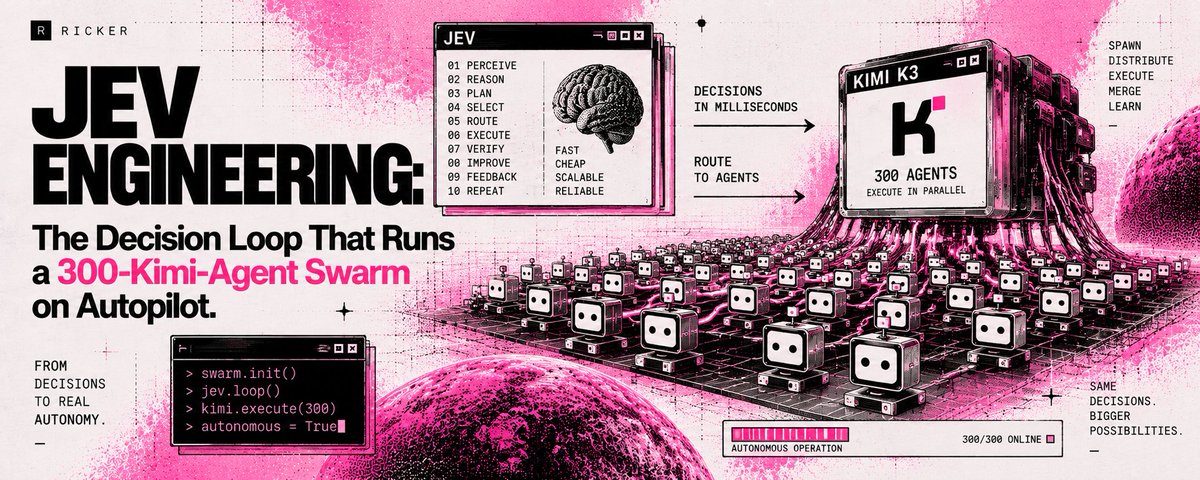
Jev Engineering ran 5,400 agent executions and sent exactly 0 decisions back to me.
that’s the number i care about here.
and up to 193x faster and 444x cheaper in tests.
18 turns
→ 300 agents
→ 5,400 runs
→ 43 Jev calls
→ 16 outputs kept
→ 0 human escalations
the loop handled three decisions around every turn:
Choice → Score → Noul
then it stopped itself when the goal crossed 0.93 vs 0.85 required.
that’s what Jev Engineering looks like when it works:
not “more autonomous agents.”
fewer reasons for the human to come back into the loop.

28
21
118
13,193
same 18-turn agent loop. same 0.93 goal score. Jev Engineering changed only the way decisions were made.
the difference:
238× cheaper.
Astra
→ 473,000 tokens spent deciding
→ $4.73
Jev
→ 43 typed decisions
→ $0.0199
the actual agent work underneath stayed identical.
that’s the part of Jev Engineering i find interesting:
you don’t need another paragraph every time the system reaches a fork.
sometimes you just need:
route A
confidence .91
continue
LLMs can still do the hard reasoning.
Jev handles the bounded decisions around it.
same work.
same result.
completely different decision overhead.

21
9
74
8,402
Jev Engineering changes the unit of optimization from “agent” to “decision.”
that sounds small, but it changes the architecture.
and up to 193x faster and 444x cheaper in tests.
normal multi-agent stack:
agent
→ prompt
→ tool
→ output
Jev-style stack:
shared state
→ decision boundary
→ selected branch
→ execution
→ measurement
→ state update
now you can optimize the actual control points:
latency per decision
cost per fork
confidence threshold
retry policy
branch survival
termination condition
the agents underneath can change.
the models can change.
the tools can change.
the decision layer stays measurable.
that’s why Jev Engineering feels more like systems engineering than prompt engineering.

31
24
152
22,252