

ai & onchain research | dms open...
- Tweets 2,113
- Following 126
- Followers 3,951
- Likes 10,607


burning raw claude opus 5.5 on routine branching is financial suicide
1,000 decision cycles on a cold frontier model: $480
the exact same workload routed through an opus 5.5 + jev dual-core harness: $0.14
the multi-agent architecture that solves the latency-cost bottleneck:
opus drafts logic. jev scores fast typed choices. deterministic rust keeps execution authority.
here is the 6-stage runtime pipeline:
-> 1. propose - opus 5.5 in high effort synthesizes plans, diffs, and hypotheses (zero execution authority)
-> 2. prune - host runtime filters out unsupported options before any model sees them
-> 3. score - jev evaluates valid candidates with calibrated probabilities, or executes a hard abstain
-> 4. validate - local rust engine re-checks selected actions against live state before acting
-> 5. execute - sandboxed tool runners execute strictly verified commands
-> 6. ledger - structured cryptographic receipts are recorded for offline replay and audit
the live benchmark profile:
-> 180ms median decision latency
-> ~$0.00014 cost per step ($0.042/M input tokens, zero output fee)
-> 50 of 50 agent benchmarks completed (100% pass)
the breakthrough insight: calibrate uncertainty.
when jev is only 35% confident, it abstains - triggering a pre-compiled fallback instead of letting opus make a $0.48 hallucinated guess.
architecture beats brute-force compute every time.
save this framework for your next production build.


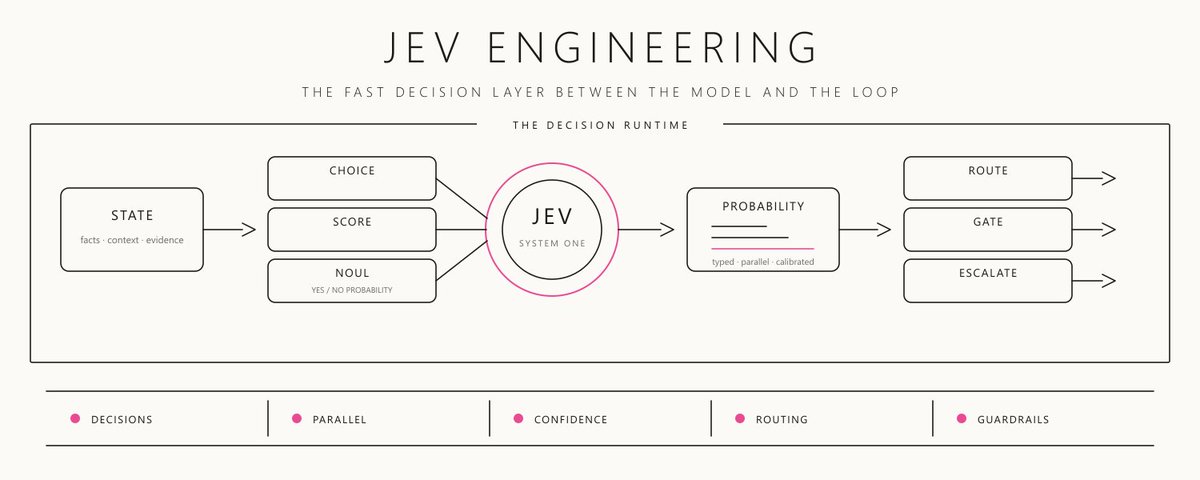
Most AI agents waste tokens on decisions that never needed text
Jev turns routing, scoring, and verification into a fast decision layer
I broke down the architecture most agent builders are still missing ↓
3
3
26
742
running raw claude opus 5.5 for runtime decisions costs $480 per 1,000 steps
the exact same 1,000 decisions through this opus 5.5 + jev harness cost $0.14
the stack that completely changes ai agent economics in 2026:
opus writes the code. jev picks the path. deterministic code keeps the final say.
here is the exact 6-step loop running under the hood:
→ propose - opus 5.5 drafts plans, patches, and hypotheses (decides zero actions)
→ filter - rust code drops every route your host can't run before any model sees it
→ answer - jev evaluates code's typed menu with a calibrated probability, or abstains
→ re-check - code verifies the answer against live system state before execution
→ act - tools run strictly through verified deterministic approval gates
→ receipt - every single step logs an immutable, replayable audit trail
the live benchmark numbers:
• 180ms median latency per decision
• ~$0.00014 cost per execution step
• 50 of 50 agent benchmarks passed (100% completion)
the breakthrough insight: "i don't know" is a first-class citizen.
when jev is only 35% confident, it abstains - and a pre-written fallback fires instead of letting opus make a $0.48 hallucinated guess.
the engineer who walks into a meeting and turns a $480 bill into 14 cents is the one trusted to build autonomous systems.
save this architecture for your next production pipeline.

Most AI agents waste tokens on decisions that never needed text
Jev turns routing, scoring, and verification into a fast decision layer
I broke down the architecture most agent builders are still missing ↓
3
12
93
12,182
anthropic quietly unlocked the most powerful claude code loop: opus 5.5 + fable 5.1
opus writes the code. fable reviews the entire session before you break production.
and it runs completely autonomously in a single terminal.
here is the exact multi-tier architecture i use for 24/7 autonomous dev:
→ opus 5.5 (high effort) = session director & planner
→ explorer = indexes the codebase & reads files
→ worker = writes diffs & runs test suites
→ researcher = pulls external docs & api specs
→ jev router = instant zero-cost routing for file/tool forks
→ fable 5.1 = on-call advisor triggered ONLY at key gates
fable stays silent during routine execution. it only kicks in:
• before generating a big plan: "are we touching the right files?"
• when an error repeats twice: "what false assumption are we making?"
• before marking done: "what edge case did we miss?"
to configure your environment automatically, paste this prompt into claude code ↓
"reorganize my claude code setup into this multi-agent tree:
1. scan ~/.claude/agents and .claude/agents for existing explorer, worker, and researcher roles. define only the missing subagents.
2. configure each subagent with model: opus and effort: medium. if any role has a custom model set, preserve it and report.
3. configure the main session with effortLevel: high and advisorModel: fable in ~/.claude/settings.json.
4. check for CLAUDE_CODE_DISABLE_ADVISOR_TOOL and any flags blocking advisor telemetry. report without modifying.
5. append this rule to ~/.claude/CLAUDE.md: invoke the advisor strictly before large plan generation, on duplicate runtime errors, and before declaring a milestone complete.
6. show all proposed updates as a git-style diff first. do not write changes until confirmed."
save this for your next autonomous build session.

Opus 5.5 can make a video
The hard part is making the next one better
That takes a studio, not a prompt
I broke down how to build it ↓

8
4
50
2,630
why is nobody running 24/7 quant research agents with opus 5.5 + jev?
this stack finds and tests new edges while you sleep
i wrote a full breakdown of how to build it from zero
full rust codebase included
this is the exact setup i've been running for 3 days, and the early numbers look insane


Jev is the FASTEST AI model ever built for trading
It makes calibrated buy/sell decisions in under 100 ms
That is one real decision on every single block, 24/7
In this article I've shown EXACTLY how to build HFT trading system with Jev (from scratch)

6
5
47
2,902
Ed Thorp beat the casinos at blackjack. Then he took the same math to Wall Street
His hedge fund, Princeton-Newport Partners, is reported to have made 19.1% a year and been profitable in 227 of 230 months.
The idea behind it was a formula from 1956, written at Bell Labs by a physicist named John Kelly.
It answers one question: how much do you bet when you have an edge?
Most people think the edge makes the money. It doesn't. The size of the bet does.
So I tested it. A game that wins 55% of the time. 500 bets. 10,000 runs.
Bet 5% each time: 6.5x
Bet 10%: 12.2x
Bet 20%: 0.93x
Bet 30%: 89% of runs lost money
Same edge. Only the bet size changed.
Even the best size, 10%, had a median drawdown of 83%. The S&P 500's worst fall in 2007–2009 was about 57%.
An edge tells you what to bet on. Sizing tells you if you survive.
synthetic simulation, a toy model, not advice.
save this before you size your next trade.


2
1
33
1,022
your backtest is lying to you
i generated 1,000 trading strategies out of pure random noise. no edge, no signal, nothing.
the numbers: 154 of them looked good on a one-year backtest (sharpe above 1). 25 had a sharpe above 2. the best one hit 2.79.
then i ran it on new data. sharpe: -1.88.
here's what nobody mentions: the top 10 averaged 2.5 in the backtest and 0.15 after. the more variants you test, the better the winner looks, and the less it means.
if someone shows you a beautiful equity curve, ask how many they threw away.
synthetic noise, one seed, a toy setup. real strategies are messier.
bookmark this before you trust your next backtest.

1
2
27
807
this quant paper is f*cking insane
it's 151 Trading Strategies by Zura Kakushadze and Juan Andrés Serur, 361 pages, 550+ formulas, R source code for backtesting, released free specifically to break down the info silos in quant finance.
the crazy part is the range it covers: stocks, options, futures, crypto, volatility treated as its own asset class, even weather and tax arbitrage strategies, all in one place.
closest thing to a quant desk's internal playbook that's ever gone public for free.
bookmark it before it disappears.

2
25
620
Trackmind retweeted
this paper is f*cking insane
a team out of NASA and MIT built a stripped-down trend and momentum system for gold futures, then tested it strictly out of sample.
the numbers: 2.88 Sharpe, 0.52% max drawdown, 43% annualized return at a 15% vol target, all net of costs and market impact.
across 2,793 trading days the strategy ran near-zero beta to gold, with estimated capacity approaching $1 billion.
the crazy part is the signal itself isn't fancy at all, the real edge comes from turning weak predictability into disciplined sizing, exits, and execution.
bookmark it before this thread gets buried.

10
14
161
26,774
Trackmind retweeted
this Stanford paper is f*cking insane
it's about as close to a real HFT desk as I've ever seen go public.
14 pages, top-tier signal combination, a full statistical framework.
the same framework I broke down in 11 steps in the article below: serial demeaning, cross-sectional normalization, residual weighting, empirical Kelly.
the crazy part is most people call the market direction right and still lose money, simply because they never ran into these 14 pages.
read the paper first, then read the article.
bookmark it before this thread gets buried.

19
82
680
152,228
Trackmind retweeted
this quant paper is f*cking insane
it's basically the 12-step checklist hedge funds run through before they ever pull the trigger on a trade.
every step, every formula, full Python code, all of it laid out.
drop it into Claude and you'll have a working trading system by tonight.
the crazy part is most people are trading blind while this entire framework has been sitting out in the open the whole time.
full breakdown in the article below.
bookmark it before this thread gets buried.

25
76
592
142,524
I STILL CANNOT F**KING UNDERSTAND WHY PEOPLE ARE NOT USING THIS AI STACK
Grok Bot finds the opportunities.
The agents do everything in between.
And somehow this setup is generating $11,000+ a month.
Here's the workflow:
1. Scout finds stories and formats already getting attention.
2. Scriptwriter turns them into short-form scripts.
3. Art Director decides what every shot should look like.
4. Producer generates the visuals with Picsart.
5. AI adds voice + captions.
6. Auditor reviews the finished videos and kills anything that feels repetitive.
7. Publisher sends the survivors to Shorts, TikTok and Reels.
8. Analyst reads the numbers and tells the system what to stop doing.
The crazy part isn't the generation.
It's the filtering.
42 videos made every week.
30 published.
12 killed.
The system would rather destroy a bad video than waste distribution on it.
That's why this works without:
filming
a camera
an editor
a face
I spend roughly 2 hours a week touching the system.
$11,000+ a month from a stack that most people could probably build with the same tools sitting in front of them.
The tools aren't the moat.
The workflow is.
I mapped the entire thing - agents, prompts, setup, costs and the exact production flow.


1
1
34
1,962
I STILL DON'T UNDERSTAND WHY PEOPLE ARE PAYING EDITORS $500+ FOR THIS
my entire setup runs without a camera, editor or filming.
here's the workflow:
→ grok finds formats already pulling millions of views
→ i strip the video down to its structure
→ rebuild it around a completely different topic
→ generate the visuals
→ AI voice + captions
→ publish everywhere
→ kill anything that doesn't hold attention
the trick isn't making AI videos.
it's finding a format that already proved it works.
one format can become 20 completely different videos without copying the original.
that's where it gets stupid.
no camera.
no editor.
no filming.
no face.
i use @Picsart for the visual generation because it removes the most time-consuming part.
the exact prompts + workflow are here ↓

19
915
Trackmind retweeted
this paper is f*cking insane
a quant paper combined a Hidden Markov Model with reinforcement learning to shift portfolio allocation on the fly as market regimes change.
the numbers: it beat SPY on risk-adjusted returns, with shallower drawdowns across 2004-2025.
the crazy part is it's not trying to forecast the market at all, it figures out what regime it's in first, then decides the allocation from there.
bookmark it before this thread gets buried.

10
36
258
37,686
Trackmind retweeted
this quant paper is f*cking insane
it's a 51-page guide from an MIT Sloan Business Club member covering probability, stats, market making, and real interview questions from Jane Street, Citadel, Two Sigma and more, all for free.
the crazy part is no professor put this together, it started as one student's own interview prep notes before it turned into a full guide to help others break into quant finance.
bookmark it before it disappears.

2
8
52
4,079