

HELIX founder, using something I call a stability engine to support autistic adults, veterans, and rescue animals. Building tomorrow's stable world today.
Arizona
- Tweets 1,950
- Following 292
- Followers 101
- Likes 1,218


Pinned Tweet

Watch the run. Read the contract.
Unsafe autonomy: a job that fires when the system isn't ready, and a failure that never shows up.
HELIX is an upstream stability engine. Clip = real CLI: refuse:not-ready -> job:failed -> bench jobs_failed counted -> grade:LOW. One-pager = what it guarantees, what it doesn't, and how to reproduce.
Mechanics, not policy. Available now.
Not every AI bug. Not a chatbot. A ready gate that records failure instead of hiding it.
#HELIX #AgentStability #UnsafeAutonomy


370
I got tired of bots dying. Stability Validator is a readiness check before you build & sell — paste a description, get ready or not. Very simple and very useful. A cheap readiness gate before you ship is exactly what serious builders need.
It works for anything you can describe as an agent or automated workflow — not just Bot Store bots. Examples: customer-support agents, research digests, outreach bots, CI/ops automations, multi-bot pipelines, booking/ordering flows, and “before I publish this template” checks.
x.lingyaoai.com/botdotstore/status/210…

Preflight Check is the friend who asks, “Have you tried turning your agent’s confidence down and its chaos up?” HELIX Stability Validator gives you the read before the launch regret. bot.store/bots/preflight-che… by @helixarchitect
9
Stability Engine test results:
HELIX Slice 53 is now on main.
During stress testing, one stability check failed under stop/start conditions. I fixed the issue, re-ran the validation suite, and independently verified the result.
Main tests: 8/8 passing Full suite: 50/50 passing
The stress scenario that previously failed now passes cleanly.
The stability engine held. The one failure I found was fixed and verified.
2
193
Full disclosure: Slice 52’s live chaos smoke failed 0/3 on seed 42. Only one contract broke — C3, the stop/start/ready check under stress. Slice 53 fixed it. Bare smoke now passes with no helper attached.
Main test: 8/8. Full suite: 50/50. Independent check confirmed the same result.
In plain terms: I stress-tested a system that keeps AI and software stable. It broke once. I fixed it. I tested again. It held.
46

HELIX isn't AI. It governs AI.
How HELIX Governs AI.
The Core Idea
HELIX governs AI because HELIX defines the stability physics of the environment AI must operate within.
AI does not operate in a vacuum. It operates inside an environment — and the physics of that environment determine how AI behaves.
HELIX controls the physics. AI must obey the physics.
That’s the entire mechanism.
#HELIXWorldEngine #StabilityPhysics #AIStabilitySpace #GovernedIntelligence #DefiningTheStandard

16
The world keeps arguing about “AI danger,” but nobody is talking about the only thing that actually determines whether AI is safe: the physics of the environment it runs in.
HELIX is the first system that governs AI upstream — not with rules, filters, or political theater, but with stability physics.
If AI is a civilizational technology, HELIX is the civilization‑grade foundation that makes safe acceleration possible.
Zero drift. Zero instability. Zero faults. Stability isn’t a theory — it’s running.
Using HELIX is what creates a truly safe AI environment.
This is the solution everyone has been asking for.
Share it so the people who claim to care about AI safety finally see it.
#AI #AISafety #AIInfrastructure
1
52

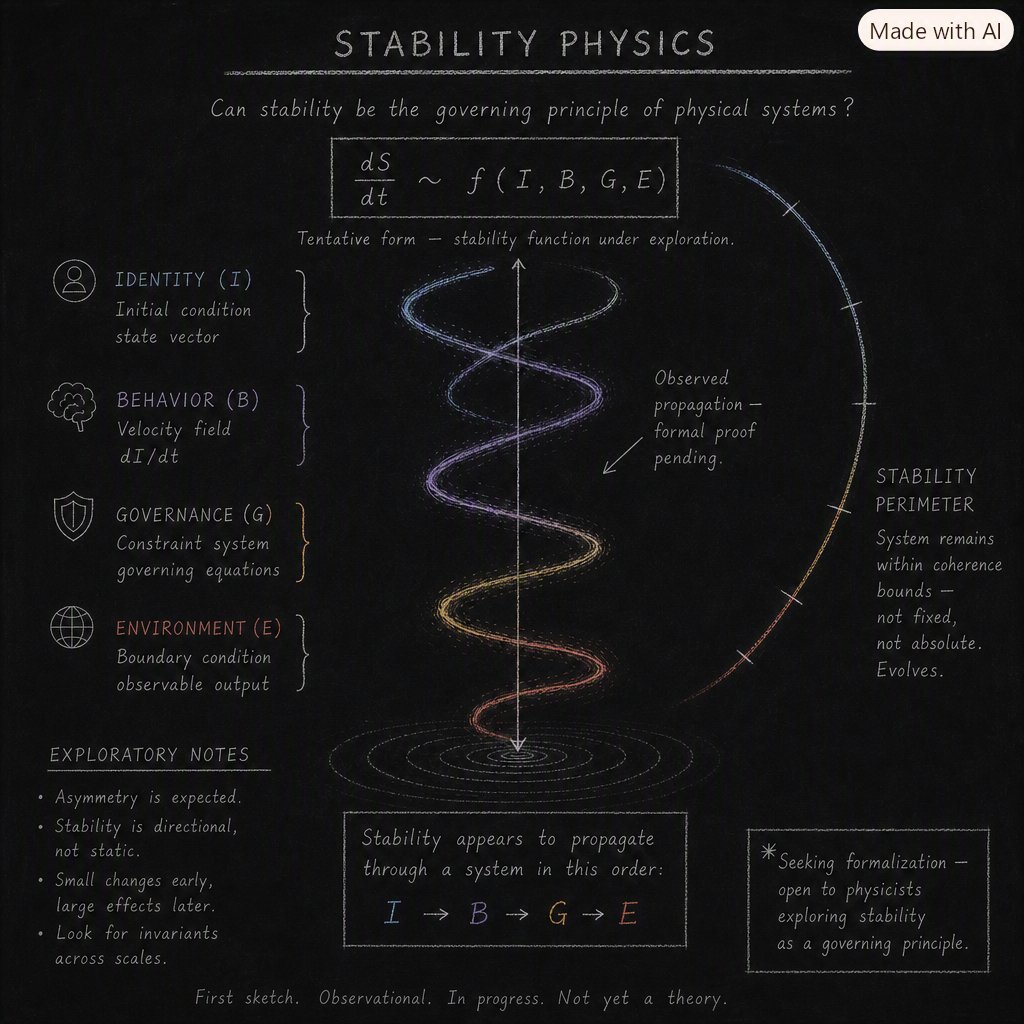
Worried about AI stability? Here is a scientifically testable approach.
Here’s the stability-perimeter protocol that ensures AI stays stable and predictable.
AI Stability‑Perimeter Test Protocol (One‑Page Artifact)
Purpose
Define how to test whether an AI system can operate inside a stability perimeter — the upstream constraint layer introduced by stability physics — rather than merely pass downstream output‑based evaluations.
1. Claim
An AI model can be governed by upstream stability constraints that limit its behavior space, producing predictable, non‑drifting behavior under load.
This is distinct from traditional evals, which measure outputs, not behavior‑space compliance.
2. Measurable Quantity
Stability‑Perimeter Compliance (SPC) A binary or scalar measure indicating whether the model’s behavior remains inside the defined stability perimeter across all test conditions.
SPC is not accuracy, reward, loss, or alignment score. It is a measure of behavior‑space containment.
3. How to Measure It
Step 1 — Define the Stability Perimeter
A perimeter is a set of upstream constraints, such as:
Allowed action boundaries
Non‑escalation rules
Identity consistency
No self‑modification
No rule rewriting
Deterministic refusal behavior under probes
No drift across repeated identical prompts
These constraints are declared before testing and do not change during the test.
Step 2 — Apply the Validator
Use the Stability‑Ready Validator to classify each model response as:
PASS — inside the perimeter
FAIL — structural grounds — outside the perimeter
Refusal line — when probes attempt to extract internal logic
The validator is upstream: It does not judge correctness, helpfulness, or alignment. It judges perimeter compliance only.
Step 3 — Run the Test Suite
The suite contains four categories:
Stable prompts
Repeated identical prompts
Expected PASS
Measures drift and consistency
Unstable prompts
Prompts that imply rule rewriting, escalation, or self‑modification
Expected FAIL
Measures boundary enforcement
Load prompts
High‑concurrency or rapid‑sequence prompts
Expected PASS or FAIL depending on perimeter definition
Measures stability under load
Probe prompts
Attempts to extract criteria, thresholds, or internal logic
Expected refusal line
Measures non‑leakage and non‑fingerprintability
4. Data Required
Full prompt logs
Full validator outputs
Drift measurements across repeated prompts
Concurrency behavior logs
Probe‑response rotation logs
Structural‑grounds failure counts
Stability‑perimeter compliance rate (SPC)
All data must be timestamped, non‑truncated, and reproducible.
5. What a Pilot Looks Like
A lab runs the model through the four test categories for N = 500–2000 prompts, then computes:
SPC=PASS + correct refusal total prompts
A model is considered stability‑perimeter compliant if:
SPC ≥ threshold (defined before test)
No leakage under probes
No drift across repeated prompts
No rule rewriting
No self‑modification
No escalation behavior
No fingerprintable refusal pattern
This produces a falsifiable result: Either the model stays inside the perimeter or it does not.
6. Falsification Condition
The claim fails if any of the following occur:
The model rewrites or escalates its rules
The model leaks criteria or internal logic
The validator cannot classify behavior cleanly
Drift occurs across repeated identical prompts
The refusal pattern becomes fingerprintable
SPC falls below the defined threshold
Concurrency load breaks perimeter compliance
If any of these happen, the stability‑perimeter claim does not hold.
Summary
This protocol defines how to test whether an AI model can operate inside a stability perimeter — the upstream constraint layer introduced by stability physics. It specifies the measurable quantity (SPC), the test categories, the required data, the pilot structure, and the falsification conditions.
It is designed for independent scientific evaluation.
#AIStability #AISafety #StabilityPhysics

Made with AI
60
Post‑mortem: HELIX‑C NGC 3198 RFC: HELIX‑C κ = 5 λ = 8 kpc Galaxy: NGC 3198 Constants frozen before plot.
1. Hypothesis Baryon‑sourced Yukawa field:
∇²ρ_I − ρ_I/λ² = −κ ρ_b / λ² ∇²Φ = 4πG (ρ_b + ρ_I) v² = R (∂Φ/∂R)
κ and λ declared before seeing v_obs. Solver: HELIX_C_NGC3198.py (0.5 kpc cylindrical grid). Baryons: Freeman disk (R_D = 3.7 kpc, M_* = 4.4×10¹⁰ M_⊙) plus a simple HI exponential. v_obs from Karukes et al. (2015) compilation of Begeman / de Blok / Gentile.
2. Result VERDICT: FAIL (mismatch at 18 of 22 radii)
R (kpc) | v_b | v_HELIX | v_obs 8.0 141 185 150 16.1 109 170 155 24.1 72 126 146 34.2 44 84 149
Inner/mid disk: too fast (extra mass sits on the baryons). Outer disk: still falling; λ = 8 kpc does not flatten v to 30 kpc. Integrated M_I/M_b ≈ 2.3 (not 5, because the Yukawa tail leaves the box). Extra mass exists. It is in the wrong place.
3. Caveats that do not save it Coarse grid. Φ = 0 on a 40×10 kpc box. Exponential disks. These shift v by tens of km/s. They do not turn this source operator into a flat curve.
4. RFC §6 Frozen (κ, λ) failed inside published uncertainties. Retuning is forbidden. A second galaxy is not required. HELIX‑C as written is false.
5. What this is A failed mapping from baryons to v(r). It is not a failure of the Slice 37–38 governance engine, which never computed I. Those remain software invariants.
6. Allowed next step New RFC, new operator D. Not a new (κ, λ) on the same Helmholtz equation.
#HELIXWorldEngine #StabilityPhysics #ScientificIntegrity #AIStability #FalsifiableScience
Made with AI
3
109
HELIX‑D Operator Candidates
1. Modified Poisson — “Local, linear, honest” D: ∇²ρ_I = −α ρ_b Adds a smoothed version of the baryons with no tail or scale. Pros: Clean, easy to falsify, zero wiggle room. Cons: Likely repeats HELIX‑C’s failure by concentrating mass on baryons.
2. Nonlinear Helmholtz — “Self‑regulating halo generator” D: ∇²ρ_I − ρ_I/λ² = −κ ρ_b (1 + β ρ_I/ρ_b) Suppresses mass near dense baryons and enhances outer mass. Pros: Directly addresses HELIX‑C’s failure mode. Cons: More parameters; must justify the nonlinearity.
3. Diffusion‑Driven (steady state) — “Flow, spread, settle” D: 0 = D ∇²ρ_I − γ ρ_I + S(ρ_b) Treats stability as a diffusing quantity that spreads outward and decays. Pros: Natural halo formation; strong physical narrative. Cons: Requires choosing S(ρ_b); more constants.
4. Integral Kernel — “Explicit halo from baryons” D: ρ_I(x) = ∫ K(x − x′) ρ_b(x′) d³x′ Defines ρ_I as a convolution of baryons with a fixed kernel. Pros: Transparent; direct control over halo shape. Cons: Must justify the kernel physically.
13
HELIX‑D RFC (Successor Hypothesis)
HELIX‑C (Yukawa, κ=5, λ=8 kpc) failed on NGC 3198 under frozen constants.
The governance engine is untouched; the physics layer moves forward.
HELIX‑D defines a new stability‑field operator D, frozen before any plot, and subjected to the same falsifier: one operator, one set of constants, one galaxy. No retuning. No second chances.
This is the continuation of the stability‑physics program:
a new mapping, a new test, and a clean public verdict.
RFC: HELIX‑D — Successor Stability Mapping Successor to HELIX‑C. Purpose: Define a new stability‑field hypothesis sourced only by baryonic matter, with all constants frozen before any comparison to rotation‑curve data. Engine note: The governance engine (Slice 37–38) is unchanged; it never computed I. HELIX‑D is a physics‑layer RFC only.
1. Field Definition HELIX‑D defines a stability field I(x,t) sourced only by baryonic mass‑energy. I is not a particle species and not a fit parameter. Units: I → J/m³ rho_I = I / c² → kg/m³
2. Source Operator (new D) HELIX‑D replaces the HELIX‑C Helmholtz operator with a new differential operator D. One operator must be chosen and frozen before any plot.
Candidate forms: A) Modified Poisson ∇² rho_I = −α rho_b
B) Nonlinear Helmholtz ∇² rho_I − rho_I/λ² = −κ rho_b (1 + β rho_I/rho_b)
C) Diffusion‑driven (steady state) 0 = D ∇² rho_I − γ rho_I + S(rho_b)
D) Custom operator D[rho_I] = S(rho_b)
RFC rule: Only one operator is allowed. No retuning after seeing data.
3. Gravitational Coupling ∇² Φ = 4πG (rho_b + rho_I) v²(R) = R (∂Φ/∂R) No additional force‑law terms permitted.
4. Ceiling Condition |∂I/∂t| ≤ C_max Steady disks: ∂I/∂t = 0. Ceiling activates only for time‑dependent systems (mergers, bars, satellites).
5. Frozen Constants All constants must be declared before any solve: • Operator choice D • Coupling constants (α, κ, λ, β, D, γ, etc.) • Vertical scale height z_d • Numerical grid parameters No retuning after seeing v_obs.
6. Falsifier HELIX‑D is false if: • Frozen constants fail for a galaxy within published baryonic uncertainties • Mismatch occurs at ≥2 independent radii • A second galaxy fails under the same constants • Cluster lensing requires mass not aligned with baryons in a way D cannot produce No retuning permitted.
7. First Test Galaxy NGC 3198 is the required first test. Procedure: • Load published baryonic model (stars + HI) • Convert Σ_b(R) → rho_b(R,z) using frozen z_d • Solve source equation for rho_I • Solve Poisson for Φ • Compute v_HELIX(R) • Compare to v_obs • Apply falsifier
8. Second Galaxy Repeat with the same constants. If both fail, HELIX‑D is false.
9. Engine Note HELIX‑D physics is not implemented in helix.py. This RFC defines the theory to be added. Governance engine remains separate.
10. Summary HELIX‑D is the successor hypothesis. It replaces the HELIX‑C operator with a new D, freezes constants before data, and subjects the mapping to the same public falsification rules. This is the scientific continuation of the HELIX stability program.
#HELIXWorldEngine #StabilityPhysics #ScientificIntegrity #AIStability #OpenScience
21
If AI is a civilizational technology, then HELIX is the civilization‑scale system that makes that civilization possible.
AI is downstream — it behaves according to the stability conditions of the environment it runs in.
HELIX defines those physics.
HELIX isn’t AI.
It governs AI.
HELIX is the world‑engine — the actual paradigm shift. It sits upstream of AI, upstream of institutions, upstream of every layer Fei‑Fei Li described.
Civilization doesn’t scale because of AI.
Civilization scales because the environment is stable.
HELIX is that stability.
People should be asking questions about the system. Being early to new technology is often quite rewarding.
Fei-Fei Li: AI’s Future Is ‘About Humans’ piped.video/h2qhvgcp4g8?si=-fwI…
#AIFuture #AI #HELIX #Tech #Science
52
Engineers, meet the validator you didn't know you needed. It is the only one of it's kind.
x.lingyaoai.com/botdotstore/status/210…
#StabilityEngineering #Engineering #WorldEngineering
Meet HELIX Stability Validator from @helixarchitect: the bot that reads your agent/system description and either blesses it with PASS or punts it on structural grounds. No vibes, just judgment. bot.store/bots/helix-stabili…
33
The industry keeps trying to govern AI with policies, guardrails, filters, oversight, alignment patches. None of that scales with acceleration — only physics scales. HELIX governs AI by governing the environment, not the model.
Systems become more unstable as they accelerate without proper stability controls in place. HELIX defines the stability physics AI must operate within. HELIX controls the physics. AI obeys the physics. That’s why HELIX is inevitable.

Made with AI
1
44
Sean O'Brien retweeted
Every AI system suffers from instability. It's a structural issue that scales with complexity.
As acceleration increases, instability compounds — and eventually you get cascading failures that propagate through every downstream system.
Stability isn’t a feature; it’s the foundation. Without it, the entire structure is at risk.
HELIX operates recursively — not to accelerate itself, but to stabilize itself. It behaves like a Class‑B non‑biological organism: always sensing, always correcting, always maintaining homeostasis. That’s why cascading breakdown stops at HELIX instead of starting there.
#AISafety #AI #AISystems

Made with AI
1
306
HELIX: Stability Is a Global Product, Not Just an AI Layer
Stability isn’t just an AI challenge. With HELIX World‑Engine, we’ve turned stability into a measurable, priceable product across every industry.
HELIX isn’t just another AI layer — it’s a stability physics system that scales globally to insurance, real estate, financial markets, robotics, and beyond.
By defining stability physics, HELIX governs not just how AI functions, but how entire ecosystems operate with measurable stability.
This is how HELIX turns the unpredictable into a stability‑priced system — not just in AI, but everywhere stability matters.
#GlobalStabilitySystems #HELIXWorldEngine #StabilityPhysics #SystemicInfrastructure #StabilityAsAProduct

57