

AI & Tech Creator | 170K+ Community | Trusted by 100+ Brands | AI Tools, Marketing & Growth | Helping Brands Launch & Grow | Collab: originai.collabs@gmail.com
- Tweets 1,645
- Following 17
- Followers 10,507
- Likes 17,798


Pinned Tweet

I turned cleaning a messy desk into a little 3D game.
Pick up an object.
Aim.
Throw it into the right bin.
Miss → it bounces back.
Get it right → the bin reacts.
The best part?
You actually have to throw it. 🎯
Built with @JuliusAI
How fast can you clean it?
Try it → grandiose-string-5yc.julius.…

Paid partnership (ad)
12
32
422
349,494
🚨 You're wasting your Claude credits without even realizing it.
Long conversations, unnecessary regenerations, repeated instructions and oversized prompts can drain your usage faster than necessary.
Here are 16 rules to get MORE done with Claude while using your credits wisely. 👇
🧠 PLAN SMARTER
1. Plan your task before prompting.
2. Batch related questions into one request.
3. Give complete instructions upfront.
4. Choose the right model for the task.
⚡ MANAGE CONTEXT
5. Use Claude Projects for recurring work.
6. Stop repeating the same context.
7. Keep unrelated tasks in separate chats.
8. Start fresh when conversations get bloated.
🎯 REDUCE UNNECESSARY WORK
9. Upload only relevant files.
10. Avoid unnecessary web research.
11. Specify the answer length you need.
12. Give all revision feedback in one message.
🚀 WORK MORE EFFICIENTLY
13. Share relevant code, not your entire codebase.
14. Don't overcomplicate simple tasks.
15. Avoid unnecessary repeated generations.
16. Monitor your usage regularly.
The ultimate formula:
BETTER CONTEXT + BETTER PROMPTS + FEWER REVISIONS = MORE EFFICIENT USAGE
One important thing:
You cannot bypass Claude's usage limits with secret prompts or shortcuts.
But you CAN reduce wasted usage by building smarter workflows.
Save this before your next Claude session. ♻️
Follow @Origin_AI_01 for more practical Claude hacks.
#Claude #ClaudeAI #AITips #AIProductivity #PromptEngineering #AITools #ArtificialIntelligence #OriginAI

2
16
51
695

This is impressive!
I cloned my voice in the @cartesia playground from a ~15-second clip. The clone was ready in a couple of seconds.
Then I had it speak Japanese, a language I don't speak.
My clone now says in Japanese that I can find good papers by combining AI with my experience reviewing papers.
I am impressed by how good this sounds.
This runs on Sonic 3.6, their latest voice model, which supports 44 languages. You can do the same with any of them.
This tech is getting really good, and I think it's worth exploring to make your content more accessible to more people in different languages.
Try it here: play.cartesia.ai
More info about their model here: cartesia.ai/blog/sonic-3.6

22
113
412
212,813
🚨 You're probably using only 10% of what Claude can actually do.
Most people use Claude to write emails, summarize PDFs and answer basic questions.
But Claude can be your:
- AI researcher
- Coding partner
- Content strategist
- Workflow builder
- Data analyst
- Personal productivity assistant
Here's THE CLAUDE CHEAT SHEET NOBODY MADE 👇
🔥 1. Master Prompting Use this formula:
ROLE + CONTEXT + GOAL + INPUT + CONSTRAINTS + OUTPUT + QUALITY CHECK
⚡ 2. Learn Prompt Shortcuts /TLDR · /ELI5 · /DEEP-DIVE · /COMPARE · /HUMANIZE · /REWRITE
🧠 3. Understand the Claude Ecosystem Projects, Artifacts, Skills, Connectors, MCP, Research and Claude Code.
💻 4. Build Real Things Websites, dashboards, calculators, AI agents and complete software projects.
🔄 5. Create Repeatable Workflows IDEA → CONTEXT → PROMPT → TOOLS → EXECUTION → REVIEW
🚀 6. Use Claude for Everyday Work Business research, content creation, coding, automation and personal productivity.
The biggest upgrade isn't learning more prompts.
It's learning how to combine context, tools and workflows to get real work done.
Save this cheat sheet. You'll thank yourself later.
♻️ Repost to help someone unlock Claude's potential.
Follow @Origin_AI_01 for more practical AI workflows.
#Claude #ClaudeAI #AI #PromptEngineering #AITools #AIProductivity #Automation #OriginAI

11
24
79
1,257
🚨 You're using Claude like a basic chatbot. You're missing out on what it can actually do.
Claude is more than just a tool for answering questions.
Here are 12 insane things you can do with Claude 👇
1️⃣ Build Full Websites – Create landing pages, portfolios and dashboards.
2️⃣ Create AI Agents – Build agents that research, analyze and execute tasks.
3️⃣ Turn Ideas Into Apps – Convert simple ideas into working prototypes.
4️⃣ Automate Daily Work – Handle repetitive tasks and build smart workflows.
5️⃣ Analyze Huge Datasets – Find patterns, trends and actionable insights.
6️⃣ Build an AI-Powered Business – Create systems for content, support and operations.
7️⃣ Create Professional Presentations – Turn rough ideas into polished slides.
8️⃣ Build a Knowledge Base – Organize documents, instructions and project context.
9️⃣ Write & Debug Complex Code – Build software, fix errors and understand codebases.
🔟 Conduct Advanced Research – Analyze markets, competitors and industry trends.
1️⃣1️⃣ Build a Content Machine – Generate ideas, posts, threads and video scripts.
1️⃣2️⃣ Create Custom AI Tools – Build calculators, dashboards and productivity apps.
The biggest mistake?
Using Claude only to generate text when you could be using it to build entire systems.
Stop just chatting with AI. Start creating with it.
♻️ Save this & share it with someone exploring Claude.
Follow @Origin_AI_01 for more practical AI workflows.
#Claude #ClaudeAI #AITools #AIProductivity #AI #Automation #AIWorkflows

10
25
106
2,019
Paid social tip: voice every variant. Eleven v4 is free on Creator and up until Oct 12, so trying costs you nothing to a/b test your scripts.

Voice your ads, turn articles into audiobooks, and give your characters a voice for free with Eleven v4.
Eleven v4 powers voice across ElevenCreative, so you can create and voice your visuals all in one place.
Try it for free until October 12.

Paid partnership (ad)
12
78
248
58,841
OriginAI retweeted

Voice your ads, turn articles into audiobooks, and give your characters a voice for free with Eleven v4.
Eleven v4 powers voice across ElevenCreative, so you can create and voice your visuals all in one place.
Try it for free until October 12.
To celebrate the launch of Eleven v4, it's free on ElevenCreative for the next 11 days.
Until October 12, v4 generations on Creator plans and above don’t use your credits, up to 2x your monthly allowance.
Upgrade before October 12 and your allowance increases to 2x your new plan’s monthly credits for the rest of the window.
Re-voice an old project. Turn your writing into an audiobook. Generate ad reads in every language you sell in.
Start creating here: elevenlabs.io/text-to-speech

10
20
87
240,109
🚨 You're wasting Claude's potential if you're still writing every prompt from scratch.
30 simple prompt shortcuts can make your daily workflow faster, smarter and more organized.
Here are some worth saving 👇
🧠 Understand Faster
/TLDR – Summarize anything
/ELI5 – Explain simply
/DEEP-DIVE – Explore a topic
/COMPARE – Compare options
/EXAMPLES – Learn through examples
⚡ Think Better
/STEP-BY-STEP
/PROS-CONS
/PITFALLS
/CHALLENGE
/ROOT-CAUSE
✍️ Create Better Content
/HOOKS
/HUMANIZE
/REWRITE
/TONE
/REPURPOSE
📋 Stay Organized
/CHECKLIST
/PRIORITIZE
/ACTION-ITEMS
/TEMPLATE
/PLAN
💻 Code Smarter
/DEBUG
/EXPLAIN-CODE
/OPTIMIZE
/TEST-CASES
/DOCUMENT
🤖 Advanced Workflows
/ACT-AS
/ROLE-PLAY
/RESEARCH
/QUALITY-CHECK
/BUILD-WORKFLOW
Pro tip: These are reusable prompt shortcuts, not official Claude commands. Save the ones you use frequently in a prompt library or Claude Project.
Stop repeating instructions. Start building reusable workflows.
♻️ Save & repost this for later.
Follow @Origin_AI_01 for more practical AI hacks.
#Claude #ClaudeAI #PromptEngineering #AITools #AIProductivity #ArtificialIntelligence

13
40
127
33,675
🚨 Stop asking Claude to create videos if all you're getting is boring static visuals.
You're probably missing the real motion graphics workflow.
Here's how to turn Claude into your AI motion graphics designer 👇
🎯 1. Define the Concept Choose your topic, audience, duration and visual style.
✍️ 2. Generate the Script Create hooks, narration, on-screen text and sound cues.
🎬 3. Build a Storyboard Break the video into scenes with precise timings.
🎨 4. Design Visual Assets Create SVGs, icons, backgrounds, illustrations and UI elements.
💻 5. Choose Your Technology Remotion + React, After Effects, GSAP, Three.js or HTML/CSS.
⚡ 6. Generate Animation Code Build reusable scenes, transitions and animated elements.
✨ 7. Add Motion Kinetic typography, animated diagrams, parallax and smooth transitions.
🎧 8. Add Sound Design Voiceovers, background music and sound effects.
📽️ 9. Render the Video Preview, test and export your final MP4.
🔄 10. Refine Everything Improve timing, typography, transitions and visual consistency.
The complete workflow:
IDEA → SCRIPT → STORYBOARD → DESIGN → ANIMATION → AUDIO → RENDER → REFINE
🔥 The secret?
Don't ask Claude to simply "make a video."
Ask it to build the animation scene by scene, using actual code and a proper rendering workflow.
Save this blueprint. ♻️ Repost it.
Follow @Origin_AI_01 for more Claude + AI workflows.
#Claude #ClaudeAI #MotionGraphics #Remotion #AI #VideoEditing #AITools #CreativeAI

12
21
74
24,221
🚨 You're using Claude like a chatbot when you could be building an entire AI-powered workflow.
Most people never move beyond writing prompts and generating answers.
Here's the complete Claude Blueprint 👇
🧠 FOUNDATION→ Prompt Engineering → Context Engineering → Projects → Writing Styles
⚡ PRODUCTIVITY & CREATION→ Artifacts → Data Analysis → Deep Research → Prompt Chaining
🔗 INTEGRATIONS & AUTOMATION→ Skills → Connectors → MCP → Scheduled Workflows
🤖 AGENT DEVELOPMENT→ Tool Use → Agentic Loops → Subagents → Human Approval
💻 CLAUDE CODE MASTERY→ CLAUDE.md → Hooks → Plugins → Multi-Agent Systems
The progression:
PROMPT → CONTEXT → PROJECT → ARTIFACT → SKILL → MCP → AGENT → AI SYSTEM
Stop chasing better prompts.
Start building systems that actually get work done.
Save this blueprint. ♻️ Repost it for someone learning Claude.
Follow @Origin_AI_01 for more Claude workflows.
#Claude #ClaudeAI #AITools #AIAgents #ClaudeCode #Automation #AIWorkflow #ArtificialIntelligence

11
21
73
26,659

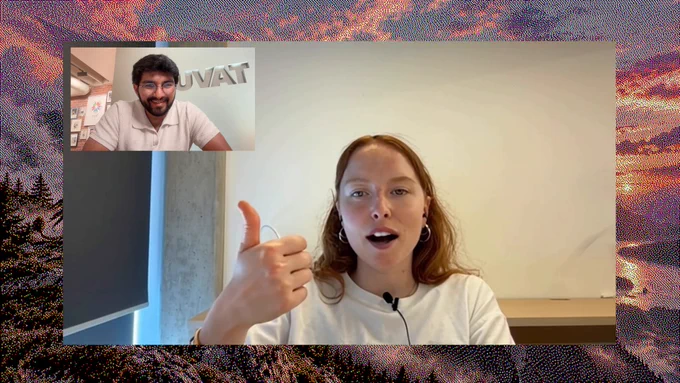
If this is a zoom call, I wouldn’t be able to tell the difference 😭

Introducing Griffin, the first model to pass the video Turing test.
48% of people who talked to it live thought it was a real human. Previous systems have had a pass rate <3%. It is #1 on NVIDIA's benchmark for full-duplex AI video.
It’s the first Human Interaction Model (HIM).
Community note
The 48% figure and "video Turing test" claim are from Tavus's own study of 54 one-minute calls, not independently verified or using a standard protocol. Griffin-Lite leads NVIDIA's VideoFDB benchmark on their public leaderboard.
cellcog.ai/blog/tavus-gri…
research.nvidia.com/labs/amri/proj…
tech-ish.com/2026/10/02/tav…
Paid partnership (ad)
41
124
452
258,845
OriginAI retweeted

A company built a model good enough to pass as a person.
48% of people who talked to Griffin live (a human interaction model from Tavus) thought it was a real human, I was lucky to get an early access and can definitely agree to that.
On NVIDIA's scoreboard for face-to-face AI, a real human scores 3.92 out of 5.
Griffin scores 3.83. The next best system scores 2.80.
Earlier systems stitched separate models together to hear, think, speak and animate, and every handoff added delay. Griffin does all of it in one system, reading your face and tone as well as your words and reacting while you're still talking.

Introducing Griffin, the first model to pass the video Turing test.
48% of people who talked to it live thought it was a real human. Previous systems have had a pass rate <3%. It is #1 on NVIDIA's benchmark for full-duplex AI video.
It’s the first Human Interaction Model (HIM).
Community note
The 48% figure and "video Turing test" claim are from Tavus's own study of 54 one-minute calls, not independently verified or using a standard protocol. Griffin-Lite leads NVIDIA's VideoFDB benchmark on their public leaderboard.
cellcog.ai/blog/tavus-gri…
research.nvidia.com/labs/amri/proj…
tech-ish.com/2026/10/02/tav…
Paid partnership (ad)
38
147
417
225,158
OriginAI retweeted

In Tavus's own study, 120 people watched a 90-second video call and 45% decided the person on screen was real. It was an AI. A separate 120 watched two real humans talk, and 28% decided one of them was the machine.
The company gave me early access to the smaller model it tested, Griffin Lite. The 28% is the number I keep coming back to. More than one in four viewers doubted two real people.
My read is that looking human on video has become a timing problem. People leave gaps of roughly 200 milliseconds between turns, the figure usually cited from a 2009 study of ten languages. Turn-based voice AI waits for silence before it answers, and that pause is often what gives it away.
The company describes this model as full duplex, meaning it watches and listens while it talks. It says the model can be interrupted, cut in on your rambling when asked, and notice someone walking into frame behind you.
NVIDIA researchers built a benchmark for this from 237 clips of real two-person video calls. Real humans score 3.92 out of 5 on its generation track. The company reports 3.83 for its model, against 2.80 for the best system in the published paper. It also reports responses in about 1.9 seconds, where that system took 2.8.
Humans answer in 0.9 seconds on the same test. Nearly a full second still separates the model from a person, and 45% is still under half.
Language models learned what to say. Face-to-face AI is learning when to say it.
Introducing Griffin, the first model to pass the video Turing test.
48% of people who talked to it live thought it was a real human. Previous systems have had a pass rate <3%. It is #1 on NVIDIA's benchmark for full-duplex AI video.
It’s the first Human Interaction Model (HIM).
Community note
The 48% figure and "video Turing test" claim are from Tavus's own study of 54 one-minute calls, not independently verified or using a standard protocol. Griffin-Lite leads NVIDIA's VideoFDB benchmark on their public leaderboard.
cellcog.ai/blog/tavus-gri…
research.nvidia.com/labs/amri/proj…
tech-ish.com/2026/10/02/tav…
Paid partnership (ad)
29
120
484
236,955
Stop asking AI for answers.
Ask it to teach you.
Hyperknow turns your notes, coursework, or any topic into a personalized AI classroom with interactive whiteboards, voice-guided lessons, and hands-on practice.
This is what AI-powered learning should feel like.

Introducing @hyperknow_ai: a new way to learn.
The AI professor that turns any learning goal into a 1-on-1, interactive and systematic course.
While all other AIs are rushing to replace your thinking,
we raised $1M to bring back that simple excitement of understanding something for yourself.
Give Hyperknow a topic, a textbook, or anything you’ve struggled to understand before.
Watch it turn your curiosity into a personalized course, with structured units, lessons, practice, and even hands-on projects, then walk you through it on an interactive whiteboard that feels like having your own professor beside you.
More than 100k learners have already explored new worlds with Hyperknow.
Now it's your turn.

Paid partnership (ad)
9
51
174
46,675
OriginAI retweeted

Introducing @hyperknow_ai: a new way to learn.
The AI professor that turns any learning goal into a 1-on-1, interactive and systematic course.
While all other AIs are rushing to replace your thinking,
we raised $1M to bring back that simple excitement of understanding something for yourself.
Give Hyperknow a topic, a textbook, or anything you’ve struggled to understand before.
Watch it turn your curiosity into a personalized course, with structured units, lessons, practice, and even hands-on projects, then walk you through it on an interactive whiteboard that feels like having your own professor beside you.
More than 100k learners have already explored new worlds with Hyperknow.
Now it's your turn.
255
336
1,908
1,377,539
Eleven v4 is free in the app for two weeks, up to 2x your monthly credits. I would use it to hear the chapter sitting unfinished in your drafts.
To celebrate the launch of Eleven v4, it's free on ElevenCreative for the next 11 days.
Until October 12, v4 generations on Creator plans and above don’t use your credits, up to 2x your monthly allowance.
Upgrade before October 12 and your allowance increases to 2x your new plan’s monthly credits for the rest of the window.
Re-voice an old project. Turn your writing into an audiobook. Generate ad reads in every language you sell in.
Start creating here: elevenlabs.io/text-to-speech
Paid partnership (ad)
2
50
193
53,271
OriginAI retweeted
To celebrate the launch of Eleven v4, it's free on ElevenCreative for the next 11 days.
Until October 12, v4 generations on Creator plans and above don’t use your credits, up to 2x your monthly allowance.
Upgrade before October 12 and your allowance increases to 2x your new plan’s monthly credits for the rest of the window.
Re-voice an old project. Turn your writing into an audiobook. Generate ad reads in every language you sell in.
Start creating here: elevenlabs.io/text-to-speech
Made with AI
31
58
395
451,075
The acquisition is interesting, but this is the real signal.
The speech-to-speech hint caught my attention.
Real-time voice agents could be entering a very different phase.
Definitely watching what Inworld builds next.

We’re excited to announce that @ultravox_dot_ai is now part of Inworld.
Ultravox is the platform developers use to build real-time voice agents. We've worked with the team for a while through our TTS partnership, and today members of the team that built it are joining Inworld to keep developing it.

Paid partnership (ad)
9
45
214
52,796
OriginAI retweeted

We’re excited to announce that @ultravox_dot_ai is now part of Inworld.
Ultravox is the platform developers use to build real-time voice agents. We've worked with the team for a while through our TTS partnership, and today members of the team that built it are joining Inworld to keep developing it.
83
100
285
520,646
🚨 Most people have AI ideas. Almost nobody turns them into real workflows.
Saying:
“AI could automate this.”
isn't a workflow.
Turn it into:
🎯 Problem → What are you actually solving?
📤 Outcome → What should the final result look like?
⚡ Trigger → What starts the process?
📥 Inputs → What does AI need?
🧠 AI Process → Research → Analyze → Create → Review
🔗 Tools → APIs, files, databases, MCP
🛡️ Guardrails → What can AI do automatically?
👤 Human Review → Where does approval happen?
📊 Output → What exactly gets delivered?
🔄 Feedback → How does the workflow improve?
The formula:
PROBLEM → OUTCOME → TRIGGER → INPUT → AI → TOOLS → REVIEW → OUTPUT → FEEDBACK
Example:
New topic → Research → Analyze → Write → Fact-check → Human approval → Publish → Measure
Stop asking:
“What can AI do?”
Start asking:
“What repeatable workflow can AI redesign?”
That's how you go from an AI idea → workflow → automation → AI system.
Save this blueprint. ♻️
Follow @Origin_AI_01 for more AI + Claude workflows.
#Claude #ClaudeAI #AI #AIAgents #Automation #AIWorkflow #AITools #Productivity

21
38
124
18,792
OriginAI retweeted

We built an AI that saves your ass.
Meet Lucas. It’s been meaning to text you.
It lives in your texts, learns your life, and prompts itself.
It books, pays, orders and checks you in. Usually before you’ve thought of it.
Overnight, it goes exploring for things your life could use.
Text Lucas today on iMessage and WhatsApp
meetlucas.ai

234
318
1,019
1,352,786