

#WhatIf: Big Questions. Curiosity-driven Science.
Kansas City, MO, United States
- Tweets 7,151
- Following 1,417
- Followers 5,603
- Likes 11,113





Stowers Graduate School alum Augusto Ortega Granillo, Ph.D., reflects on his time at the Institute and the experiences that helped shape where his scientific career has taken him today. Check it out ⬇️

🔗From the Stowers Graduate School to the Max Planck Institute 🧬
Alum Augusto Ortega Granillo, Ph.D., reflects on his journey at #StowersGrad and how pairing #biology with physics is shaping his #research today.
Read more + applications are NOW OPEN: bit.ly/4xpAc2Y
2
6
643
This beautiful #MicroscopyMonday shows how maternal regulation governs early embryonic development by coordinating gene expression in both time and space to direct proper embryonic growth. 🔬
@gopalkushawah (@BazziniLab)

3
11
592
Stowers Institute retweeted

1/11
Our newest study asks how far cellular reprogramming extends in the ordinary course of animal life. Metamorphosis offers the test of maximal severity: the wholesale conversion of one body plan into another. Out now in Nature Communications.
nature.com/articles/s41467-0…

1
41
98
5,772
Stowers Institute retweeted
This work was led by @paul_bump (now at Pomona College) in Chris Lowe's lab @HopkinsMarine Station, with Brewster, Formery, Lubeck, Campbell, Morri, Sit, Rokhsar, & @BenhamPyleLab. Supported by @czbiohub, @NSF, @ScienceStowers, the Myers Trust, and the Haderlie Memorial Award

1
9
367
🚨Register early and save your spot! Early bird pricing for the 2026 Stowers Research Conference ENDS MONDAY, September 14. #SRCKC26
✔️ Abstract submission deadline: 9/14
✔️ Early bird pricing ends: 9/14
Register now: bit.ly/43Vb9so
1
3
371
NEW #research from the @Ozel_MN Lab in @PNASNews 🧠
A first-of-its-kind atlas of 232,251 cells is revealing how #neurons build their identities in the first hours of life.
The findings uncover new insights into how the #brain generates its remarkable diversity of neurons. #neuroscience #brainscience
🔗 bit.ly/3UATViG

4
11
577
Stowers scientists partnered with @GoogleDeepMind to help advance AlphaGenome, an #AI model built to better understand how #DNA sequences regulate gene activity.
🔗@statnews takes a closer look at the #technology and its potential for genomic research, read the article here: bit.ly/4ikuUlF
1
7
314
Stowers scientists are featured in @FortuneMagazine for their work with @GoogleDeepMind on AlphaGenome Atlas—an AI-powered resource mapping predictions for 9 billion possible single-letter #DNA changes across the human genome. 🧬
Read more about the collaboration and what it could mean for understanding how our #genome works: bit.ly/4x6NMYR
@JuliaZeitlinger @ZeitlingerLab
1
4
236
Stowers Institute retweeted

What a wonderful collaboration, excited to see this released to the public!

We’re launching AlphaGenome Atlas: an AI-powered searchable database mapping the predicted impact of all 9 billion possible single-letter DNA changes.
Here’s how it could help researchers better understand our biology 🧵

3
11
735
Stowers Institute retweeted
Excited to be a part of this collaboration! The AlphaGenome Atlas will be a huge accelerant in our field for understanding regulatory encoding.

Excited to release AlphaGenome Atlas 🧬 We used AlphaGenome to predict the regulatory impact of all 9B possible SNVs in the human genome. We collaborated with amazing scientists to analyze and apply it, and developed a portal to browse the genome using this new lens 🔬
🌐 Portal: alphagenome.google/atlas
📖 Blog: goo.gle/4heuCvn
📄 Preprint: deepmind.google/blog/alphage…
🧵 1/6

4
14
859
Stowers Institute retweeted

Happy to have contributed to this work! Amazing to see cis-regulatory motif maps across so many cell types readily available. Get a bird’s eye view of the cis-regulatory code or dive in deep into specific details, I highly recommend it!
Excited to release AlphaGenome Atlas 🧬 We used AlphaGenome to predict the regulatory impact of all 9B possible SNVs in the human genome. We collaborated with amazing scientists to analyze and apply it, and developed a portal to browse the genome using this new lens 🔬
🌐 Portal: alphagenome.google/atlas
📖 Blog: goo.gle/4heuCvn
📄 Preprint: deepmind.google/blog/alphage…
🧵 1/6
3
6
22
1,899
The Stowers Institute has partnered with @GoogleDeepMind and leading #research institutions to help reveal the regulatory language of the human genome. 🧬
Today, Google DeepMind unveiled AlphaGenome Atlas: a new one-petabyte, AI-powered resource containing predictions for more than 9 billion possible single-letter #DNA changes.
For the first time, scientists can explore a comprehensive map of possible single-letter DNA changes through a web browser, helping them more quickly prioritize variants that may influence biology and disease.
Stowers Investigator and #AI Initiative lead @JuliaZeitlinger, Ph.D., and her team provided helped guide the resource’s development and demonstrated how the Atlas can reveal patterns in the regulatory sequences that control when genes are turned on and off.
“AI really feeds on lots of data, and it loves complexity. That’s exactly biology.”
The international collaboration includes Google DeepMind, the Stowers Institute, @broadinstitute, the @UniofExeter, @MSKCancerCenter and @Stanford.
Explore the full story: bit.ly/4r4Bn6C

4
12
1,132
NEWS: Today @GoogleDeepMind unveiled its new AlphaGenome Atlas: bringing AI-generated predictions for all 9 billion possibilities into one searchable resource, now available for use.
The Stowers Institute and Stowers Investigator and #AI Initiative lead @JuliaZeitlinger, Ph.D., partnered with Google DeepMind, using the Atlas to study the short #DNA sequences, or “words,” that help control when genes are turned on and off. Their work showed how the resource can help reveal the fundamental rules that shape gene activity across different cell types.
Nine billion possible single-letter changes can occur across the human #genome. Understanding what each one might do through laboratory experiments alone would be nearly impossible.
AlphaGenome Atlas was developed by Google DeepMind with input and research applications from collaborators across several leading scientific institutions including the Stowers Institute, the @UniofExeter, @broadinstitute, @MSKCancerCenter, and @Stanford.
Insights from the project could ultimately help scientists better understand cellular identity, #development and how disruptions in gene regulation contribute to disease.
Learn more: bit.ly/4r4Bn6C
2
4
13
901
Exciting to see AlphaGenome Atlas out in the world! 🧬
Stowers scientists worked alongside @GoogleDeepMind and collaborators to bring biological insight to this new AI-powered resource and help reveal the regulatory language of the human genome.
We’re launching AlphaGenome Atlas: an AI-powered searchable database mapping the predicted impact of all 9 billion possible single-letter DNA changes.
Here’s how it could help researchers better understand our biology 🧵
1
3
675
Stowers Institute retweeted

Proud to announce that my lab’s first paper is now out in PNAS! pnas.org/eprint/PHVEJEXUPCNH… Also check out our new preprint on BioRxiv: biorxiv.org/content/10.64898…
2
2
18
1,067
🎉 Congratulations to Stowers Visual Storyteller and Multimedia Producer Jill Toyoshiba on her @emmymidam nomination!
Her nominated story dives into the fascinating coral #research happening right here at the Institute. 🪸
Watch the nominated video below and explore the story: bit.ly/4fAYkcb

3
8
544
This week's stunning #MicroscopyMonday shows individual gene expression (colors) which highlight the diversity and localization of cell types within a #flatworm. 🪱 (@Planaria1 Lab)

2
12
373
Stowers Institute retweeted

Spatio-temporally regulated maternal RNA decay factor essential for zebrafish development biorxiv.org/content/10.64898… @gopalkushawah @ScienceStowers
1
3
9
510
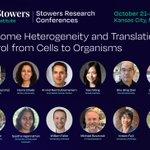
How is translation regulated across different cell types, tissues, and organisms?
Join us October 21–23 as experts explore ribosome heterogeneity, specialized ribosomes, translational control, and the technologies driving the next generation of discoveries. #SRCKC26
🔗 Register: bit.ly/43Vb9so

2
4
16
1,524
Stowers Institute retweeted
Happy to see our most recent paper out! Fantastic lead by @MelanieWeilert and a fun collaboration with @rmartinezcorral in Barcelona!

Cooperativity enables widespread role of low-affinity motifs in chromatin accessibility and increases regulatory potential dlvr.it/TV9LR8
12
36
3,691