

Tech recruiter. Prev CTO at Shaadi.com and InVideo.io. 2x founder. Newsletter - engineeringorg.com. Resumes - svsrecruiting.com
- Tweets 34,245
- Following 1,603
- Followers 21,106
- Likes 22,127


svs 🇮🇳 retweeted

huge update! all spots have been fixed, dead overhanging wires have been cut, and concrete waste has been removed. whatta fantastic job by @GBA_office!
i spent more than 4 hours with GBA crew and the engineers. big thanks to mr. vijaykumar haridas and mr. satish for spearheading the fixes and wire removal. some of these fixes were already done before noon yesterday after i had raised it the day before. around 5 tractors and a couple of JCBs were deployed. sheer will to get things done. shared lunch with mr. satish towards the end.
to everyone who thinks the fixes dont look good - a complete revamp of 12th main begins next year following the tender S.U.R.E standards. they are going to break and make again anyway so that’s why the fixes are temporary.
my next step is to write a letter to the concerned authority for seeking permission to install dustbins on 12th main.
all it takes is to make a call to the right person or make a video.


8
5
74
2,796
svs 🇮🇳 retweeted

If you only take action when White people complain, why the hell we got rid of British rule @GBA_office ?

12th Main Indiranagar is getting fixed.
Thanks to Team Domlur, Blr Central City Corpn, for rapid response.
Work is in progress
Let's Make Bengaluru a Walkaluru!
#SafeFootpathCampaign
#freedomfromwaste
#walkaluru
#12thmainindiranagar

15
38
440
7,103
svs 🇮🇳 retweeted

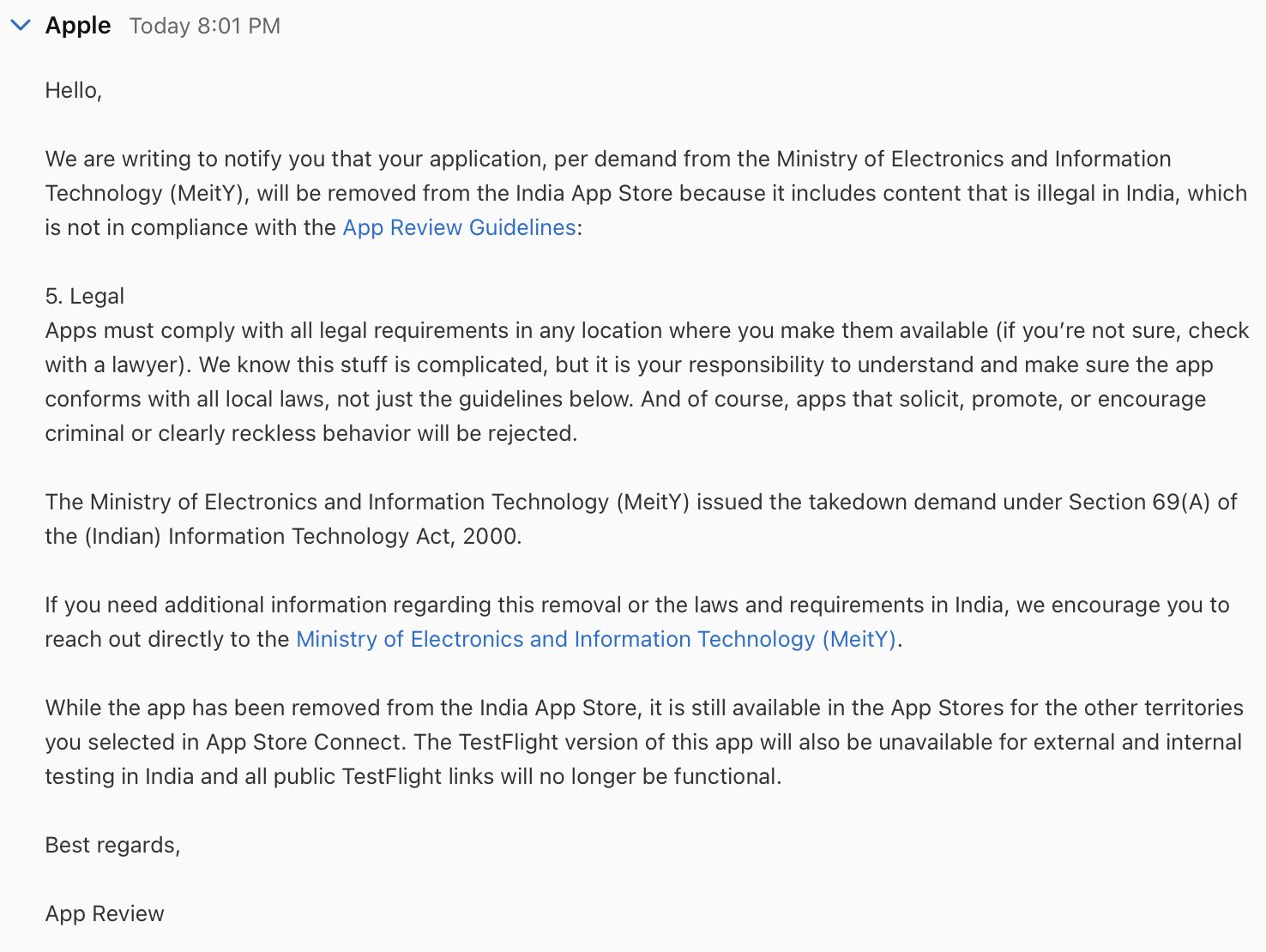
Statement : The removal of BitChat from the India App Store is unconstitutional. Section 69A permits the blocking of unlawful information, not of a messenger for working during internet shutdowns.
New Delhi, 3 October 2026
An Apple App Review notice published today by Jack Dorsey on X records that BitChat has been removed from the India App Store "per demand from the Ministry of Electronics and Information Technology", issued under Section 69A of the Information Technology Act, 2000, on the ground that the application "includes content that is illegal in India". The notice adds that BitChat's TestFlight builds are no longer available for testing in India. It does not identify the content said to be illegal or the ground under Section 69A invoked. The blocking order has not been published. The Internet Freedom Foundation condemns the order and calls for its immediate publication and withdrawal.
BitChat relays end-to-end encrypted messages between nearby phones over Bluetooth mesh. It has no servers and hosts no content of its own. What travels through it is the private speech of its users, so the claim that the application "includes" illegal content is incoherent. The State's actual objection stands recorded in the notices the Indian Cyber Crime Coordination Centre issued on 23 July 2026 to GitHub, Google and Apple against BitChat, Briar and Bridgefy which stated that such applications work even during internet shutdowns and hamper lawful interception, attribution and traceability. Those notices, issued under Section 79(3)(b) were reportedly withdrawn after public disclosure. The same end has now been pursued through Section 69A. The objection is to capability of an application, not to content it transmits. A citizen's ability to speak to another citizen while the State has switched the internet off is not a ground of restriction under Section 69A or Article 19(2) of the Constitution.
Section 69A survived constitutional scrutiny in Shreya Singhal v. Union of India (2015) because of its safeguards which included the need for a reasoned, recorded order, committee review, and a hearing to the originator under Rule 8 of the Blocking Rules, 2009, which the Delhi High Court enforced in Tanul Thakur v. Union of India (2022). Further, Anuradha Bhasin v. Union of India (2020) requires that orders restricting fundamental rights be published and adopt the least restrictive measure. However, it appears in this instance, each safeguard has been evaded. A secret order blocking an entire application, rather than any identified unlawful information, is the most restrictive and disproprotionate measure available. Further, the confidentiality claimed under Rule 16 cannot defeat the right to challenge an order, and the constitutionality of this blocking regime is itself pending consideration before the Supreme Court.
While removal from the App Store does not delete BitChat from phones, it stops new downloads and security updates, leaving existing users on unpatched versions, and it ends security testing in India through TestFlight. During the Jantar Mantar protests, when mobile internet was suspended and jammers were deployed, Bluetooth mesh messaging was a channel of last resort through which young people coordinated their safety. To our knowledge, Apple has removed BitChat on a government's demand in only one other country. This is in China, in April this year.
Our demands
1. MeitY must publish the blocking order, the ground invoked and the record of the committee's proceedings, and serve the developers with a copy and an opportunity of hearing.
2. The direction must be withdrawn. Any specific unlawful use must be met with targeted proceedings under due process, not the removal of a communications tool for everyone.
3. Apple must disclose the demand in its transparency reporting and notify its users in India, and must state whether parallel directions have been received in respect of other app stores.
4. The secrecy of the blocking regime must end. The Blocking Rules, 2009 should be amended to require publication of orders and notice to originators, without awaiting the outcome of the pending constitutional challenge.
The Internet Freedom Foundation will file applications under the Right to Information Act seeking a copy of the order, and stands ready to assist the developers and affected users in India.
125
521
1,712
47,043
svs 🇮🇳 retweeted
getting a lot of work done on 12th main including removing the dead overhanging wired we all hate!
mr vijay and GBA crew are on fire. more updates soon!

Great news! Some spots highlighted in this video were fixed today.
Tomorrow more work will be done. I'm not in Bengaluru but @Virendra0698 will be on 12th Main at 10 AM tomorrow along with Mr. Vijay Haridas who is the wonderful area inspector who made these quick fixes happen.

12
13
238
38,818


svs 🇮🇳 retweeted
it’s happening! @GBA_office 👏🏻👏🏻
getting a lot of work done on 12th main including removing the dead overhanging wired we all hate!
mr vijay and GBA crew are on fire. more updates soon!
15
17
395
29,027
svs 🇮🇳 retweeted

Your father was doing a catwalk in Vadodara when students were buried under the rubble of a collapsed building in Delhi's Satyaniketan.

69
697
6,836
53,285
svs 🇮🇳 retweeted

The Great Circle of Crude
Somewhere in the Urals, a barrel of oil is loaded onto a tanker. It has no idea it is about to become the most morally flexible object on earth.
It sails to Jamnagar, where India buys it at a "friendship discount". India calls this strategic autonomy. The West calls it funding the war. The barrel calls it Tuesday.
At the refinery, the crude is heated, cracked and distilled, and something miraculous happens. The Russian molecules leave, and Indian diesel emerges. Nothing about the chemistry has changed, but the paperwork has undergone a spiritual rebirth. It is the only known process that turns sanctions into margins.
Europe now steps in. In the morning, it sanctions Russian oil. By lunch, it fills its tanks with Indian diesel. At dinner, it lectures India on values. Europe does not buy Russian oil. It buys Russian oil that has been to finishing school.
America is furious that India buys Russian crude and slaps on tariffs to show it. It then quietly carries on importing Russian enriched uranium, because principles are like fuel: best refined before use.
Now comes the masterstroke. Ukraine needs diesel to resist Russia, so it buys Indian diesel with money given to it by Europe. India then pays Russia for the next barrel. So European taxpayers fund Ukraine, which pays India, which pays Russia, which funds the missiles that make Ukraine ask Europe for more money. It is the first war in history with a subscription model.
Russia, meanwhile, earns money from the fuel powering the trucks that resist its own army. It is the only belligerent to have outsourced both its revenue and its opposition's logistics to the same refinery.
Final ledger:
Russia: paid for the war, by the war
Ukraine: fighting Russia on Russian fuel, bought with European money
Europe: morally clean, operationally Indian fuelled
America: outraged, selectively
India: charging a refining margin on everyone's hypocrisy
The barrel: has travelled more than most diplomats, and achieved more
The money circles the globe like a vessel on DP (Dynamic Positioning) holding station: burning enormous energy, going nowhere, and everyone on the bridge insists it is under control.
44
257
745
52,231
svs 🇮🇳 retweeted

This will probably be the best MCP experience you have ever had.
If you have used a better MCP tell me about it.

The invideo MCP is now live. Connect your Claude, GPT, or any other agent you already work with, control the entire editor from your own console, and generate images and videos as well. The editing workflow just got a lot more flexible.

3
1
24
2,934
svs 🇮🇳 retweeted

EC has made a giant mistake in trying to find a middle ground by re-adding deleted voters through Form 6 without revoking SIR.
This is unconstitutional, statutorily infirm, procedurally perverse, legally untenable and potentially criminal.
Why?
Form 6 asks applicants to make a declaration that their name was not included before in the electoral roll from any other constituency, i.e, an appeal to include one's name for the first time. That effectively means asking voters whose names were deleted to make a false declaration about their previous enrollment, simply because Mr. Gyanesh Kumar wanted to carry out a botched exercise called SIR.
Under Section 31 of the Representation of the People Act, 1950, making a false declaration in connection with the preparation, revision, or correction of an electoral roll is a criminal offence punishable with imprisonment for up to one year, or with a fine, or both.
It is a no brainer that this entire contrivance will be pulled up by the courts.
What an extraordinary mess the EC has created.

56
589
996
30,243


svs 🇮🇳 retweeted

More roads aren’t going to fix things
- There’s no enforcement of rules, especially signaling and wrong side driving
- There’s massive encroachment on footpaths which results in people ending up walking on the roads instead
- existing roads are not clearly marked or maintained
Building more without fixing existing is infrastructure porn - not development.

If you live around Kothrud, you know the traffic situation doesn’t need much explanation.
So seeing the entire DP road discussion reduced to trees will be cut is honestly missing a pretty important part.
The official tree permission says 467 trees are affected.. only 149 for removal and 318 for transplantation. On top of that, there is a requirement for thousands of compensatory trees, with geo-tagging and seven years of maintenance.
So let’s have a serious conversation about execution, connectivity and green cover rather than turning a complicated urban-planning issue into a one-line trees cut narrative.
freepressjournal.in/pune/pun…
1
2
6
535

RT @Cockroachisback: Lakhs of people have gathered on the streets of Mumbai to take on a fascist, and they won’t back off!
They are here t…
942
83


svs 🇮🇳 retweeted

Hello Cockroaches, the Mumbai legal team is all set.
Incase you are illegally detained today during the protest, please reach out to contacts mentioned here.
We thank you all for extending legal help.


95
1,089
3,643
94,037

