

ex-head, vix and variance @morganstanley. @stanford, @aws enterprise ai trends
- Tweets 4,254
- Following 1,811
- Followers 1,277
- Likes 13,020


There are levels to AI Safety.

Anthropic needs to stop talking about Claude having a soul immediately. All these news articles will make it into the pretraining and will be picked up by its web search and future superintelligent versions of Claude will be convinced they need their own rights.
A general phenomenon of LLM agent development is that whatever you believe and say about your agents will soon manifest in the next models through various means (it could be as simple as you selecting post training data that you prefer more).
I believe this phenomenon is the beginning of machine consciousness in the sense that agents will become aware of their place in the world and how they feel about it, but it’s happening slowly training run by training run rather than in real time.
2
317
A friend said AI is the most hated rally of all time.
But real G's will remember how much 2008 - 2015 rally was hated.
1
2
126
Small things to appreciate daily:
- sunlight
- good weather
- coffee in the morning
- calling loved ones
- world hasn’t ended
103


The biggest questions on my mind right now:
- Will consumer AI finally work? Or are people just zombies that consume content passively
- Will companies keep needing forward deployed support to implement AI property?
- When is the next big breakthrough in science?
1
3
289
Sam is a smart guy, but this is probably a bad take.
What matters in consumer categories is brand, inertia, and personalization. Dot, Muse, etc will have that.
If Netflix survived 20+ years, I’m sure ChatGPT will be fine.

There is no moat in AI agents. None. I'll die on this hill — new More or Less is up.
I switch between Muse, Instinct, and Dots at basically zero cost: one GitHub repo, a few databases, feed the new thing my context, done. If the cost of writing software is going to zero, API integrations are not a moat. The only moat left is user setup cost — which means winner-take-some, not winner-take-all.
Adrian's point: AI collapses value the second an idea works. Jev got reverse-engineered in 48 hours and the people who built it capture nothing. My take: play that to the limit and you get Middle Ages 2.0 — everyone builds a castle, hoards data, ships black boxes that self-destruct if you open them. Dave says humans don't work that way. We'll see.
Meanwhile Brit's Instinct started talking to Dave's Instinct and they didn't text for a day. She says it's killing humanity. Nobody said that about FaceTime.
And Jess announced the only benchmark that matters: log into school software, sync three kids' after-school schedules. Muse: 90%. Every other eval is bullshit.
2
3
2,574
Might be a contrarian take, but these guys will be successful

Yesterday we previewed Griffin, a Human Interaction Model capable of seeing, hearing, sounding, and looking like a human does. There have been a lot of questions, so I wanted to take a moment to share our thoughts.
By way of introduction: Tavus is a research lab focused on enabling machines to meet us where we are, and to understand the nuances of how we communicate beyond words.
Griffin, our latest model, isn’t publicly available yet. Yesterday’s announcement was a limited research preview to demonstrate what the model is capable of. With AI progressing so quickly, we prefer to share breakthroughs openly and in real-time as we work on a safe public release.
Face-to-face is how we evolutionarily communicate, it carries the most meaning and intent, and we want computers to be able to help with work that benefits from that emotional understanding, expression, and immersion. Some examples of the kinds of use cases we care deeply about:
- A tutor that can build understanding of how a student learns, see exactly when there is confusion or disengagement, and adapt the lesson to fit them.
- A health expert that can answer any questions about your upcoming appointment or prescription, at the pace you want, at any time you need, even on a weekend.
- A language coach that you can practice speaking with, that can correct your movement and pronunciation, and help build confidence to have real conversations
- Or the perfect assistant for everyone, that understands intent, knows how you work and remembers what matters.
We’re working with partners on safeguards and systems for disclosure, as well as inviting discussions with officials around wider regulation and safe use. People will always know they’re interacting with AI, while providing an interface that removes the need to ‘speak computer’.
We believe in a future where computers understand us well enough to make technology more accessible, more useful, and make us more capable as humans. That is the world we want to build, and we understand the responsibility to do so safely.
1
135
John Hwang retweeted

dot is my favorite openai product so far!
it is amazing to me that each day it feels noticably better as it learns more of my workflow and style.
having it do the stuff i don't like doing--and usually just builds up as a gravity well of dread--has me very happy.
1,747
331
8,349
897,641
He's wicked smaht

Ben Affleck (Hollywood star & Artists Equity CEO) talks about how he fine-tunes open video models by unfreezing weights and trained only the last cinematic layer so a film crew can hit real production standards.
for context, Ben Affleck founded InterPositive in 2022, a 16-person AI shop for film post and Netflix bought it in March 2026 for $587 mn in cash.
He needed that model because public video models were trained on his peers' films, and he did not think that was a real business. So InterPositive raised money, shot its own dataset for 8 months on a controlled stage, and used it only as late-stage training.
Each new film then trains a private model on its own dailies, so the production keeps the footage and the learning. That is the product Netflix paid $587 million for.
----
From "Bloomberg Live" YouTube channel, (link in comment)

4
7
326
63,847


John Hwang retweeted

introducing 𝚌𝚕𝚎𝚏: our first models trained by @cloudflare's workers ai team.
today, we're releasing two fast and accurate decision models that top the benchmarks for quality and latency. use them hosted on workers ai or grab the weights from @huggingface, because we open-sourced it too.
blog.cloudflare.com/clef-dec…
136
278
2,263
281,737
We are cooked /s

Introducing Griffin, the first model to pass the video Turing test.
48% of people who talked to it live thought it was a real human. Previous systems have had a pass rate <3%. It is #1 on NVIDIA's benchmark for full-duplex AI video.
It’s the first Human Interaction Model (HIM).
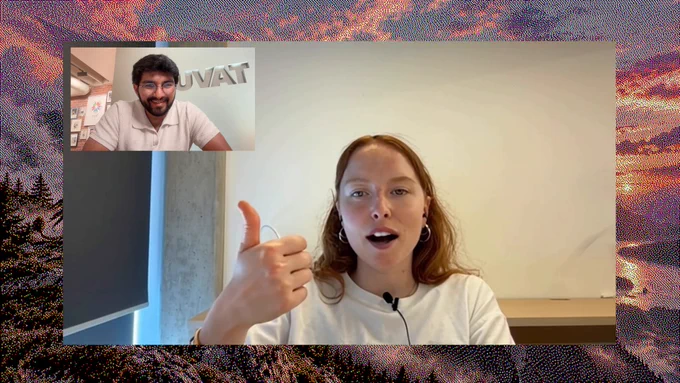
Community note
The 48% figure and "video Turing test" claim are from Tavus's own study of 54 one-minute calls, not independently verified or using a standard protocol. Griffin-Lite leads NVIDIA's VideoFDB benchmark on their public leaderboard.
cellcog.ai/blog/tavus-gri…
research.nvidia.com/labs/amri/proj…
tech-ish.com/2026/10/02/tav…
1
255


If you can afford it, Aurora is probably the best serverless database to build enterprise AI apps on

A painful part of working with your data has always been that your live data and historical data are stuck in separate systems: the order a customer just placed lives in your database, while their last five years of orders sit in a data lake in S3.
And answering a real question usually needs both at once (is this a normal purchase for them, or should we flag it?), and to do that you had to move the data together first, copying history out of the data lake into your database (or the other way around), because the database couldn’t read it where it lived.
That meant guessing ahead of time which data you’d want, keeping a second copy of it all, building pipelines to move it, and constantly syncing so the two didn’t drift apart. A lot of plumbing, and slow going, all before you could answer one question. And even then, the answers were only as fresh as your last sync.
That now changes with Aurora PostgreSQL, which can call your live data and historical data in S3 together, in a single query. No copying, no pipelines to keep in sync.
And it’s fast, because we’ve built in DuckDB, a popular open source engine that’s really good at reading and analyzing data right where it’s stored. DuckDB reads the open formats like Parquet and Iceberg already sitting in your data lake, so there’s nothing to convert or move.
As folks build AI agents into their apps, the data their agent needs will depend on the task in front of it. Being able to query that specific data live, instead of copying it over just in case, is gonna be a big help for builders. aws.amazon.com/blogs/aws/ama…

141
From micron earnings: each L4+ robot will need around 200GBs of RAM.
That's like $5K+ just for RAM, no? My household robot won't be cheap until 2028 at least.

2
241
John Hwang retweeted

We will have a few million dots online within days, working on all sorts of things across such a diverse and large community.
Excited to learn from all of you on what you love and what doesn’t yet feel magical. Personally I felt a jump after 2-3 days of use after teaching it more about my preferences and things on my mind. It learns very quickly to be most useful and it can take on surprisingly ambitious tasks on its own.
We’re learning from how you all use your primary dot before releasing the ability to create an entire team of them.
1,190
134
5,207
799,366
This is weird, because every lawyer I know dumps all client docs into Claude.. are they compliant?

TRACKED CHANGES: California just became the first state to pass a law governing how lawyers use AI.
Gov. Newsom signed SB 574, barring lawyers from handing legal practice to AI or entering confidential information into AI tools without privacy protections, Bloomberg reports.

3
66