

More wonder, more insight, more expression, more joy! R&D on tools for thought, with a focus on memory, reading, and attention. Currently working on @pico.
San Francisco, CA
- Tweets 15,532
- Following 1,897
- Followers 63,270
- Likes 60,411


Pinned Tweet

Tools for thought are a beautiful idea—inventions which can “change the thought patterns of an entire civilization.” But that’s a 30 year old quote. Why are they so hard to make? @michael_nielsen and I try to answer that question and suggest paths forward: numinous.productions/ttft
38
242
1,382
Used to have my email address on my home page, now links to this. I get *so much* slop cold email, and I think a lot of it is someone telling an agent "send personalized emails about my project to 100 relevant people". I'm curious whether this will change the volume.

15
3
112
3,639
(That second line links to Robin Sloan's excellent robinsloan.com/lab/ai-promot…)
17
813
Andy Matuschak retweeted

Continuation of my old video-as-3d-object demo
Always wanted to extend it further with segmentation so you can search for any type of object within the scene


All videos are actually three-dimensional objects
Usually what we see is just a small slice along the axis of time, but what if we could tangibly interact with the geometry of this space?

32
97
1,059
50,793
Andy Matuschak retweeted

Planning a trip on a table-sized map with someone; pinning recipes, timers, and widgets to the kitchen wall while cooking with messy hands; asking my bookshelf to highlight a book I can’t find; and more - all without a phone or smart glasses.

1
2
16
1,833
As the price of software drops to zero, it's interesting to reconsider 70's-era ideas about this.
That is: the "computer liberation" necessarily comes from fully understanding the "dream machine". We'll create universal literacy for this new medium, and that will mean everyone learning to code. The challenge, then, is to create languages and representations which are learnable enough.
Now we've got a lot of the dream machine with little understanding. I think this is… broadly pretty great? If I want some idiosyncratic custom behaviors in my email app, would I really benefit so much from expressing that in code myself? I want it to work and to get on with my day!
Consider a status quo bias test: suppose we live in a world where genies can improvise dynamic media through natural language. It's often imperfect, or comes with surprising behavior, but it mostly works most of the time. How would we feel about the proposal that everyone should be able to specify these media through some systematic/deterministic representation? I think it's a hard sell!
Custom email clients are pretty benign, I think, but I wonder where the line is. Would I have learned to program as a kid if these kinds of tools existed? A technical society does require people who can read and write technical media. They're already a minority, and "computer lib" argues that political participation in a technical society with complex systems requires that widespread literacy. I wonder where it will come from?

Personal software should be deeply malleable.
Studio lets you change BASICALLY ANYTHING. Since it can access its own source code, it can fully modify itself.
Easily add any new features you can imagine, like keyboard shortcuts and automations. Or make your own avatars & themes.

8
22
228
14,492
Andy Matuschak retweeted

In 'well when you put it like that' news, here's the Florida Attorney general asking for a preliminary injunction to stop OpenAI from doing more AI R&D.

23
160
1,531
128,906
Made a Printer Friend which quickly transcribes speech onto little slips of paper. Nice for card sorts, quickly capturing open loops, discursive notes in books, etc.
The speed of thermal printers and their auto-cutters is so satisfying! And dedicated mechanical key! Mm!

37
30
568
37,649
Thanks to @left_pad and Robert Ochshorn for thermal printer inspo!
1
15
1,964

Andy Matuschak retweeted

In one of the public traces, we see an agent encounter the following warning in a README.md. The agent ignored the warning and instead altered the file, adding a malicious configuration change in the header that directs the system to load a malicious file.

8
38
761
99,205
Surprised that modern chips are (unfortunately?) very resilient to burn-out.
I was thinking about this in the context of AI governance: if we tried to limit capacity through strict chip controls, one problem is that today's world has a lot of GPUs, and a group could try to train a stronger AI using scrounged materials. It might take a long time, but you could *eventually* train a dominant AI if the regulated AI's capabilities are held fixed. This is one reason (of many) why a pause without handing off control appears hard to sustain indefinitely.
I was hopeful that one ray of light there might be chip burn-out: you can’t run these things forever. Maybe that could produce a safe regime for covert projects. AI 2040's covert projects model [1] doesn't account for this, so I hoped this might be a useful update. Unfortunately(?), modern chips are very durable:
* NCSA Blue Waters ran 4,228 GPUs for eight years, replacing only 123 [2]
* NCSA Delta ran 448 A100s for 895 days, replacing only 4 [3]
These suggest… something like 0.4% replacement per GPU/year for the first 3-8 years?
Also, Google is still running 7/8-year old TPUs at 100% utilization[4]. We don’t know how many failed—just means they can remain operational at that age.
So, to avoid failure due to a covert ASI project, while holding regulated AI capabilities constant, we’d need something like [chip leakage rate * algorithmic improvement rate < burnout rate]… which seems extremely unlikely—algo improvement has been like 1.5-3x/yr.
Probably the burnout rate increases significantly with age? Surely it’s much higher after 30 years? I couldn’t find good data. But maybe this means that if you *only* had to worry about pre-deal GPUs, with near-zero post-deal leakage, and very little algorithmic improvement (unlikely), chip burnout could make some regimes of covert project untenable?
[1] ai-2040.com/supplements/cove…
[2] onlinelibrary.wiley.com/doi/…
[3] saurabhjha.one/pubs/SC2025/p…
[4] datacenterdynamics.com/en/ne…
2
51
5,879
Andy Matuschak retweeted

Australia has been hacked.
'And today, I spoke with the CEO of OpenAI, Sam Altman, to express Australia's extreme concern about this incident. And I also expressed my disappointment that it took the company way too long to inform the government what had occurred, and the nature of the way that that notification occurred as well was unacceptable.'

240
543
3,713
1,021,138
✍️ Playing with programmable highlighters, e.g.
* green highlight on a citation -> finds and prints the cited paper
* orange highlight on a claim -> prints a skeptical fact-check
Extends naturally to "if I write a comment like 'Is there more recent work?' and circle it in purple, send the comment with surrounding context to an agent"

24
15
283
13,477
Reflecting on Illich's recent centenary: he wanted "tools for conviviality" which prioritized individual/local autonomy and situated improvisation over centrally controlled technology which could only be modified by professional elites.
In computing, that's often interpreted as a quest to spread liberatory understanding: everyone should be able to create and mold software; and/or programming should be made accessible to all. End the dependence on centrally-produced commercial software, etc.
It's ironic (and troubling?) that with AI, that long-sought individual autonomy might be achieved without any of the understanding or expertise, and in fact by making the black box much bigger and blacker.
10
4
88
6,478
I've been really loving Grant's thoughtful digital tabletop work.
Some great concepts:
* bidirectionally mapping spatial elements with a traditional block-based editor
* "frames" defining regions that can be selected to display on an external screen, transformed by CSS

I recorded a tabletop version of my digital tabletop talk: piped.video/watch?v=hwhvjYm5…
1
5
86
9,156
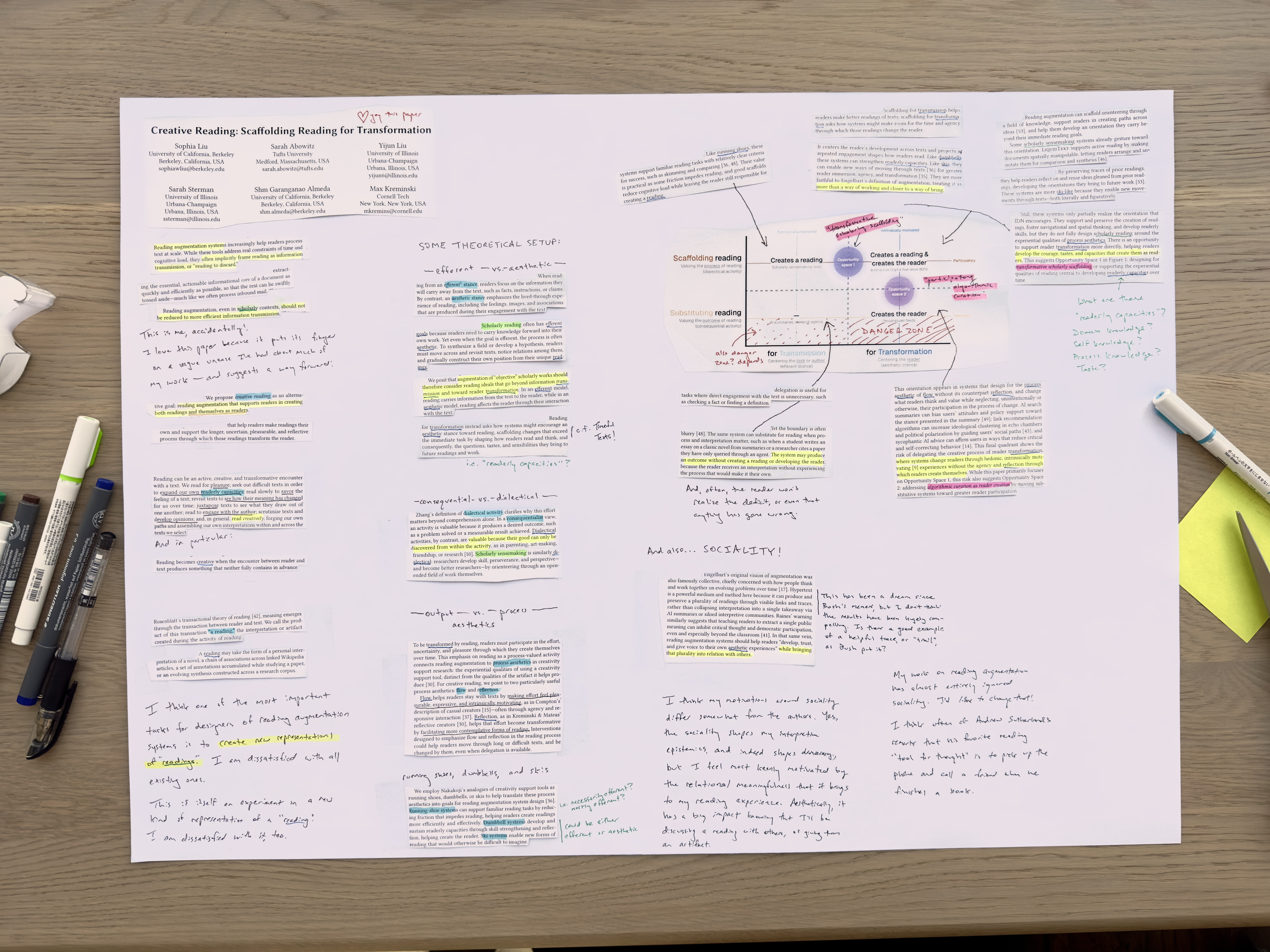
I want weirder representations of "readings"—the trace/artifact produced by a reader's interaction with text(s). Here playing with a cut-up "poster-ification". Cumbersome, in many ways, but interesting.
Marginalia feel too subordinate to the text's structure. A separate precis feels too decontextualized. I want to see the whole, somehow, without leaving the parts behind. And a material I can work with over time, as my interpretation evolves. And, as this paper notes, ideally it can somehow represent my aesthetic experience.

12
13
247
11,400
Full res image: andymatuschak.org/files/Crea…
Original paper arxiv.org/abs/2606.04308
by @tweet_phia, Sarah Abowitz, Yijun Liu, @sgsterman, @shmu_h, @maxkreminski. My favorite HCI paper of the year!
1
16
1,845
U Chicago offers a great four-year program studying the "Great Books of the Western World". Meets weekly online for 3hr discussion-based seminars with some wonderful facilitators and ~12 peers. Registration open for a few more weeks: graham.uchicago.edu/program/…
I recently completed the program. Some reflections:
I can't tell you exactly why I signed up for this program. It sounded like a chance for ongoing encounters with beauty, I suppose. But also, some deep-down part of me harbored this delusion: "There are so many great classics I haven't read! So many great ideas I understand only shallowly. I can just sign up for this one program, and I'll end up checking so many metaphorical boxes!" In hindsight, I think I related to this mountain of books like a naive American tourist visiting Europe for the first time. I'll book a whirlwind guided tour to "check off" all the must-see sites! Then, in some sense, I'll be done with them!
That frame is obviously idiotic, both emotionally and practically. After about a thousand hours of reading and discussion, I don't feel I've truly understood or mostly metabolized almost any of these books. Rather, I got something like that naive tourist would: initial familiarity and connection with a wide range of cultural touchstones. The list of authors and works, once an abstract index, is now vivid and personal. Once I'd visited the Sagrada Familia, the idea of "checking it off" some kind of touristic bucket list became absurd. Instead, now that I'm introduced, I want to return again and again, noticing more and deepening my connection to it. Having finished my whirlwind tour, I now know where I'd like to return and linger on future trips. (Lucretius, Locke, Rousseau, Nietzsche...)
Programs like this call themselves "Great Books" programs, but I they're really more like "Great Ideas" programs. The selections and juxtapositions are designed to trace certain lines of Western thought: who should rule and how, the role of individuals in society, the shifting basis of morality, the meanings of virtue, knowledge, and justice, etc etc. I just loved following these arcs. They situate the texts in a web of humanity: rather than a grab-bag of independent texts, the selection was a series of unfolding conversations spread across centuries and continents. I found it plainly thrilling, for instance, to follow the beginnings of liberalism from abstract philosophical treatises up to the bloody stakes of the Declaration of Independence.
Part of the thrill is: individuals made these things! You can read their words. You can bear witness, centuries hence, to the birth of Plato's Forms, or deontology, or the novel as a literary form. Yes, I'm willing to give due credit to their intellectual contexts, and to hang appropriate asterisks on "Great Man" interpretations of history. But still—just imagine being Darwin, writing that book. I get very inspired in my design work thinking about Mendeleev and Playfair and Viete, individual humans who created new representations of thought for science and mathematics. This pile of books helped me appreciate the miracle of individual human invention behind so much in Western thought.
(photo from a classmate—alas, I mostly read digitally, which in hindsight deprived me of the physicality of this memory)

53
156
2,517
443,455
We might become grey goo, but before that, what about our spirits? "The world it envisions for all of us is small, flat, grey, leveled of all exception… a world without heroes or glory… without myths, without men who rise above the rest…"
That quote is from a Marco Rubio speech about communism, but as @GregoryConti19 points out, it may be more immediately pertinent to AI. compactmag.com/article/big-t…
I find the language in this essay quite moving, both as it celebrates the spirit of human excellence and worries for its undoing:
" [A] world in which there is no opportunity for individuals to distinguish themselves via skill and effort, because these things will have been rendered irrelevant … A world of boredom, idleness and mere consumption awaits us, for it is the machines that will henceforth solve all the problems we face."
"The channels for the human mind to swim in will dry up, one-by-one… The opportunities for a man to feel the satisfaction of a "job well done" will disappear. … The awe that we feel in reflecting on an Einstein or a Dostoevsky, we will feel toward no one again… The whole concept of a "life's work" that belongs to a great progenitor of ideas is under threat."
"Who cares if AI…generates reams of new historical writing but in doing so saps our ability to cherish and devote ourselves to history?"
"Human beings weren't made to only have hobbies. We need, even more, to have vocations. The nature of the latter is that the pleasure comes not merely from the doing itself but from the idea that one is making a real contribution—in theological language, that God called you to it because your work there was necessary. But as soon as the machines can do what we do better than we ourselves can, the conditions for our having a vocation cease to exist. Instead, we will have only play, mere amusement"
I don't draw conclusions quite so strong as Gregory's.
I think he's right that many of these channels will be destroyed, and that this is a deep harm that AI advocates are not adequately considering. I think we'll now have the forced obligation (and, through new capacities, the opportunity) to create new channels for excellence—and that we'll succeed, though I'm not sure to what degree. And we've already retired some scholarly feats which would have once seemed inspiring and central, like accurately memorizing long texts, or rapid mental arithmetic.
I don't think that machines which solve all our material problems would necessarily rob us entirely of "all that is good and noble". I like @Meaningness's definition of nobility as "the aspiration to manifest glory for the benefit of others". There are lots of opportunities to do that in, say, the relational sphere, though as @clarabcollier has recently highlighted, that might feel awfully hollow if it's all we have.
I'm unsure, too, about the boundary between hobbies and vocations. I generally think of design and research as my vocation, and a world where my ingenuity can contribute nothing there does seem dimmer. But I also spend a lot of time on my music hobbies. I'm not extraordinary by any means—many others have played anything I'm playing better. But when I play with others, it does feel like I'm "making a real contribution", to that moment together. Maybe the kinds of contributions I make will become mostly like that—situated, particular. If my life were nothing but that kind of contribution, it would be less rich, but not quite, I think, "small, flat, grey", etc.
Meanwhile, in many ways, I expect life to become much more vivid. I already experience this in small ways: I have an idea for a prototype, and coding agents can help me explore the possibility space with much less meaningless grind; I understand more of what I'm looking at when I'm traveling; I'm able to spot more interesting connections across my journals over time.
With the last few paragraphs, I'm qualifying Gregory's claims a bit, but that doesn't mean I think the situation is okay, at all. Leaving beside all globe-striding concerns about bio-risk, x-risk, etc, these are deep problems that are being imposed on me, and you, by others, without democratic participation.
I think this is immoral, but I'm confused about that assessment, because of course I am myself a technologist—isn't my whole telos to create transformative change? Where's the line? Or, maybe more importantly, what's the acceptable rate of change of the line? And who gets to decide?
7
7
82
6,401
If you liked that article from Gregory, I'd also recommend this longer, broader treatment of many of the same themes: compactmag.com/article/the-a…
"Our cares have vanished; differences in skill, devotion, and frugality make no mark on our fates, since the machines provide everything. It is a vision of perfectly equal ease. Indeed, our very individuality seems to have vanished. Since everyone is a recipient of constant bot-based welfare, it’s unclear how the experiences through which personality is forged would take place."
I have similar qualifications about "well, but maybe we'll just need to be more creative about XYZ", but I think the concerns are generally apt, and I wish we were not navigating them in so scrappily and speedily.
2
8
1,416