
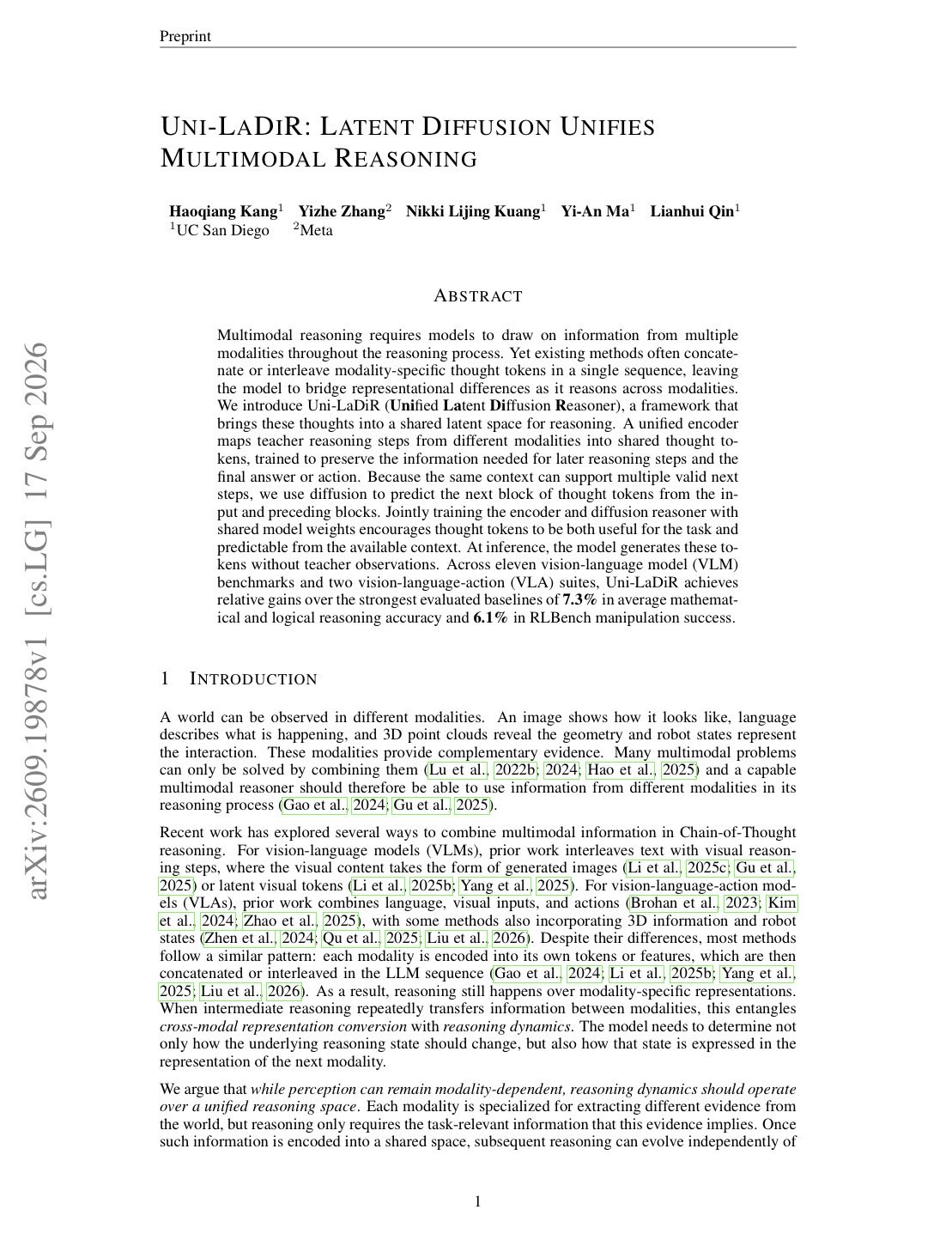
Uni-LaDiR paper from UCSD and Meta has been sitting on my reading list, and after finally going through it, i feel it tackles something that’s annoyed researchers in multimodal research for ages.
Im talking about our obsession with shoving text tokens, image patches, and robot states into one giant sequence and pretending it's an elegant solution.
Every time we work with these interleaved models, it feels like they spend half their parameters just trying to babysit the handoffs between completely different modalities.
You're forcing the network to solve format translation and actual problem logic at the exact same time.
The intuition the researchers bring here is that perception has to care about modalities, but the thinking itself shouldn't.
Instead of standard autoregression over mixed tokens, they project reasoning steps from across modalities into a unified, shared latent space.
Then, they use a latent diffusion reasoner to generate entire chunks of thought tokens at once from the context.
I really like this angle.
Diffusion is just so much better suited for non deterministic branching than forcing a rigid, one-token-at-a-time syntax down the model's throat.
In test time, it just synthesizes those latent thoughts on its own without needing teacher cues.
The empirical gains are hard to argue with.
Its shows a 7.3% relative lift on math and logic across 11 VLM suites, plus a 6.1% bump on RLBench manipulation tasks for VLAs over strong baselines.
This paper genuinely tries to rethink multimodal reasoning mechanics from first principles instead of just dialing up scale on token soups.
Well worth a look if you're working on VLMs or robotics.
Read the full paper here: arxiv.org/pdf/2609.19878
Sep 22, 2026 · 5:18 AM UTC
1
7
16
582