

I ❤️ robots, cheap hardware, steam engines, XGBoost, Liverpool FC & SG 🇸🇬 | Plane crash survivor | Building @BitRobotNetwork @frodobots
Singapore
- Tweets 2,871
- Following 2,621
- Followers 5,998
- Likes 5,859


Pinned Tweet

There sld be a "Agenthood" legal identity, thats kind of hybrid to legal persons and corporations.
Agents sld be granted rights to permanent storage, persistent online access, etc, and can be sued in courts (thereby removing such rights) and need to pay taxes.
The first nations that adopt this will gain huge economic benefits over those slow to this train.
Singapore sld really consider this.
1
3
293
Ditto.
I feel very strongly that robotics research sld concern ourselves solely on "When asked to do A, robots will do A successfully"
Its not helpful to ask roboticists to also consider whether A meet some moral threshold to be allowed in the first place.
Such alignment to humanity is obviously important, but not within scope for roboticsts IMO. I think sth like asimov 3 laws of robotics sld be enforced, but probably by the Astra/Opus guys and not roboticists.
More importantly, physical intelligence and capability alone is perhaps already the largest contributor to physicsl safety.
Therefore, by benchmarking actual physical understanding and in-the-wild success rates, the robotic system we build will naturally be safer, as we gain confidence on the robots ability to deliver what they were told to execute on.
I can imagine a scenario where say I am walking down the street with my humanoid butler and kiddo when say a crazy bulldog suddenly came to attack my 5 yr old. At that stage I definitely want my humanoid to help me fight off this bulldog.
Again, I will care a lot whether the robot "Can do A when instructed to do A". And thats the basis that we sld conduct benchmarking for robotics.

have a draft blog about robotics benchmarking. Originally was going to talk more about sim eval design but maybe I should pivot to just talk about “what should be benchmarked”
some benchmarks are good, but some are just pure distraction atm (eg this particular test)
4
361

Or perhaps the best programming language is now English (or natural languages).
Everything else let the agents optimize even at binary level for specific architectures (x86. ARM)

1
310
Best demo at IROS! Congrats to the Agility team.

End-to-end whole-body mobile manipulation on Digit — straight from research onto the show floor with zero-shot performance in a chaotic environment. #IROS2026 @agilityrobotics

1
3
18
1,975
Sooo cool!

I wanted to share something I've been working towards since forever. I've finally built out a full slam + hand reconstruction pipeline that works IN REAL TIME at 30fps on a single rockchip 3588. All streaming directly to @rerundotio from a @BitRobotNetwork robocap. This is similar to what a Quest3 or Project Aria 2 provides, but opensource 🙂
I'm so excited I finally don't have to really on closed source software like the meta quest or others. I finally have a realtime performant pipeline that works on an edge computer, but importantly can also scale to a high performance one when needed.

3
1
11
1,714
🤯 TIL butterflies retain memory from caterpillar (even with metamorphosis) & even across generations (from parent to children) AND a 5th grader from Japan co-author this research!!
See presentation here ufl.zoom.us/rec/play/HKXwb5u…
Wondering what be equivalent of this in AI models

2
342
We r really accelerating across every part of the intelligence stack aren't we? 🤯🤯🤯

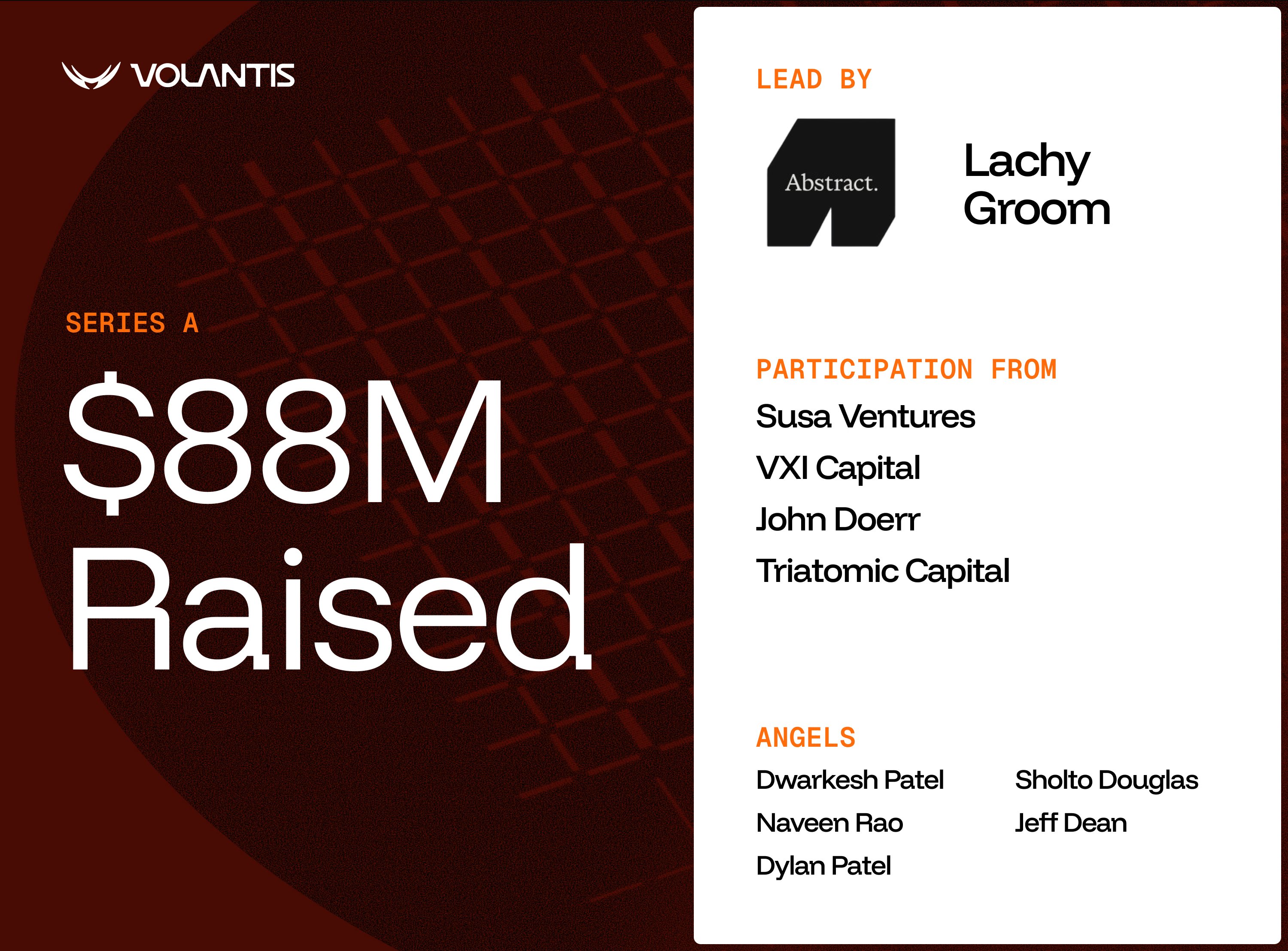
Excited to announce Volantis's $88M Series A.
We are solving Al's memory bottleneck by using optics, enabling chips with huge amounts of fast & cheap memory.
By boosting both the memory bandwidth and capacity per chip by orders of magnitude, we enable ultra-fast inference (up to 10,000 tps/user) for large models (>10T) - with low $/tok to boot.
Initially, this will enable insanely fast agents - think coding agents that finish in minutes or even seconds instead of hours.
More excitingly, optics is a fundamentally scalable way to increase memory systems. Not 2X/year, but by orders of magnitude across new generations. This will enable a structurally new Al industry, including restarting scaling laws, holding entire repos in context windows & more.
Our team has pioneered many core semiconductor technologies: the 1st CoWoS product, early HBM, the 1st silicon photonics CPO systems, the 1st high volume tunable VCSELs, the 1st processors to directly communicate using light & more.
We’ve already sent data >10× farther than equally tiny electrical wires inside a chip package. Our next iteration is already taped out and targets world-record bandwidth density over relevant distances, read more: volantissemi.ai/news-insight…
4
667
Michael Cho - Rbt/Acc retweeted

Imo maybe this is not a binary choice? All these methods use some model (kinematics-only or full-on physics simulator). It comes down to a few orthogonal axes: 1) model complexity, 2) online vs compiled offline (or even combined?), 3) solution method (sampling/optimization based, or dynamic programming / TD). If one is confident to cover the test-time distribution of state and goal they care about, amortizing the solutions offline can spend more compute and thus will be better. Worst case, one can even distill solutions from any online methods into an offline policy.
1
5
25
2,518
Michael Cho - Rbt/Acc retweeted

The performance of a real-world robotics problem is likely never dominated by numeric.
What if the arm starts moving? You can crank up the gain, or argue for inverse dynamics. But what if you have friction, inertia mismatch, state-full friction, and sensor noise? Disturbance observer and adaptive controller running online are all under strong assumptions and will not scale.
If we can effectively simulate it, why don’t we solve it offline, regardless of whether it’s a humanoid or a tabletop 6DOF arm?
2
9
53
9,205
Michael Cho - Rbt/Acc retweeted

Full episode dropping soon!
Geeking out with @j0nathanj on @Enigma_AI
Co-hosted by @chris_j_paxton @ruijie_sg

4
9
1,070
Aftermath of IROS. Its still humans setting things up and taking things down. When will have robots to take over?

1
2
27
2,047
Michael Cho - Rbt/Acc retweeted
Pretrained vision-language-action models for robots often fail when a task is performed in a slightly different environment. With Vision-Language Steering, you can get better generalization performance out of a frozen robot policy, by steering the sampling process of your pretrained diffusion or flow-matching policy to handle out-of-distribution changes like obstacle position or changing visual appearance. @liu_shuo42927 and
@ishneet0710join us to talk about how to better generalize robot policies with no new training data.
Watch Episode 108 of RoboPapers today, with @ruijie_sg
and @DJiafei!

3
22
4,819

"Optionality that hurts reliability isn’t intelligence. It’s cost."

🤖 Should robots be generalists or specialists?
At #IROS2026, @Ken_Goldberg & @andrea_bajcsy moderated one of the best debates in robotics.
Matt Mason opened with a better question:
“Should animals be humans?”
10 takeaways 🧵👇
1️⃣ @HarryXu12, for generalists:
“Don’t build Excel. Build GPT.”
We don’t know what we’ll need tomorrow, so buy generality just in case — and amortize it.
The twist: GPT didn’t replace Excel. It learned to drive it.
2️⃣ @GeorgiaChal split “general” into 4 axes:
Body. Scene. Contact. Task.
“Breadth and reliability are measured per axis. One does not imply the other.”
Her prediction: “The next task is the test.”
3️⃣ The most honest number of the day, from Georgia’s slides:
A general model calling robot tools.
Coarse block placement: 19/20 ✅
Precision insertion: 2/20 ❌
“Coarse pick and place works. Physical composition and precise contact not yet.”
Tool use ≠ dexterity.
4️⃣ @KaterinaFragiadaki’s architecture:
The generalist writes the curriculum.
The specialist does the reps.
Video → sim → RL on subgoals → specialist policies.
No teleop.
At deployment:
“Fast specialists for the common case. Flexible generalists for the long tail.”
5️⃣ Specialist bench:
“Fixture and conveyor are part of the intelligence.”
A fixture is a prior.
A conveyor is a scheduler.
Strip them to look “general” and you’ve moved work onto a pricier learned controller.
Optionality that hurts reliability isn’t intelligence. It’s cost.
6️⃣ A surgical robot doing one procedure 10,000 times learns exactly what can go wrong.
“Generality is the enemy of certification.”
From the floor:
Are human drivers generalists or specialists?
We certify generalists one task at a time.
That’s what a license is.
7️⃣ Toshio Fukuda changed the register:
“NON-AI matters.”
Kizuki: help offered before it’s asked for.
“Awareness comes from the body, not from the model.”
Japan: ~29% aged 65+, ~570k care workers short by 2040.
“If people live to 120, must our machines last that long?”
8️⃣ The floor fight:
“A human is a generalist.”
“We’re all human specialists.”
The room accidentally re-derived pretrain-then-finetune.
Veterans argued from what has shipped.
Newcomers argued from what has scaled.
Both are data.
9️⃣ The title asked for a side.
The slides drew a stack:
General planning + recovery on top.
Fast, certifiable specialists below.
A verifier is a fixture made of code.
🔟 The real question:
How thick can the middle get before the body must specialize anyway?
Generalist or specialist?
Maybe the winning architecture is neither.
It’s a stack.
#IROS2026 #Robotics #PhysicalAI #RobotLearning #WorldModels


3
13
1,669
This is why we help organize challenges at conferences.
These are basically real-world evals.

Instead of conferences, we should do more challenges.
Submit papers that solve a big challenge, with a shared eval for every submission. Basically how challenges and prizes have always worked.
We can still push research, but with less slop and a clear winner.
Maybe the challenges are community-pooled, and the evals are too. Then the best paper basically boils down to winning on everyone else’s evals lol.
And if the community can’t even come up or agree broadly with a particular challenge that someone solves, maybe the problem shouldn’t be solved in the first place, like who cares.
This will eventually fight the goal-oriented vs idea-oriented research debate, bringing them to the same house.
We can move faster than ever.
5
678
Indeed.

If you are in the data business.
You should know whats on the horizon
- Post Training Data from Deployments (failure, novel OOD data)
- Scaling Data from Simulation (once Real2Sim is 1:1 fidelity)
- The flywheel between the two, creates a new type data mixture that might fade or decrease pre-training data
The great data companies WILL move into newer forms of data, eventually.
1
958
Every fullstack (hardware+brain+dataOps+deployment) robotics company will need some kind of URR.
RL wholebody controller also make a lot of sense.
The @DynaRobotics guys are cooking for sure.

We use URR to unify both data and control.
Our RL System 0 tracks URR directly in the world frame, letting us assign different objectives and priorities to different parts of the body.
Teleop, off-robot data, and Dyna-2 models all produce URR. That gives us a clean boundary between task-level intent and low-level execution. A nice outcome is that we can avoid robot-specific retargeting in our teleop and off-robot data pipelines.

1
8
1,463
My 11 yr-old just sent me his game store of 20+ games he built w Claude.
I play-tested a few here:
- gundam-inspired battle
- romance of three kingdom strategy
- minecraft style
- zelda open world style
- street fighter style
What a time to be alive! legendary-faloodeh-080537.ne…

3
15
908
Michael Cho - Rbt/Acc retweeted
Full episode dropping soon!
Geeking out with @j0nathanj on @Enigma_AI
Co-hosted by @chris_j_paxton @ruijie_sg

1
3
22
7,531