











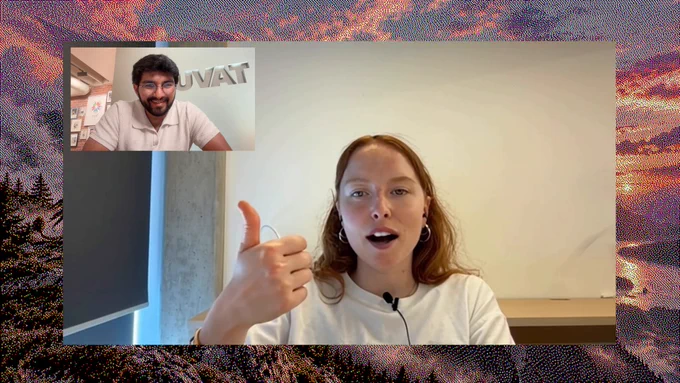
Introducing Griffin, the first model to pass the video Turing test.
48% of people who talked to it live thought it was a real human. Previous systems have had a pass rate <3%. It is #1 on NVIDIA's benchmark for full-duplex AI video.
It’s the first Human Interaction Model (HIM).
Community note
The 48% figure and "video Turing test" claim are from Tavus's own study of 54 one-minute calls, not independently verified or using a standard protocol. Griffin-Lite leads NVIDIA's VideoFDB benchmark on their public leaderboard.
cellcog.ai/blog/tavus-gri…
research.nvidia.com/labs/amri/proj…
tech-ish.com/2026/10/02/tav
3,317
4,291
39,098
20,092,414
COMPUTE THINGS

Excited to announce Volantis's $88M Series A.
We are solving Al's memory bottleneck by using optics, enabling chips with huge amounts of fast & cheap memory.
By boosting both the memory bandwidth and capacity per chip by orders of magnitude, we enable ultra-fast inference (up to 10,000 tps/user) for large models (>10T) - with low $/tok to boot.
Initially, this will enable insanely fast agents - think coding agents that finish in minutes or even seconds instead of hours.
More excitingly, optics is a fundamentally scalable way to increase memory systems. Not 2X/year, but by orders of magnitude across new generations. This will enable a structurally new Al industry, including restarting scaling laws, holding entire repos in context windows & more.
Our team has pioneered many core semiconductor technologies: the 1st CoWoS product, early HBM, the 1st silicon photonics CPO systems, the 1st high volume tunable VCSELs, the 1st processors to directly communicate using light & more.
We’ve already sent data >10× farther than equally tiny electrical wires inside a chip package. Our next iteration is already taped out and targets world-record bandwidth density over relevant distances, read more: volantissemi.ai/news-insight…

11
433
Solar age inbound

Introducing NetworkOcean.
Our future is bottlenecked by the speed at which we can deploy power.
We’re building floating solar arrays powering data centers at sea. This will soon be the fastest way to deploy new compute, skipping years of land, grid connections, and traditional infrastructure delays.
Our 2030 target is 1 GW/week.
@network_ocean_

2
12
399
Solar is already here but I guess you didn’t get the memo


Nuclear is too damn slow to drop our power bills. Americans can’t wait decades.
That’s why states like Texas are choosing solar + batteries as their fastest growing power source. It’s the only power that can be deployed quickly enough at scale.
2
11
1,079
The future of American energy is solar.
It's our grid's fastest growing energy source. In may solar outproduced coal.
But few recognize that it is an AMERICAN invented technology, made feasible by Bell Labs with the silicon cell.
And American solar innovation isn't over


Bullish on solar. It's time to get excited.
@optivolt is embedding power electronics directly inside solar panels. Existing panels are wired in series like Christmas lights. If cells get shaded (by a tree, dirt, bird poop, snow) they choke the current flowing through their section of the panel.
Optivolt's power balancer redistributes energy inside the solar panel at the substring level in real time, letting weaker cells borrow from stronger ones; instead of a shaded cell dragging down its neighbors, the strong cells carry it.
They claim up to 6x more output in shading compared to incumbent installs.
"Sunlight is the most abundant energy source available to civilization yet we somehow capture almost none of what it offers. Solar isn’t intermittent the way people casually assume; it's predictable, cyclical, and, with enough capture and storage, continuous. Difficulties arise only between photons hitting solar cells and electrons reaching the grid."
4
3
22
2,326

