
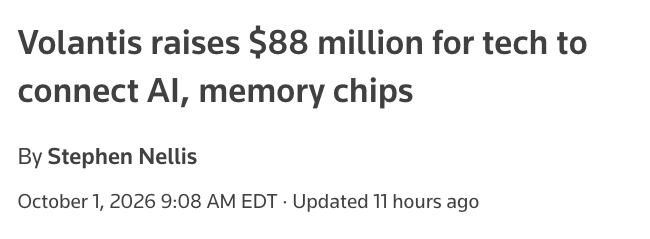
Volantis Semiconductor raised an $88M Series A, bringing total funding to $97M, to attack AI’s memory bottleneck with photonics.
Backers include:
OpenAI's Sam Altman
SemiAnalysis'S Dylan Patel
Jeff Dean
John Doerr
and others
The company is building an optical “fabric” designed to connect AI processors to much larger pools of memory while dramatically increasing bandwidth.
Volantis says its architecture can boost both memory capacity and bandwidth by more than 10x, targeting inference for models larger than 10 trillion parameters at speeds of up to 10,000 tokens per second per user.
The core problem it is trying to solve is the “memory wall.” Volantis argues today’s architectures force a tradeoff: on-chip SRAM offers very high bandwidth but limited capacity, while HBM-based GPUs and TPUs offer far more memory but eventually run into bandwidth constraints as models scale.
Its approach replaces more of the electrical data movement with optics, using custom integrated micro-VCSEL lasers and eliminating traditional optical fiber to push much more data across short distances inside AI systems.
The company says it has already transmitted data more than 10x farther than similarly tiny electrical wires inside a chip package, and its next-generation design has already taped out.
The near-term use case is much faster inference.
Volantis says a coding agent that currently takes around 30 minutes could potentially complete the same task in roughly 30 seconds, while also lowering cost per token through higher throughput and cheaper pooled memory.
If the technology scales as planned, the bigger idea is enabling much larger context windows, entire code repositories in context, and AI systems that are currently limited more by memory movement than raw compute.

Excited to announce Volantis's $88M Series A.
We are solving Al's memory bottleneck by using optics, enabling chips with huge amounts of fast & cheap memory.
By boosting both the memory bandwidth and capacity per chip by orders of magnitude, we enable ultra-fast inference (up to 10,000 tps/user) for large models (>10T) - with low $/tok to boot.
Initially, this will enable insanely fast agents - think coding agents that finish in minutes or even seconds instead of hours.
More excitingly, optics is a fundamentally scalable way to increase memory systems. Not 2X/year, but by orders of magnitude across new generations. This will enable a structurally new Al industry, including restarting scaling laws, holding entire repos in context windows & more.
Our team has pioneered many core semiconductor technologies: the 1st CoWoS product, early HBM, the 1st silicon photonics CPO systems, the 1st high volume tunable VCSELs, the 1st processors to directly communicate using light & more.
We’ve already sent data >10× farther than equally tiny electrical wires inside a chip package. Our next iteration is already taped out and targets world-record bandwidth density over relevant distances, read more: volantissemi.ai/news-insight…

Paid partnership (ad)
Oct 2, 2026 · 12:29 AM UTC
12
9
104
70,574


