
Founder & product builder. 10+ years building Internet products across SaaS, AI, and consumer apps. Sharing notes on growth and entrepreneurship.
- Tweets 59
- Following 43
- Followers 5
- Likes 105






DeepSeek open-sourcing infrastructure for Huawei Ascend may end up being more important than it looks.
For companies deploying open models locally, and for other open-model labs, this means there’s now a more serious alternative hardware stack to build on — not just Nvidia.
Ascend doesn’t need to beat Nvidia everywhere. If it can offer better cost/performance for common inference workloads, that alone is enough to attract real adoption.
This also makes export controls more complicated.
They can slow China’s access to the most advanced chips, but open models and open software stacks are much harder to contain once they’re released globally.
My concern is that restrictions may preserve the advantage of a few upstream companies, while many downstream businesses simply want cheaper and more reliable compute.
I’d rather see long-term AI leadership come from better technology, better economics, and stronger ecosystems — not from keeping alternatives out of the market.
Open competition is harder, but it creates stronger companies.
github.com/tile-ai/tilelang-…


I keep coming back to one question: is OpenAI leaving too much on the table in China?
Chinese models are increasingly running on domestic AI hardware at scale. OpenAI is openly constrained by inference capacity. Huawei is accelerating its chip roadmap. And Sam will be in the room during Xi Jinping’s U.S. visit.
To me, this is a good moment for OpenAI to rethink its China strategy.
If there is any legal room to do it, I think OpenAI should seriously consider reopening access for Chinese users and exploring more compute options, including Chinese inference hardware.
Staying out of China doesn’t stop Chinese AI from developing. It mostly means giving up users, revenue, developer adoption, and feedback while the local open-model ecosystem gets stronger.
The same is true for chips. If inference capacity is already limiting growth, relying on a narrow supplier base becomes a business constraint, not just a political choice.
OpenAI is competing with both Anthropic and a rapidly improving Chinese open-model ecosystem.
I don’t think more isolation creates a stronger OpenAI. More users, more developers, and more infrastructure options probably do.
Sometimes the best strategy is simply to return to the business fundamentals.
44
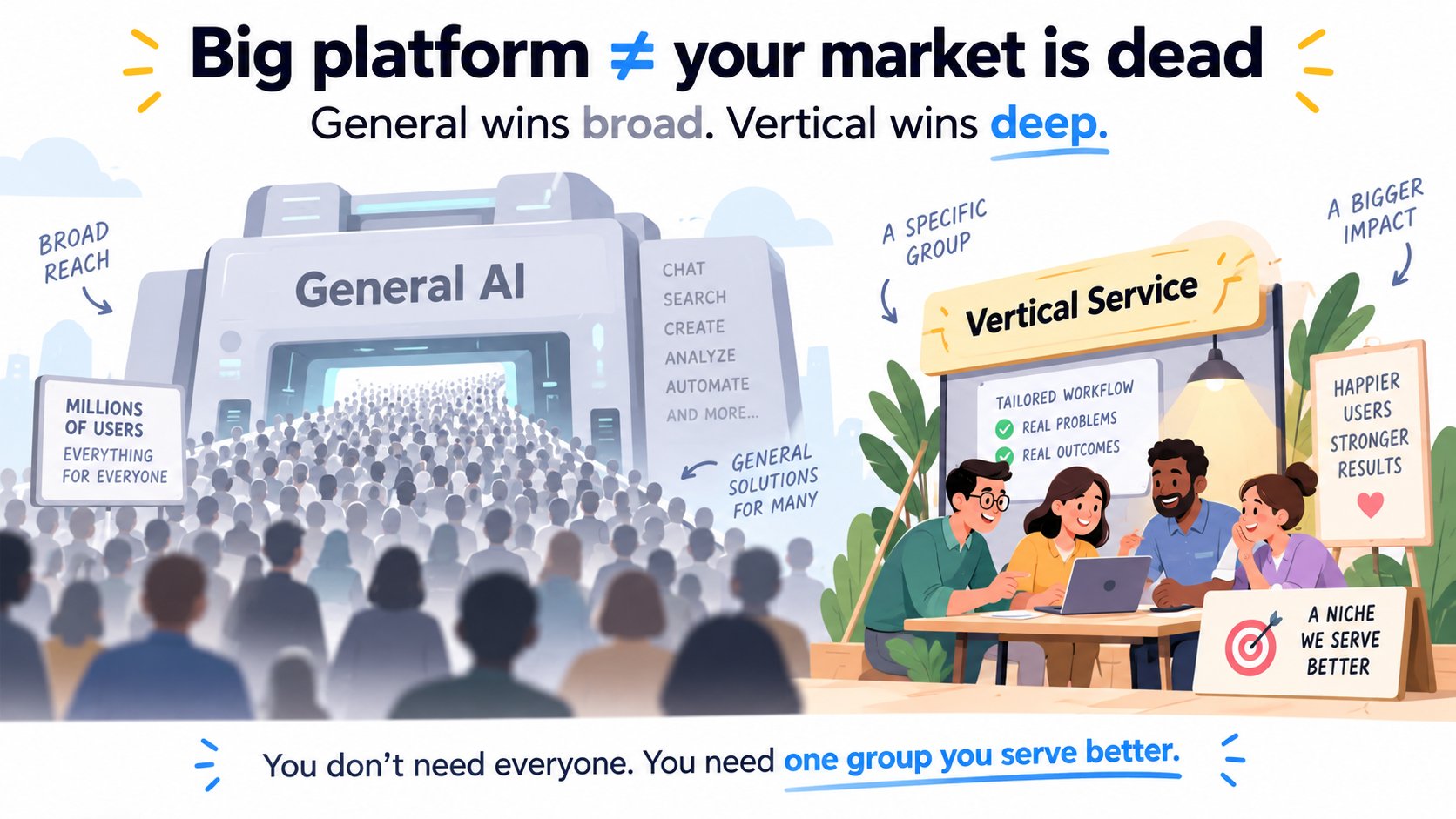
I see a lot of founders getting discouraged every time a big company launches something like Grok, Muse, or Dot:
“Another Agent direction is dead.”
I think that’s giving up too early.
Unless your product is basically a 100% copy of what they launched, you probably don’t need billions of users to build a good business.
A general-purpose product and a deeply specialized service can look similar from far away, but feel very different to the people who actually use them.
And I don’t think AGI changes that.
The more general the platform becomes, the more room there is for someone to understand one specific user, workflow, or industry much better.
You don’t need to beat the general product everywhere.
You just need to be meaningfully better for one group of people.
1
20
Anthropic’s new post on GLM-5.3 is interesting.
The cyber risk itself may be real — Anthropic says GLM-5.3 has capabilities similar to Mythos Preview, a model it chose to keep tightly restricted.
But the framing also has a clear market implication.
You can’t really stop an open-weight Chinese model from existing. But if models like GLM are increasingly framed as security or compliance risks, that can make U.S. enterprises much more cautious about deploying them.
And enterprise adoption matters a lot to Anthropic’s business.
That makes GLM a particularly uncomfortable competitor: strong coding performance, much lower cost, open weights, and now production inference running entirely on Chinese AI accelerators.
So I don’t think this is only a safety story.
It’s also becoming a competition over which models enterprises will feel comfortable deploying.
Safety research is never just technical once it starts influencing who enterprises are willing to buy from.
anthropic.com/research/glm-5…
29
Seeing Opus5.5 create surprisingly good video experiences mostly through code made me wonder if programming itself is close to another shift.
Today AI still writes Python, TypeScript, C++, Rust — languages designed for humans.
But eventually, why should AI keep programming through a layer built for human readability?
The next step may be a more machine-native language or intermediate layer, designed for AI to generate, verify, optimize, and execute directly.
If that happens, the efficiency gap could become enormous. Human programmers may eventually step out of the implementation layer almost entirely, leaving execution to AI.
I don’t think this is very far away. It will probably happen in stages.
When do you think the first real AI-native programming stack actually ships?

1
105
Meituan is much more than a food delivery company. It’s one of China’s largest local-services platforms, with deep reach into restaurants, hotels, travel, mobility, merchants, and everyday consumer services.
So it’s not that surprising to see them build a large model. China has a deep AI talent pool, and domestic compute is also becoming much more capable.
LongCat-2.0 was already trained and served on a 50,000-chip Chinese accelerator cluster, so the infrastructure side is clearly catching up too.

LongCat-2.5-Preview is now live.
1.6T parameters. ~48B active. A 1M-token context window.
Natively multimodal. Built to take on long-horizon tasks.
From terminals and browsers to GUIs, spreadsheets, and design tools.
Try it now:
🚀 API: longcat.ai/platform/
💬 Chat: longcat.ai/chat/

81
I keep coming back to one question: is OpenAI leaving too much on the table in China?
Chinese models are increasingly running on domestic AI hardware at scale. OpenAI is openly constrained by inference capacity. Huawei is accelerating its chip roadmap. And Sam will be in the room during Xi Jinping’s U.S. visit.
To me, this is a good moment for OpenAI to rethink its China strategy.
If there is any legal room to do it, I think OpenAI should seriously consider reopening access for Chinese users and exploring more compute options, including Chinese inference hardware.
Staying out of China doesn’t stop Chinese AI from developing. It mostly means giving up users, revenue, developer adoption, and feedback while the local open-model ecosystem gets stronger.
The same is true for chips. If inference capacity is already limiting growth, relying on a narrow supplier base becomes a business constraint, not just a political choice.
OpenAI is competing with both Anthropic and a rapidly improving Chinese open-model ecosystem.
I don’t think more isolation creates a stronger OpenAI. More users, more developers, and more infrastructure options probably do.
Sometimes the best strategy is simply to return to the business fundamentals.
1
2
86
Field Notes #2 — Continuous Outcome Improvement
I’ve been thinking about Outcome Systems as AI services that don’t just complete tasks, but take responsibility for the user’s final result.
But I think an Outcome System needs one more core idea: Continuous Outcome Improvement (COI).
Completing the task is not enough.
Every real outcome should feed back into the system:
What worked?
What failed?
Why?
What should change next time?
That learning should accumulate in memory, playbooks, workflows, and decision rules — not disappear into another chat history.
Over time, the service should get better simply because it has delivered more real outcomes.
Agents complete tasks.
Outcome Systems own the result.
COI makes the service better every time it runs.
And this is different from RSI:
RSI improves the intelligence.
COI improves the service.
1
21
AI + robotics can lead to universal high income — but only if the productivity gains are broadly distributed.
If a handful of tech companies own the intelligence, automate away labor, and capture most of the savings as profit, the outcome could be the opposite: greater concentration of wealth and less economic power for individuals.
So this isn’t only a technology problem. It’s also a distribution problem.
AI creates abundance, but public institutions still need to make sure the gains don’t accumulate almost entirely in a few companies.

A welfare state and free immigration will obviously bankrupt any country.
AI + robotics is the only path to universal high income for everyone on Earth.
1
65
Outcome System Build Log — Day 3
After a week of building, the architecture is becoming much clearer.
MCP is only the connection layer. It is not the product architecture.
The system is starting to take shape as four layers:
1. Goal + context
What does the user actually want, and what has already happened?
2. Planning + decisions
What should happen next? What constraints matter? What does success look like?
3. Execution
Use the right capability — including the user’s existing AI agents — to do the work.
4. Review + feedback
Did the result actually meet the goal? If not, what needs to change?
But these are not four steps in a one-way pipeline.
They form a continuous loop:
Goal + context → planning + decisions → execution → review + feedback → updated context → next decision
A completed task is not the end of the system.
It becomes new context for the next decision.
The agent is not the product.
The agent is a worker inside the product.
The product is the loop that keeps the goal, context, decisions, execution, and feedback connected over time.
Still building.
2
2
36
Probably impossible for policy reasons, but I’d be curious whether Huawei Ascend could eventually become another useful inference option for OpenAI — especially as inference demand keeps growing.
Hopefully, the market becomes more open over time.

This would suck, but we will prioritize great service for customers until we can get back on top of things.
1
40
Outcome System Build Log — Day 2
Start lighter.
I’m leaning toward launching through MCP first — possibly without a Web app at all.
The idea is simple:
The user gives the final goal. The system breaks it down, decides what needs to happen, and uses the AI already running on the user’s machine to handle execution.
This narrows the initial audience to people already using tools like Codex or Claude.
But it also lets me ship much faster, avoid rebuilding browser/computer automation, and focus on the part I actually want to validate:
Can the system make good decisions and consistently drive the outcome?
Execution is improving too fast for me to compete with the top AI harnesses anyway.
For an MVP, I’d rather build on top of them than rebuild them.
Day 2: use existing agents as the hands. Focus on the brain and the outcome.
1
49
This is also why I remain skeptical of Anthropic.
My concern is not safety alignment. Safety is necessary.
What worries me is the control mindset outside of safety.
When Anthropic has a technical lead, it seems comfortable using that lead to set premium pricing simply because it can, tightly control access to its best capabilities, and monitor or restrict usage in ways that go beyond basic safety needs.
That may maximize short-term margins, but it leaves less room for small builders to experiment, survive, and create businesses on top of the platform.
To me, frontier AI is becoming infrastructure. Infrastructure should create room for an ecosystem, not squeeze as much value as possible back into the platform owner.
I think this will eventually backfire.
Within the next year, I expect Anthropic to be overtaken by other frontier AI companies — probably more than one.
Safety needs guardrails. Ecosystems need room to breathe.
Field Notes — Where do the jobs go after AI?
We talk a lot about the jobs AI will replace.
What gets discussed much less is: where does the new demand go?
I don’t think demand disappears. It becomes more fragmented, personalized, and specialized.
AI lowers the minimum cost of starting a company. Work that once required a 20-person team may soon be done by 3–5 people with agents.
That could change the structure of the service economy.
Instead of one SaaS serving 100,000 users, we may see 100 highly specialized businesses, each serving a few thousand customers with a tiny team.
Large companies will keep cutting standardized roles and building general-purpose platforms.
Some of the people leaving those organizations — engineers, product managers, marketers, consultants, industry experts — will use AI to form much smaller companies and serve needs that were previously too narrow to be economical.
A marketing team for dentists.
An AI compliance service for one type of exporter.
A growth service just for indie game developers.
An after-sales service for one category of industrial equipment.
The important part is that these companies can’t survive by simply wrapping the same general AI everyone else has.
Generic AI becomes infrastructure. Specialized service becomes the product.
The scarce skill shifts from doing the work to understanding a specific customer, designing the service, and owning the outcome.
This is why I keep emphasizing AI services.
AI may reduce the number of people needed inside large companies, while simultaneously reducing the minimum viable size of a new company.
The future may be less about everyone finding a job in a large organization — and more about many more people building very small, highly specialized service businesses.

8
Field Notes — Where do the jobs go after AI?
We talk a lot about the jobs AI will replace.
What gets discussed much less is: where does the new demand go?
I don’t think demand disappears. It becomes more fragmented, personalized, and specialized.
AI lowers the minimum cost of starting a company. Work that once required a 20-person team may soon be done by 3–5 people with agents.
That could change the structure of the service economy.
Instead of one SaaS serving 100,000 users, we may see 100 highly specialized businesses, each serving a few thousand customers with a tiny team.
Large companies will keep cutting standardized roles and building general-purpose platforms.
Some of the people leaving those organizations — engineers, product managers, marketers, consultants, industry experts — will use AI to form much smaller companies and serve needs that were previously too narrow to be economical.
A marketing team for dentists.
An AI compliance service for one type of exporter.
A growth service just for indie game developers.
An after-sales service for one category of industrial equipment.
The important part is that these companies can’t survive by simply wrapping the same general AI everyone else has.
Generic AI becomes infrastructure. Specialized service becomes the product.
The scarce skill shifts from doing the work to understanding a specific customer, designing the service, and owning the outcome.
This is why I keep emphasizing AI services.
AI may reduce the number of people needed inside large companies, while simultaneously reducing the minimum viable size of a new company.
The future may be less about everyone finding a job in a large organization — and more about many more people building very small, highly specialized service businesses.
1
21
Outcome System Build Log — Day 1
Choosing the problem.
I’m starting a new solo project today.
I have three rules when choosing what to build:
It has to solve a problem I personally have — ideally one I’m a heavy user of.
It has to be something I’m genuinely interested in.
I’m deliberately not starting with TAM, user scale, or moats — the questions investors usually care about.
This time, I’m choosing marketing — specifically, helping small founders consistently acquire users.
As someone building AI products, I keep running into the same problem:
Ideas come fast. Products get built fast.
But once something is shipped, I often don’t have the time, energy, or expertise to consistently get it in front of the right users.
So I want to build an AI service for solo and small founders.
And I don’t want the product to say:
“Here are 20 marketing tools you can use.”
I want it to say:
This week you acquired 43 potential users.
Reddit contributed 17.
Pinterest contributed 8.
Two channels had poor ROI, so their priority was reduced.
Next week, resources will shift toward X.
That’s the outcome I want to build toward.
Not another marketing tool. A service that takes responsibility for the result.
Day 1.
7
I think the power side of the AI race is still being underestimated.
China doesn’t need to fully close the chip gap to close the model gap. Better algorithms, smaller and more efficient models, stronger post-training, and simply deploying far more domestic chips can compensate for weaker single-chip performance.
Today, the gap can look small for a few weeks simply because release cycles don’t line up. My expectation is that within 3–4 months, even comparing the best Chinese and U.S. models available on the same day, the practical gap could be only ~5%.
In 9–15 months, single-chip performance may no longer be China’s main bottleneck. At that point, power, grids, and the speed of infrastructure buildout could matter much more.
China may erase the model gap before it erases the chip gap.
And once that happens, the AI race increasingly becomes an infrastructure race.

Grok Bot Summary of Elon Musk’s G20 Address Today 🇺🇸
Power, data centers, and the bottleneck
- There’s already a power crisis for AI, not a far-off one.
- Consensus he cited: at least a 15 gigawatt shortfall of power in 2027 for AI chips.
- AI chip production is rising ~40–50% a year. Power outside China is rising ~10–20%. The faster curve will overwhelm the slower one.
- Google, Anthropic, and others are already leasing compute from SpaceX because SpaceX built its own power plants. That was the only way they could turn capacity on fast enough.
- China has lots of electricity, but GPU export bans block the latest chips there. The real constraint is electricity growth outside China.
- Opportunity for other countries: build a lot of power, host AI data centers, and tax them / charge reasonable fees.
AI as a growth engine
- Countries should lean into new tech instead of staying stuck in the past.
- His rough estimate: digital AI alone could lift the global economy by 20–30%, or about $20–30 trillion a year.
- By the end of next year, AI should be able to do anything digital, anything that doesn’t require physically shaping atoms by hand.
- Software prediction: in about 12–18 months, AI writing software will be “Stockfish-level.” Humans won’t be able to compete, the way a chess engine on a phone can already beat Magnus Carlsen.
- Same window: AI becomes extremely good, possibly that same level, at all forms of engineering and anything digital.
- He also plugged 𝕏 as where almost all serious AI discourse happens, and said that’s how he follows the field day to day.
Robotics and physical AI
- Physical tech always takes longer than digital. Software copies instantly. Hardware needs huge global supply chains and moving a lot of atoms.
- A humanoid robot’s usefulness is three things multiplied: AI software × onboard AI chip × electromechanical dexterity (especially the hands). All three are improving exponentially.
- Once robots start making more robots, growth goes recursive: slow at first, then explosive.
- 10-year forecast (he called it conservative): well over a billion humanoid robots, each about 5× as productive as a human. That would mean those robots outproduce all humans combined.
- That physical layer is where he sees the economy growing by a factor of 10 or more, not just 20–30%.
How countries actually get new tech built?
- New things should be default legal, not default illegal. Heavy regulation (he pointed at the EU) doesn’t kill progress, but it slows it a lot.
- Startups are like saplings in a forest. Most governments over-support the big existing trees (incumbents) and under-support the small ones.
- Big companies have access to political leaders. Startups don’t. Policy should be biased toward young companies on purpose.

1
12
Nan Yu moving from Linear to OpenAI to work on Codex and ChatGPT is interesting timing.
My read: Codex’s next bottleneck may no longer be coding ability — it’s coordination.
As code generation gets cheaper, the hard part becomes organizing requirements, context, humans, and multiple agents into one coherent system.
If Linear’s product thinking carries over, Codex could evolve from a coding agent into something closer to a software-team operating system — coordinating planning, execution, review, and shared context across people and agents.
That would also be an early step toward the broader shift I expect: AI tools becoming service platforms, not just better assistants.
Not proof, but definitely a signal worth watching.

Some personal news—I’m joining OpenAI to work on Codex and ChatGPT.
I’m grateful to the Linear team for an incredible 4 years and proud of what we've built together. I look forward to bringing everything I've learned there about the craft of software into this next chapter.
1
8