
Founder & product builder. 10+ years building Internet products across SaaS, AI, and consumer apps. Sharing notes on growth and entrepreneurship.
- Tweets 60
- Following 43
- Followers 6
- Likes 109







和百度当年区别很大,当年没人封杀百度,中概股在美股上市海外资本追捧,天时地利人和全占了。现在是先持续多年全方位的封杀华为,又搞了大批量高端芯片禁令,华为纯靠自己一个个产业拼杀出来。华为增长到现在的国内份额比起当年百度,难度上升好几个指数级吧
9
1,109
DeepSeek open-sourcing infrastructure for Huawei Ascend may end up being more important than it looks.
For companies deploying open models locally, and for other open-model labs, this means there’s now a more serious alternative hardware stack to build on — not just Nvidia.
Ascend doesn’t need to beat Nvidia everywhere. If it can offer better cost/performance for common inference workloads, that alone is enough to attract real adoption.
This also makes export controls more complicated.
They can slow China’s access to the most advanced chips, but open models and open software stacks are much harder to contain once they’re released globally.
My concern is that restrictions may preserve the advantage of a few upstream companies, while many downstream businesses simply want cheaper and more reliable compute.
I’d rather see long-term AI leadership come from better technology, better economics, and stronger ecosystems — not from keeping alternatives out of the market.
Open competition is harder, but it creates stronger companies.
github.com/tile-ai/tilelang-…


I keep coming back to one question: is OpenAI leaving too much on the table in China?
Chinese models are increasingly running on domestic AI hardware at scale. OpenAI is openly constrained by inference capacity. Huawei is accelerating its chip roadmap. And Sam will be in the room during Xi Jinping’s U.S. visit.
To me, this is a good moment for OpenAI to rethink its China strategy.
If there is any legal room to do it, I think OpenAI should seriously consider reopening access for Chinese users and exploring more compute options, including Chinese inference hardware.
Staying out of China doesn’t stop Chinese AI from developing. It mostly means giving up users, revenue, developer adoption, and feedback while the local open-model ecosystem gets stronger.
The same is true for chips. If inference capacity is already limiting growth, relying on a narrow supplier base becomes a business constraint, not just a political choice.
OpenAI is competing with both Anthropic and a rapidly improving Chinese open-model ecosystem.
I don’t think more isolation creates a stronger OpenAI. More users, more developers, and more infrastructure options probably do.
Sometimes the best strategy is simply to return to the business fundamentals.
51
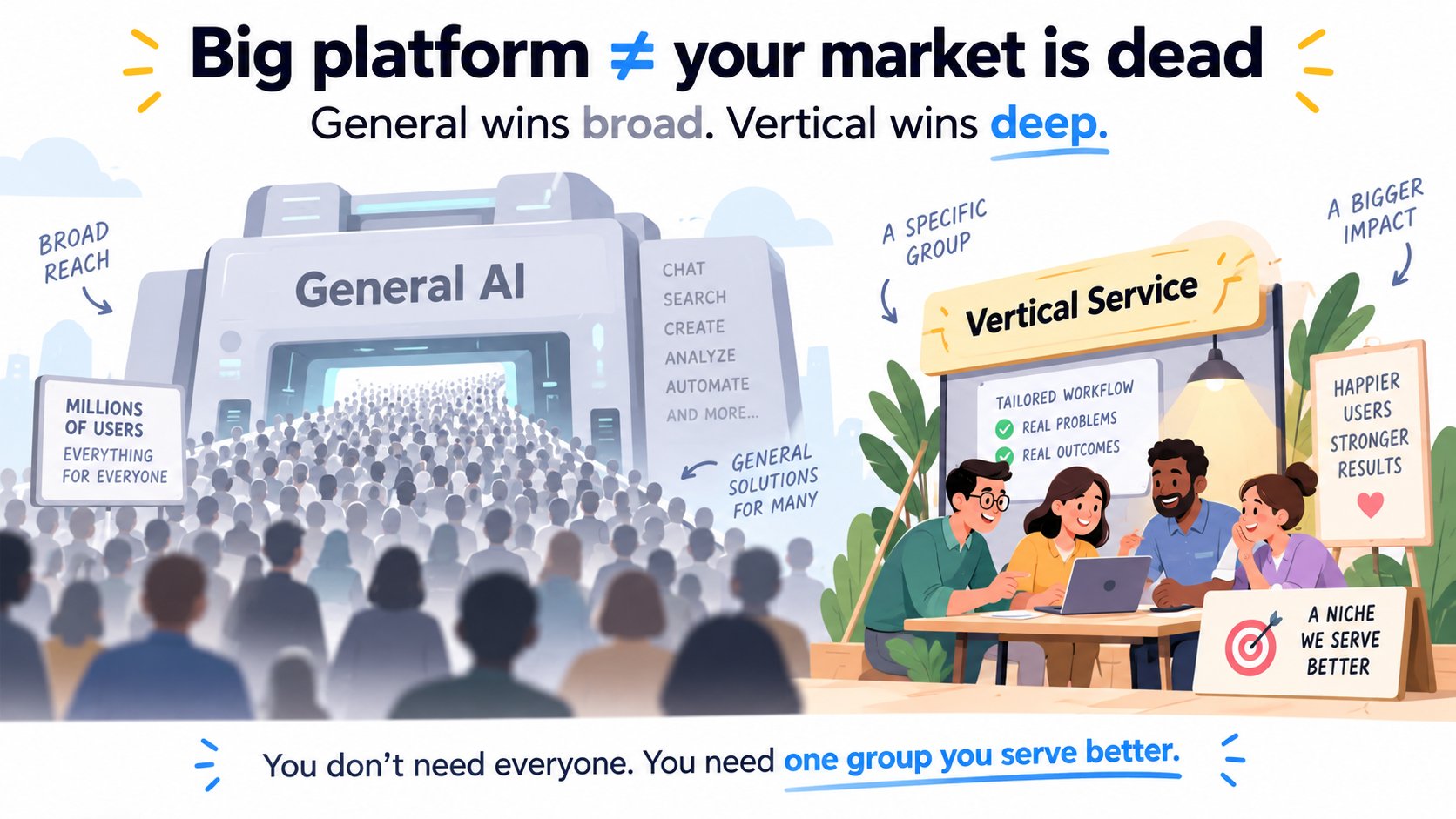
I see a lot of founders getting discouraged every time a big company launches something like Grok, Muse, or Dot:
“Another Agent direction is dead.”
I think that’s giving up too early.
Unless your product is basically a 100% copy of what they launched, you probably don’t need billions of users to build a good business.
A general-purpose product and a deeply specialized service can look similar from far away, but feel very different to the people who actually use them.
And I don’t think AGI changes that.
The more general the platform becomes, the more room there is for someone to understand one specific user, workflow, or industry much better.
You don’t need to beat the general product everywhere.
You just need to be meaningfully better for one group of people.
1
23
Anthropic’s new post on GLM-5.3 is interesting.
The cyber risk itself may be real — Anthropic says GLM-5.3 has capabilities similar to Mythos Preview, a model it chose to keep tightly restricted.
But the framing also has a clear market implication.
You can’t really stop an open-weight Chinese model from existing. But if models like GLM are increasingly framed as security or compliance risks, that can make U.S. enterprises much more cautious about deploying them.
And enterprise adoption matters a lot to Anthropic’s business.
That makes GLM a particularly uncomfortable competitor: strong coding performance, much lower cost, open weights, and now production inference running entirely on Chinese AI accelerators.
So I don’t think this is only a safety story.
It’s also becoming a competition over which models enterprises will feel comfortable deploying.
Safety research is never just technical once it starts influencing who enterprises are willing to buy from.
anthropic.com/research/glm-5…
30
Seeing Opus5.5 create surprisingly good video experiences mostly through code made me wonder if programming itself is close to another shift.
Today AI still writes Python, TypeScript, C++, Rust — languages designed for humans.
But eventually, why should AI keep programming through a layer built for human readability?
The next step may be a more machine-native language or intermediate layer, designed for AI to generate, verify, optimize, and execute directly.
If that happens, the efficiency gap could become enormous. Human programmers may eventually step out of the implementation layer almost entirely, leaving execution to AI.
I don’t think this is very far away. It will probably happen in stages.
When do you think the first real AI-native programming stack actually ships?

1
105
Meituan is much more than a food delivery company. It’s one of China’s largest local-services platforms, with deep reach into restaurants, hotels, travel, mobility, merchants, and everyday consumer services.
So it’s not that surprising to see them build a large model. China has a deep AI talent pool, and domestic compute is also becoming much more capable.
LongCat-2.0 was already trained and served on a 50,000-chip Chinese accelerator cluster, so the infrastructure side is clearly catching up too.
4
946
this is less about a simple price cut and more about expanding the market beyond coding.
Codex already has a strong developer base. Now OpenAI is pushing in two directions:
General users — turning agentic work into something non-technical users can use, closer to the Manus model.
Developers and startups building their own products on top of the API and Codex harness, extending OpenAI into thousands of vertical use cases.
Opening up the harness, adding Work, and now cutting API/credit pricing all point in the same direction: lower the cost of building on OpenAI and expand distribution.
This also puts direct pressure on the low-cost model market where DeepSeek has been strongest.
Codex is the cash cow. OpenAI is using coding profits to subsidize a land grab across the rest of the AI market.
Go chase the next billion users. Just don’t burn the developers who got you here — coding users are still your core base and your strongest pillar.

As we continue to push the frontier of capabilities while improving efficiency, we're dropping API and credit pricing of GPT-5.6 Sol by over 20% for the next 3 months.

2
251
光打嘴炮就太low了,大家都是成年人,拿数据看,都是可以查到的资料。
GLM 系列从 2025 年 7 月的 GLM-4.5 对标 2024 年 6 月发布的 Claude 3.5 Sonnet,到 2026 年 6 月的 GLM-5.2 与同年 5 月发布的 Claude Opus 4.8 在 coding、agent 等场景形成直接比较,时间间隔由约一年缩短至数月

3
3
603