

A laid‑back guide to building your wealth. NFA. Opinions are my own. Not seriously serious. The Dude abides.
USA
- Tweets 17,903
- Following 1,872
- Followers 3,332
- Likes 34,382


You're not bullish enough on @VAST_Data via $NSLR @neostellarvc exposure.
Major partners: $NVDA $CRWV $SPCX

2
267


The Dude Invests retweeted

Volantis says its photonics-based memory architecture can deliver:
• 10x+ more memory capacity and bandwidth
• Support for 10T+ parameter models
• Up to 10,000 tok/s per user
• Lower cost per token through optical memory pooling
• 30minute coding-agent task in 30secs

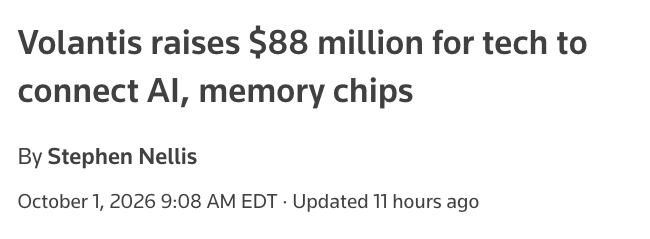
Volantis Semiconductor raised an $88M Series A, bringing total funding to $97M, to attack AI’s memory bottleneck with photonics.
Backers include:
OpenAI's Sam Altman
SemiAnalysis'S Dylan Patel
Jeff Dean
John Doerr
and others
The company is building an optical “fabric” designed to connect AI processors to much larger pools of memory while dramatically increasing bandwidth.
Volantis says its architecture can boost both memory capacity and bandwidth by more than 10x, targeting inference for models larger than 10 trillion parameters at speeds of up to 10,000 tokens per second per user.
The core problem it is trying to solve is the “memory wall.” Volantis argues today’s architectures force a tradeoff: on-chip SRAM offers very high bandwidth but limited capacity, while HBM-based GPUs and TPUs offer far more memory but eventually run into bandwidth constraints as models scale.
Its approach replaces more of the electrical data movement with optics, using custom integrated micro-VCSEL lasers and eliminating traditional optical fiber to push much more data across short distances inside AI systems.
The company says it has already transmitted data more than 10x farther than similarly tiny electrical wires inside a chip package, and its next-generation design has already taped out.
The near-term use case is much faster inference.
Volantis says a coding agent that currently takes around 30 minutes could potentially complete the same task in roughly 30 seconds, while also lowering cost per token through higher throughput and cheaper pooled memory.
If the technology scales as planned, the bigger idea is enabling much larger context windows, entire code repositories in context, and AI systems that are currently limited more by memory movement than raw compute.
9
8
107
32,177


Talk about investing. 🥹

BREAKING: Michael Jordan’s game-worn 1998 NBA Finals Game 3 jersey just sold for $12.26 million, the all-time record. (Sold on @joopiteronline)
Michael Jordan continues to be the king of basketball collectibles, and it’s not close. This is insane.

2
164
Artificial Intelligence bull market is over... dead! 💀
Enter 'Super Intelligence' bull market. 🐂🐂🐂
2
173
I'd love to see new social media platform.
Everything announced today by OpenAI:
Dots
ChatGPT Space
GPT-6.1 Sol
$500 Ultrafast Plan
Private Intelligence
Codex in the cloud
Refreshed Codex CLI
Code Review
Codex Security Cloud
Decisions API
Agents API with Computer use
Bedrock Managed Agents, powered by OpenAI
Plugin extensions
Improved plugin creation, submission and discovery
Sites can now host plugins
MCP events for plugin automations
Pages
Collaborative slides
Create teams and share tasks
ChatGPT in Slack and Microsoft Teams
Meetings plugin
Shareable profiles
Sign in with ChatGPT
Pro 500
OpenAI Marketplace
2
260


If markets shake off the jitters I think we could see this IPO in Q2 2027.
This is the final boss.
OPENAI ARR NEARS $70B AS ENTERPRISE SALES MORE THAN DOUBLE - AXIOS
OpenAI’s annualized revenue run rate is approaching $70 billion, up more than 70% since the start of Q3, according to Axios.
The biggest acceleration is coming from enterprise.
Its B2B revenue has grown more than 100% since July, as OpenAI closes the gap with Anthropic in enterprise AI adoption.
Consumer growth has also remained strong, with OpenAI adding more revenue in Q3 alone than it added during all of 2025.

1
179

