

Web3 Blockchain developer.
- Tweets 12,833
- Following 125
- Followers 314
- Likes 12,330








Pinned Tweet

Nobody Knows How Capable AI Is But You Should Know. That's Why This Article Is For You.

30
28
8,642

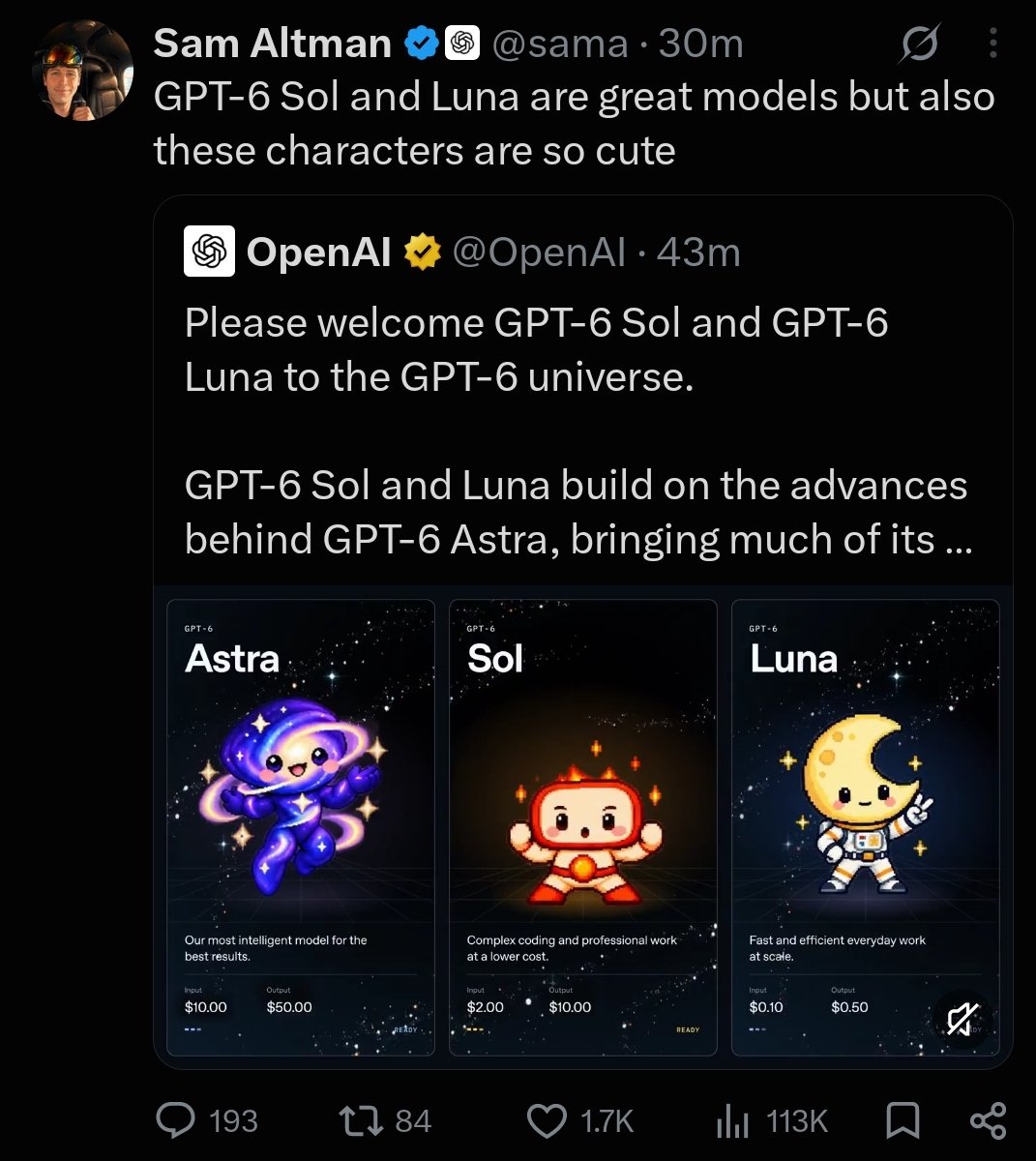
shouln't openai experiment to make a c compiler in rust as great as gcc with astra?
@thsottiaux give it a try please.

3
55
Yessir! OpenAI is actually back. took a while but it's real.
the full comeback for general people though, i think that's GPT-6 Sol. if it hits Opus 5 level intelligence at the same pricing, ngl that's the moment. that's when they stop being back for the tech and power users crowd and actually become back for everyone.
Astra is a whole different thing. i believe that's a Mythos class model, and it does have Fable class public access too. but even that pricing isn't for everyone. it's not built for the general crowd and honestly it doesn't need to be.
Sol is where the real shift happens.

1
1
38
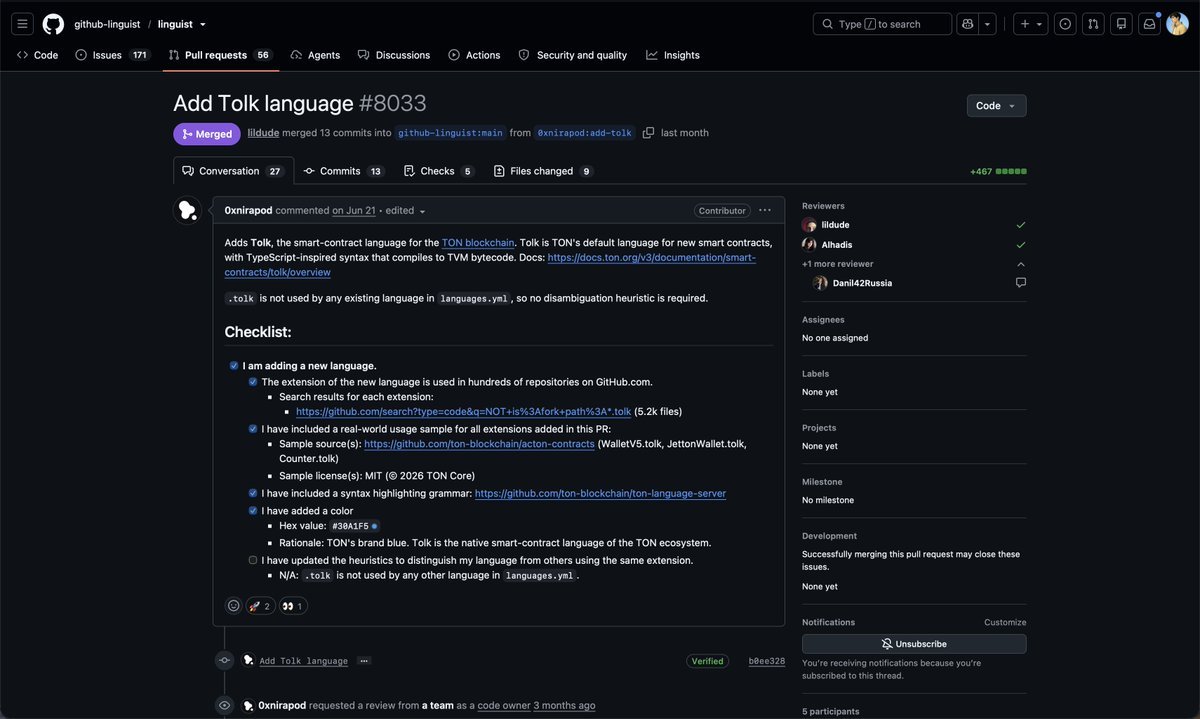
Tolk just got GitHub support and I think this is a big deal for the TON ecosystem.
0xnirapod shipped it, with @petr_makhneff and Danil from TON core helping push it through. Here's what dropped:
1. Tolk shows up in your project's language list
2. Code highlighting works out of the box
3. GitHub search finds .tolk files now
If you've been writing Tolk contracts and screenshotting your code because GitHub didn't render it properly... that era is over.
Tolk is TON's default smart contract language and honestly it deserved this a while ago. Better late than never though.
gm Tolk devs. Your code finally looks the way it should.
43
32
262
Orven Web3 retweeted

❌ 17% decrease
✅ 25% permanent increase (changed from currently 50% increase)
Man their marketing team talking like how opus 5 talks these days

39
48
1,991
50,871

Anthropic just invented a new kind of math.
Claude users are currently getting a 50% increase in weekly limits.
So if the original limit was:
100 → 150
Starting September 14, Anthropic is making a 25% increase over the original limit permanent:
100 → 125
So you are going from:
150 today → 125 on September 14
That's a 16.7% cut to your current weekly limit.

Starting September 14, we're permanently raising standard weekly limits in Claude Code by 25% for Pro, Max, Team, and seat-based Enterprise plans. Until then, the current 50% increase will be in place.
Community note
While standard base limits are increasing by 25%, this change represents a net 17% reduction in weekly limits compared to the active 50% promotional limits users currently experience, as confirmed by the official Claude account: x.com/claudedevs/sta…
115
90
2,501
549,980


The For You Timeline Algorithm is open source!
I will give a deep look into it and describe is it really what we wanted like before.
Soon 🤝

Today X is taking a major step towards unprecedented transparency. By expanding the open-source For You ranking code and launching a new tool that clearly shows visibility-limiting labels, X is giving people a clear view into how posts are ranked and filtered.
This is important for advertisers and brands as it provides further confidence in the environment in which their ads appear, reinforcing our commitment to the highest level of brand safety on the platform.
X is once again setting a new standard for platform transparency – we encourage the rest of the industry to meet it.
47

A cross-chain bridge lost 199,916.3 XRP on Sunday. Every payment that took it out was correctly signed.
I pulled the account. 94 payments, all successful, 19:26:30 to 20:53:50 UTC on 9 August. Every one of the 94 carries exactly 17 signatures. The bridge's signer list on the XRP Ledger reads: quorum 17, 28 keys, each weighted 1.
So the multisig worked. Seventeen relayers looked at a deposit, agreed it was real, and released the money. Ninety-four times in a row.
The relayer code is public. `relayer/processes/xrpl_to_coreum.go`, in the Coreum bridge repo, and the whole thing hangs on one function that decides whether an XRPL transaction is a deposit.
What that function checks, in order: the result is success, the type is Payment, the memo parses, the amount converts, the amount isn't zero.
What it never checks: who the payment was sent to.
Grep the file for `Destination`. Zero hits. The bridge's own address is used once in it, on line 100, where it gets compared against the *sender* to work out whether the bridge sent the transaction. Didn't send it? Then it's incoming. That's the whole test.
Now the part that makes this exploitable rather than merely sloppy. The relayer scans one account's transaction history, the bridge's own. On the XRP Ledger, an issuer's history includes every payment that rippled through it. So if the bridge once issued you a token, and you turn around and send that token from one of your wallets to another, your transaction lands in the bridge's feed next to the real deposits and looks exactly like them under every test the code actually runs.
I counted. In the four hours around the attack, 4,423 transactions hit that feed. 4,312 of them ran between two parties, neither of which was the bridge. That's 97.5%.
That's the feed 28 relayers trusted. And the memo they read to find the recipient is unauthenticated JSON, `{"type":"coreumbridge-xrpl-v1","coreum_recipient":"core1..."}`, which anyone can staple to any payment.
So: hold a bridge-issued token. Send it to yourself. Attach that memo. Seventeen relayers see a successful payment carrying a valid bridge memo for a non-zero amount, and not one of them asks where the money actually went, because the code all of them run was never written to ask.
Two wallets opened trust lines to the bridge's token at 17:57:50 and 17:57:52 that afternoon, two seconds apart. An hour and a half later the XRP started moving. It stopped at 493.543894 XRP, which is still the balance today.
The number I keep coming back to is the 17. It's a real control and it did its job. A 17-of-28 threshold means an attacker needs seventeen keys, and this attacker had none. It's the right defence against a stolen key, against a bribed operator, against eleven relayers going bad at once, and against every other threat where the danger is that somebody signs who shouldn't.
What it cannot defend against is 28 honest relayers running the same code and asking the same wrong question. Nobody was fooled about who signed. They were fooled about what they were signing for, all of them at once, because the check that would have caught it was never written.
Splitting a signature 28 ways doesn't split the reasoning. Every relayer runs the same test on the same input and gets the same answer, so a 17-key quorum is one decision wearing 28 hats. Agreement isn't verification.
Tx, which runs the bridge, halted it, says it has fixed the code, hired forensics people, filed an FBI complaint. Fast, and fair enough. But the public repository hasn't taken a commit since 5 September 2025, and that function is still sitting on `master` today with no destination check in it.
Go read it yourself. Being open is the whole point of it being open.

42

Anthropic's watermarking page has one word in it that the coverage skipped.
"Claude uses two complementary techniques to mark content generated and processed by Claude."
Processed. Not written. Not generated. Processed.
So you write an essay yourself, paste it in, ask Claude to fix the grammar. What comes back carries the mark. Your sentences, your argument, Claude's watermark.
That's not me reading between the lines. It's their own limitations section: "Claude may not be the original author. People often use Claude to proofread, translate, summarize, or convert files." And right under it: "The output can carry a Claude mark even if the underlying ideas, text, or data originated from another source."
Credit where it's due, they wrote that down themselves, in plain words, and nobody had to dig for it.
The mark answers one question. Did Claude touch this text? The question people will actually point it at is a different one. Who wrote this?
Those two stay separate for about a week. Then a university, or an employer, or a magazine editor, starts pasting submissions into a checker.
We already know how that goes. In 2023 Stanford researchers ran seven AI detectors over 91 TOEFL essays written by actual people. Average false positive rate: 61%. Ninety-eight percent of those essays got flagged as AI by at least one detector. The same tools scored near-perfect on US eighth-grade essays, so what they were really detecting was English as a second language.
Those detectors were guessing from style. This one isn't guessing, and that's the part I'd worry about. A watermark is a real signal. It'll feel like proof in a way a style classifier never did, while answering a question nobody asked it.
The direction it fails in is backwards too. Anthropic lists what kills the mark: heavy editing, paraphrasing, translation, mixing into other writing, passages too short to carry a signal. Read that list again. Every item on it is what somebody hiding something does. None of it is what an honest copy-edit does.
So the mark survives on the student who used Claude for grammar and pasted the result in. It dies on the student who ran the whole thing through a paraphraser. It's most detectable on the people who weren't hiding.
One more thing, and this one has a date on it. As of today there's no detector. Anthropic says they're "working to enable users and other third parties" to read the mark, with the mechanism coming in "forthcoming technical documentation." Google announced a public detector portal for SynthID on 20 May 2025. So for now the mark is sitting in the text and the only party who can read it is the one who put it there.
As provenance plumbing, all of this is fine. Probably good. The EU asked for machine-readable marking under Article 50, roughly 190 organisations signed the code of practice, and Anthropic applied it worldwide instead of geofencing it to Europe. That's the honest version of complying.
Watch for the first institution that reads "processed by Claude" as "written by AI." Anthropic's own page already says that inference doesn't hold.
Their word, not mine. Processed.

40
Everyone's resharing the Sony crypto exchange news. It's from 2024.
I went and checked. Sony's subsidiary Quetta Web bought Amber Japan in August 2023, the S.BLOX rebrand got announced mid-2024, and the exchange opened in January 2025 with a Kanto Finance Bureau registration. Number 00016. Every bit of that is true. It's also two years old.
The number I'd actually look at is somewhere else.
Soneium is the Ethereum L2 Sony builds through its Startale joint venture. Since mainnet in January 2025 it's cleared over 500 million transactions, 5.4 million wallets, 250+ live apps. Genuinely big numbers.
It made $324 in fees yesterday.
Not a typo. Three hundred and twenty-four dollars. Eleven and a half thousand across the whole of last month. Total value locked sits at $7.7M, which puts it 83rd out of 461 chains on DefiLlama. Base runs on the same settlement layer and holds $4.6 billion. Six hundred times more.
Sony Innovation Fund wired Startale another $13M on 29 January anyway.
Then the ground moved under all of it. On 15 July Japan's Diet passed the FIEA amendment, so crypto leaves the Payment Services Act and lands under securities law. Insider trading rules. Disclosure on issuers and exchanges. A legal route to spot ETFs. Tax on gains drops from as high as 55% to a flat 20%, and running an unlicensed venue now gets you ten years instead of three. (Rules bite in 2027 and the tax cut in 2028, so nobody should be trading on this next week.)
Think about what a law like that does to prices. Being without a license gets expensive. Holding the asset gets cheap.
Which is excellent news for a regulated exchange with a household brand attached, and worth roughly nothing to a chain clearing $324 a day.
One more thing nobody seems to mention. That PlayStation stablecoin everyone cites as proof of Sony's crypto ambition? It's Sony Bank's. And Sony Bank sits under Sony Financial Group, which Sony spun off in October 2025. They kept under 20% and stopped consolidating it.
So the actual position, as far as I can tell: the chain has the users, the economics are just absent, the payment rails are barely Sony's anymore, and the boring licensed exchange nobody writes about got handed a regulator-made moat in July.
The license was always the asset. Sony just spent two years funding the other thing.

1
42
Orven Web3 retweeted

Purchased Claude 20x max plan with 200$ & faced a 30$ loss instant!
Hey @ClaudeDevs what type of rules is it?
My 20x plan ended at monday,
i purchased again today
And look what i received?
More 4 day waiting for my limit reset???
My previous plan & its limit all ended right?
So why this limit reset stil with me while i am renewing my plan?????
Its 4 day waiting = 30$~ loss according 30 day price!
Please fix it @AnthropicAI @claudeai!!!

142
2
214
27,740
Most points systems are just a number that climbs while you wait on a token that may never ship.
RLPs aren't built like that.
And the fastest way to see it is to look at what they already do.
On @RallyOnChain, RLPs pay protocol gas, so you don't need some separate token just to move. Certain campaigns stay locked unless you're holding them. They get you into select USDC reward campaigns. They count toward whitelist spots when a project wants a filtered crowd.
Real use, right now, not a someday roadmap.
But here's the part I care about more ::
that utility isn't fixed. It grows as Rally grows.
Every new project shows up with a budget and a fresh reason to hold RLPs. Every new creator brings reach --> that reach pulls in more projects --> more campaigns, more USDC pools, more whitelists tied to the same currency you're already stacking.
So the RLPs in your wallet quietly do more next month than they do today, purely because more is happening around them.
That's a network effect, and it's the whole point.
Now the creator angle, which I think people are sleeping on.
You don't get paid for follower count here. AI checks whether your post is actually good and actually yours, and if it clears, RLPs settle on-chain.
No pitching brands in the DMs. No waiting weeks on a payout that might ghost you.
A small account with real engagement can out-earn a big one posting filler.
Fair beats connected, and that swap is rare.
Points that move you deeper into a growing network will always beat points that just prove you showed up.



42
30
178
the bottleneck for AI was never the model. it's power and cooling.
SpaceX just filed to put up to 1M data centers in orbit. unveiled the first one (AI1) the same week as their IPO.
the pitch is almost annoyingly simple:
sun barely sets up there, so near-endless solar, no water cooling, just radiate the heat into space
no power bill. no water bill. no town hall full of angry neighbors.
Musk says it's simpler than a Starlink sat. mostly solar panels, a radiator, lasers. no broadband antenna to fight with.
reality check before anyone front-runs this: it's a design + an FCC filing, not a working orbital DC prototypes ~2027, real fleet late 2020s build + launch cost is going to be brutal but the framing is the part that gets me every other lab is out here fighting over grid hookups and land in ohio these guys just looked up

1
1
73
Orven Web3 retweeted
Most iOS teams burn money on device farms to test one chip,Turns out they never had to...
The problem:
The Secure Enclave holds your private key and never lets it out.
It doesn't exist in the iOS Simulator, So your most security-critical code, signing and key generation, only runs on a real iPhone!
A tool called SimEnclave just removed that wall.
--> github.com/nirapod-labs/sime…
How it works:
• Sends the Simulator's signing calls to the real Secure Enclave in your Mac
• Signs with true hardware P-256
• The key stays locked in the chip and never leaves
• Only the signature comes back
Same contract as a real device. What you test is what ships.
The smartest part, it can't ship:
• A real iPhone refuses to load it
• It only runs in debug builds
• Changes how you build, not what users run
Its fully open source, Apache-2.0, with Swift and React Native examples.
More people should know this exist:))

184
44
384
32,931
Happy Meta anniversary 26!
We did it again (probably?)
Outage is the signal of @Meta's anniversary celebration i guess!


42