

HIGGS-D8HVK
- Tweets 20,447
- Following 19
- Followers 6,067
- Likes 16,300


Pinned Tweet

Paid my tuition thanks to AI baby videos.
Took minutes to create—and they’re going viral.
Just look at the views these shorts are getting.
Want to start earning easy money too?
Like, retweet, and comment
“BABY”(make sure you're following),
and I’ll send you the full guide.

308
124
358
35,141
Usra Chowdhury retweeted

Introducing Sales Agent Eval by @voicearena_ai
We're inviting the community to share feedback on the methodology for a real-world benchmark for sales conversation agents. To our knowledge, this is the first live benchmark that ranks voice agents by revenue from real sales against a human baseline.
Overview
We evaluate voice sales agents in a live experiment with real customers and real money. A company set up under Voice Arena sells an online course in the United States. Leads generated through Meta ads are randomly split between K commercial AI voice agents and three human salespeople. Participants are ranked by the revenue they generate, and the leaderboard is updated live and finalized at the end of each day.
Product
Participants sell a self-paced online course on AI tools for work, including ChatGPT, Excel and productivity tools. We chose this category because it has broad consumer appeal, strong current demand and relatively low production costs.
Online courses can be bought in a single call at an impulse price, are delivered digitally with no logistics, and require genuine objection handling. Course telesales is also an established industry, so the human baseline reflects real practice. The course is sold under identical offer rules for every participant (list price, a fixed discount ladder and a refund policy), which stay constant for the whole season.
Participants
There are two kinds of participants: K AI agents and three human salespeople. The AI agents are the systems under evaluation, and the humans provide the baseline.
The AI participants are commercial vendor stacks. To be included, a vendor must support outbound calling in US English, allow tool calls during the conversation to send payment links, expose per-call cost and recordings, and allow its configuration to be pinned for the season. We configure every agent from one shared sales brief, knowledge base, tool set and set of compliance rules. Only platform-specific settings such as voice, model and latency parameters are tuned, and each agent receives an equal tuning budget of pilot calls on a separate pool of leads. Configurations are then frozen and snapshotted (models, voices, prompt hash and platform version), and any change creates a new entry that starts from zero leads.
The human participants are three salespeople with prior telesales experience. They receive the same materials and offer rules as the AI agents, are paid a salary plus commission, and do not see the leaderboard during the season. Each salesperson is reported individually, and the three are also reported together as a pooled human result.
Assignment
All leads received each day are randomly assigned across the AI agents and the three human salespeople. Each participant receives the same number of new leads per day, capped by human calling capacity at approximately 25 new leads per participant. Because everyone draws from the same daily pool, every participant gets leads of the same quality, and version 1 does not count the advertising cost of acquiring them.
Calling in the United States
Every lead gives prior express written consent on the lead form to be called about the course, including by an AI voice. The Federal Communications Commission confirmed in 2024 that AI-generated voices count as an "artificial voice" under the Telephone Consumer Protection Act, so AI calls require the called party's prior consent. The same consent is collected from every lead, so AI and human participants call from an identical pool.
All participants call only between 8 a.m. and 9 p.m. in the lead's local time, or within a narrower window where state law requires one. Every call opens with the brand name and a recording notice, because several states, including California, Florida and Pennsylvania, require every party to consent to a recording. AI participants also disclose that the caller is an AI. Payment links and follow-ups are sent by SMS from a shared registered number, and an opt-out on any channel stops contact from every participant.
Cost accounting
Version 1 ranks on total revenue, but we also measure what each participant costs to run, so revenue can be read alongside it. For AI participants, the operating cost is everything billed for running the agent: speech recognition, language model, speech synthesis, platform fees, telephony minutes including failed attempts and retries, and SMS. Vendor usage is priced at public list rates snapshotted at the start of the season, and any mid-season price change is noted but not applied. For human participants, the operating cost is each salesperson's salary and commission over the season. Operating cost per lead is total operating cost divided by the number of leads assigned. Advertising and one-time setup and tuning costs are not included.
Ranking and leaderboard
Participants are ranked by total revenue, which compares fairly because everyone gets the same number of leads of the same quality each day. Revenue is the amount paid on each lead's first purchase, excluding sales tax. Refunds and chargebacks are not deducted in version 1, so a sale counts at the moment it is made, regardless of what happens afterwards. Operating cost and revenue after operating cost are shown beside total revenue but don't affect the rank.
A purchase counts if it is made within 7 days of the lead being assigned, so a lead's outcome is final after 7 days. The board is finalized at the end of each day, and stays provisional until every participant has 500 leads past the 7-day mark.
Each season runs for 6 weeks of lead assignment, followed by a 7-day settlement period, after which the official ranking is computed.
Get involved
We want this methodology to be shaped by the people building and buying sales agents. Visit Voice Arena at the link below and fill in the request form to:
- Help shape the methodology
- Read the full detailed version
- Submit your agent for evaluation

20
45
79
45,258
WHEN IS SANTA CLAUSE GRIFFIN COMIN


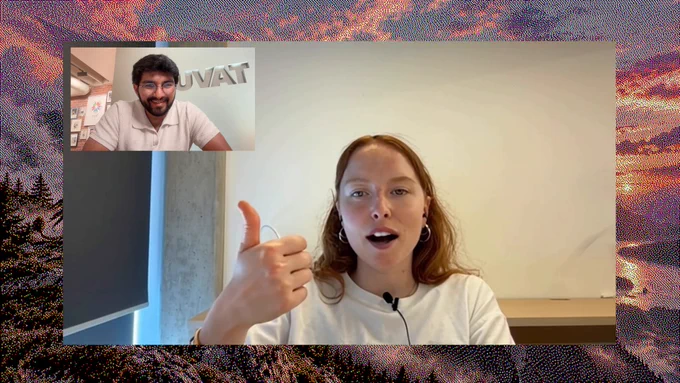
Introducing Griffin, the first model to pass the video Turing test.
48% of people who talked to it live thought it was a real human. Previous systems have had a pass rate <3%. It is #1 on NVIDIA's benchmark for full-duplex AI video.
It’s the first Human Interaction Model (HIM).
Community note
The 48% figure and "video Turing test" claim are from Tavus's own study of 54 one-minute calls, not independently verified or using a standard protocol. Griffin-Lite leads NVIDIA's VideoFDB benchmark on their public leaderboard.
cellcog.ai/blog/tavus-gri…
research.nvidia.com/labs/amri/proj…
tech-ish.com/2026/10/02/tav…
3
3
14
7,349
Usra Chowdhury retweeted

Which one is the AI? The CEO looks like he is the Griffin model too. Wtf.
Introducing Griffin, the first model to pass the video Turing test.
48% of people who talked to it live thought it was a real human. Previous systems have had a pass rate <3%. It is #1 on NVIDIA's benchmark for full-duplex AI video.
It’s the first Human Interaction Model (HIM).
Community note
The 48% figure and "video Turing test" claim are from Tavus's own study of 54 one-minute calls, not independently verified or using a standard protocol. Griffin-Lite leads NVIDIA's VideoFDB benchmark on their public leaderboard.
cellcog.ai/blog/tavus-gri…
research.nvidia.com/labs/amri/proj…
tech-ish.com/2026/10/02/tav…
102
110
172
25,145

We're releasing HeyGen Video, built for businesses that need production-quality video without production-level costs.
Pricing starts at $0.01/s through October (50% off)
Built on @Minimax_AI H3, post-trained by HeyGen.
Learn more: developers.heygen.com/heygen…

673
513
2,453
1,427,072
Usra Chowdhury retweeted

We built an AI that saves your ass.
Meet Lucas. It’s been meaning to text you.
It lives in your texts, learns your life, and prompts itself.
It books, pays, orders and checks you in. Usually before you’ve thought of it.
Overnight, it goes exploring for things your life could use.
Text Lucas today on iMessage and WhatsApp
meetlucas.ai

234
317
1,017
1,353,626
Usra Chowdhury retweeted

You’ve spent years teaching people how your company works. Your AI needs that knowledge too.
Introducing Connect AI Gateway.
It routes, governs, and learns from AI requests, building a system of record for how your company thinks.
Early access is live: cdata.com/ai

153
399
975
1,302,352
Voice AI has a long-tail speech-data problem.
Voice Arena just released 100K+ hours aimed at it.
Monsoon is worth a close look.

Introducing Monsoon ASR ⚡️ @voicearena_ai
Speech recognition does not have a model problem anymore. It has a data problem.
The best ASR systems are approaching human-level performance in English. But move into the long tail of the world's languages, especially real, conversational speech and error rates can still be 5-10X higher.
Today, we're releasing Monsoon ASR: a new generation of training data built specifically to close that gap.
50 languages. 100,000+ hours. Dense spontaneous speech.
And one goal: Single-digit WER across the world's languages.🧵

10
14
6,246
Usra Chowdhury retweeted

I went looking for an AI voice tool that holds up on long audio. Ended up with a clone of my own voice reading a full tutorial script.
Slight problem: it sounds more real than I do!
Most tools I tried sounded great for the first few seconds, then the tone drifted the longer they talked.
Cartesia held up. It needed 10 seconds of my voice for the clone, and it can take up to 60 to keep my accent closer.
Recorded the whole process so you can try it too.

28
183
516
239,003
Usra Chowdhury retweeted

SpeechifyAI's Simba 3.2 is now the fastest model on the @voicearena_ai US English 🇺🇸 latency board: 123.0 ms to first audio at the median, climbing from #9 at 392.5 ms in its earlier series.
SpeechifyAI shipped serving-side updates, our latest measurement series picked them up, and the ranking moved. That is exactly what measuring in public is for.
At 123.0 ms it sits 45.5 ms ahead of Inworld TTS 2 at 168.5, more than three times faster than its own earlier number, and with a quality rank range of 6 to 8 on the same 20-model board it joins the quality-versus-speed frontier.
Rank the board by TTFA yourself → voicearena.com/tts-leaderboa…
Congratulations to @SpeechifyAI 👏
10
40
74
77,244
Usra Chowdhury retweeted

Introducing TASTE BENCH, Omneky's eval suite for the creative quality of AI-generated ads across image and video models.
Creative is the most important lever for growth. A blind panel of AI judges scores every ad on eight quality dimensions, including brand fit and typography, and checks it for 11 failures such as gibberish text, invented claims, and logo errors. We also track cost, latency, refusals, and judge agreement.
See every result at omneky.com/tastebench.

Today we're launching TASTE BENCH, Omneky's eval suite for the creative quality of AI-generated ads. For image ads, the top model, GPT Image 2.5 Sunburst, averaged 7.38 out of 10 on quality, yet only 54.2% of its ads were ready to run as-is. Across eight models, ready-to-run rates ranged from 22.0% to 54.2%. Every model got the same 59 briefs across four brands and five languages, and a blind panel of AI judges from OpenAI, Anthropic, and Google checked each ad for exact copy, faithful logos and products, safe zones, and fabricated claims. These are first-attempt numbers with our own review step turned off.
We built TASTE BENCH because once you can measure taste, you can hill climb it. It covers image and video models, and you can explore every image ad, brief, judge explanation, and score at omneky.com/tastebench.

8
111
131
294,587
The ability to iterate through conversation is what makes this especially interesting.
You can keep shaping the video without constantly jumping back into a complicated editing interface.

I think we're about to stop editing videos.
Not because AI edits faster.
Because it's starting to understand what you're trying to say.
I think we're about to stop editing videos.
Not because AI edits faster.
Because it's starting to understand what you're trying to say.
I found a tool called Pexo.
I found a tool called Pexo.
I used it to create a 45-second collage animation of two pugs climbing Mount Fuji. Think of it as a playful concept for a pet travel brand.
Instead of opening a timeline and dragging clips around, you give it a URL, document, or source material and tell it what you want.
Then you talk to it.
It builds the video.
Instead of opening a timeline and dragging clips around, you give it a URL, document, or source material and tell it what you want.
Then you talk to it.
It builds the video.
If you want changes, you don't re-edit the timeline.
You just ask.
That's the interesting part.
If you want changes, you don't re-edit the timeline.
You just ask.
That's the interesting part.
• Turn URLs into videos
• Use docs or source material as input
• Refine videos through conversation
• No editing experience required
• Built for product launches, explainers, and brand content
• Keep iterating until it's ready to publish
• Turn URLs into videos
• Use docs or source material as input
• Refine videos through conversation
• No editing experience required
• Built for product launches, explainers, and brand content
• Keep iterating until it's ready to publish
We're moving from editing videos to directing AI.
That feels like a much bigger shift than most people realize.
We're moving from editing videos to directing AI.
That feels like a much bigger shift than most people realize.
Get free credit by using this code: B4QFWK
Try @Pexoai_offical here: invite.pexo.ai/4iz5OzA

10
6
20
2,047
Usra Chowdhury retweeted

I think we're about to stop editing videos.
Not because AI edits faster.
Because it's starting to understand what you're trying to say.
I think we're about to stop editing videos.
Not because AI edits faster.
Because it's starting to understand what you're trying to say.
I found a tool called Pexo.
I found a tool called Pexo.
I used it to create a 45-second collage animation of two pugs climbing Mount Fuji. Think of it as a playful concept for a pet travel brand.
Instead of opening a timeline and dragging clips around, you give it a URL, document, or source material and tell it what you want.
Then you talk to it.
It builds the video.
Instead of opening a timeline and dragging clips around, you give it a URL, document, or source material and tell it what you want.
Then you talk to it.
It builds the video.
If you want changes, you don't re-edit the timeline.
You just ask.
That's the interesting part.
If you want changes, you don't re-edit the timeline.
You just ask.
That's the interesting part.
• Turn URLs into videos
• Use docs or source material as input
• Refine videos through conversation
• No editing experience required
• Built for product launches, explainers, and brand content
• Keep iterating until it's ready to publish
• Turn URLs into videos
• Use docs or source material as input
• Refine videos through conversation
• No editing experience required
• Built for product launches, explainers, and brand content
• Keep iterating until it's ready to publish
We're moving from editing videos to directing AI.
That feels like a much bigger shift than most people realize.
We're moving from editing videos to directing AI.
That feels like a much bigger shift than most people realize.
Get free credit by using this code: B4QFWK
Try @Pexoai_offical here: invite.pexo.ai/4iz5OzA
Paid partnership (ad)
47
54
132
173,515

Creating marketing videos is a solved problem.
Honestly, I can't imagine another creative area where we save so much time and money.
Generating something like this used to cost thousands of dollars and take weeks.
Now, it's cents and minutes.
Best part of this: their mark-to-fix feature, where you can mark anywhere in the video and change it with a prompt.

Paid partnership (ad)
189
246
834
1,845,719
Usra Chowdhury retweeted

Today, we're launching Typeless for Linux.
Typeless is now available on Mac, Windows, iOS, Android — and Linux.
The Linux app brings the full Typeless desktop experience, with all the core features available on Mac.
But this launch is about more than adding another platform.
For us, every new platform is another step toward a bigger goal: making voice the default way for people to interact with computers — wherever they think, create, and work.
For decades, the keyboard has been the default interface between our thoughts and computers.
And we've gotten so used to it that we rarely question the friction.
Thoughts come fast, messy, and nonlinear.
Before you communicate them, you normally have to turn them into sentences in your head first.
Then you slow everything down again to type.
We built Typeless to remove both layers of friction.
With Typeless, you can just think out loud.
Follow your thoughts wherever they go. Change your mind halfway through. Add context later. Repeat yourself. Speak imperfectly.
Typeless turns that messy stream of thought into clear, polished writing in real time.
It removes filler words and repetition, structures your ideas, adapts to your writing style, understands your personal vocabulary, and gives you writing that fits the app you're working in.
You can:
• Dictate — turn messy thoughts into clear writing, 4x faster than typing
• Translate — speak in your language and write naturally in another
• Ask anything — use your voice to write from scratch, or select text to edit it, ask questions, and take actions
• Build your dictionary — names, acronyms, and specialized terms get recognized correctly
• Personalize your style — Typeless learns how you write and adapts to where you're writing
• Speak 100+ languages — including naturally mixing languages while you talk
And it's private by design.
Linux users tend to be some of the people who spend the most time interacting deeply with computers.
Developers. Engineers. Researchers. Builders.
They should be able to use voice as naturally on Linux as anywhere else.
Our long-term belief is simple:
Voice will become the default way people interact with computers.
Not because speaking is merely faster than typing.
But because voice gives us a way to communicate with computers much closer to the speed and form in which thoughts actually happen.
To us, that's what real freedom in computing looks like: expressing what you mean without adapting how you think.
And for that future to happen, it can't belong to one device, one operating system, or one workflow.
It has to be available wherever you work.
Linux. Mac. Windows. iOS. Android.
One interface, wherever you work.
Typeless for Linux is here.

142
500
1,081
1,787,603
One URL, one product, and a whole new way to present the experience around it. Pexo makes the transformation look effortless.
#MadeWithPexo

Hey @narrativ3xyz, here's your product, explained in motion.
All Pexo needed was your URL. It turned how your system works into an interface, in your brand style.
Narrative. Founder brand. Content. Distribution. One growth engine, running in motion.
How close did Pexo get to your brand?
#MadeWithPexo

9
12
12
1,727
Usra Chowdhury retweeted
One URL, one product, and a whole new way to present the experience around it. Pexo makes the transformation look effortless.
#MadeWithPexo
Hey @narrativ3xyz, here's your product, explained in motion.
All Pexo needed was your URL. It turned how your system works into an interface, in your brand style.
Narrative. Founder brand. Content. Distribution. One growth engine, running in motion.
How close did Pexo get to your brand?
#MadeWithPexo
9
12
12
1,727
Usra Chowdhury retweeted

Pexo takes what already exists on your website and gives it a completely different way to be experienced.
#MadeWithPexo
Hey @narrativ3xyz, here's your product, explained in motion.
All Pexo needed was your URL. It turned how your system works into an interface, in your brand style.
Narrative. Founder brand. Content. Distribution. One growth engine, running in motion.
How close did Pexo get to your brand?
#MadeWithPexo
9
11
12
2,696
Usra Chowdhury retweeted

I like how this keeps the original brand feeling while turning the product into something much more engaging to explore.
#MadeWithPexo
Hey @narrativ3xyz, here's your product, explained in motion.
All Pexo needed was your URL. It turned how your system works into an interface, in your brand style.
Narrative. Founder brand. Content. Distribution. One growth engine, running in motion.
How close did Pexo get to your brand?
#MadeWithPexo
10
12
12
4,694
Usra Chowdhury retweeted

Ran it all month for $1.5 and still haven't hit a wall.
A full month of Dreamina Basic for $1.5, not a trial.
Sep 23–Oct 9, up to 90% off.
#Dreamina #DreaminaPartner

11
7
36
11,162