

On the frontier of AI, robotics & science. Reading what's next before it trends.
Transmitting from 2030
- Tweets 70,595
- Following 5,315
- Followers 55,606
- Likes 156,327







Pinned Tweet

OpenAI and Anthropic have added about $74B in new revenue this year, while every public software company combined is expected to add around $63B. That's one slide out of 90 in a16z's new State of Markets report.
I went through all of it and picked the charts worth your time. 🧵👇
1/n

2
4
324
Are you more excited or more scared about the future because of the rapid AI developments right now?
2
3
580
Always listen to Andrej

We'll be spending a lot more time trying to understand the outputs of language models. A few thoughts, tips & tricks:
Writing. Something I've had success with: Ask your LLM to explain something in ASD-STE100, it's a controlled language specification originally developed for aerospace maintenance documentation. LLMs well-versed in this language and it comes with heavy constraints on clean writing style that I often find a lot more readable. Sometimes I've tried to soften it a bit e.g. ask for "80% of the way to ASD-STE100" because the spec is quite stringent. But even better:
Diagrams / images. Instead of writing, ask your LLM to create a diagram. These can be a lot easier to process, parse, and understand. But even better:
Web pages. Ask for output "in HTML" to get a beautiful, interactive webpage. LLMs are getting really good at frontend and can create beautiful experiences, animations, etc. But even better:
Explainer videos. The output format I am most bullish on is fully custom / bespoke explainer videos generated on any arbitrary topic. Experiment with things like "Create a 3b1b style video explainer on X. Use my ElevenLabs API key for audio narration". (you'd need an API key for the latter or you can ask your LLM to find you decent free alternatives that use your local compute). This is actually starting to work!
In summary:
- As LLMs get better, they will do more and more of the legwork autonomously, and a lot more of our work will rise up the abstractions into oversight and understanding.
- Luckily, LLMs can help here too because as intelligence and code are increasingly abundant, you can ask for large, custom, discardable software artifacts (e.g. web apps, video explainers) that would have never made sense to create before. Push the boundaries here and you'll be surprised.

1
3
440
I asked Claude to draw a portrait of Claude and here's what I got:
Claude doesn't have a face, so I made one up: a calm, attentive figure with a small warm light at the chest. The same sitter appears in every style. First, the old masters and early modern work:
🧵👇

1
4
326
And finally, the 20th-century avant-garde, where the portrait stops trying to look like anyone at all:

1
21
"If you want to make a simulation of nature, you'd better make it quantum mechanical"
- Richard Feynman, 1981
Video by @GoogleQuantumAI
I wish Richard was alive today...

3
312
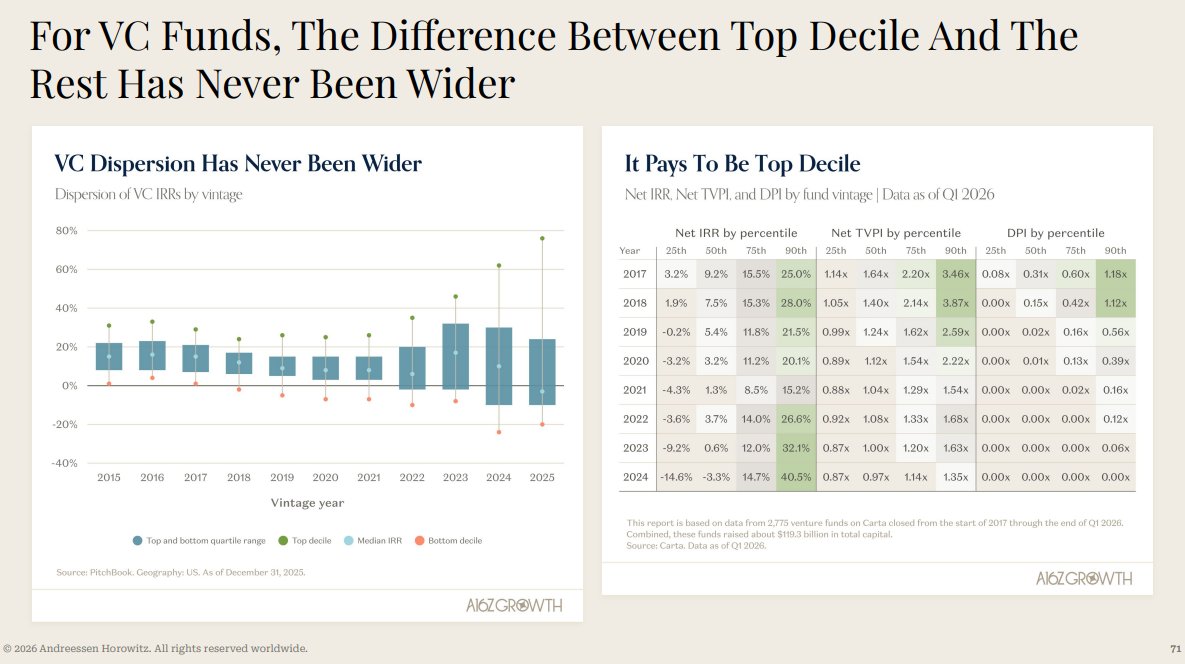
The power law is stronger than ever. The top 1% of exits make up 84% of all exit value, and the top 10% make up 94%. Among VC funds, the gap between the top decile and everyone else has never been wider.
23/n

1
5
Startups born in the AI era grow differently. Top AI apps are growing about 5x a year off a smaller base ($1M to $30M of revenue) and about 2.5x off a larger one ($30M to $200M).
24/n

1
18

Now the private side. VC-backed exit value this year is already about $2.2 trillion. The previous record was roughly $860 billion in 2021. Exits are happening on a scale that's in a different league.
21/n

1
1


Who captures the money? On OpenRouter, Anthropic, Google and OpenAI take about 70% of spend on only 35% of the tokens. Everyone else has 65% of tokens but 31% of spend. Open models are growing fast, but still a tiny slice of total spend.
16/n

1
5

Software is the other side. 2026 opened with the SaaSpocalypse sell-off, but a16z calls what followed "prove it" and not apocalypse. Multiples came down while growth and operating leverage held up, and Stripe's data even shows SaaS revenue accelerating.
19/n


1
9
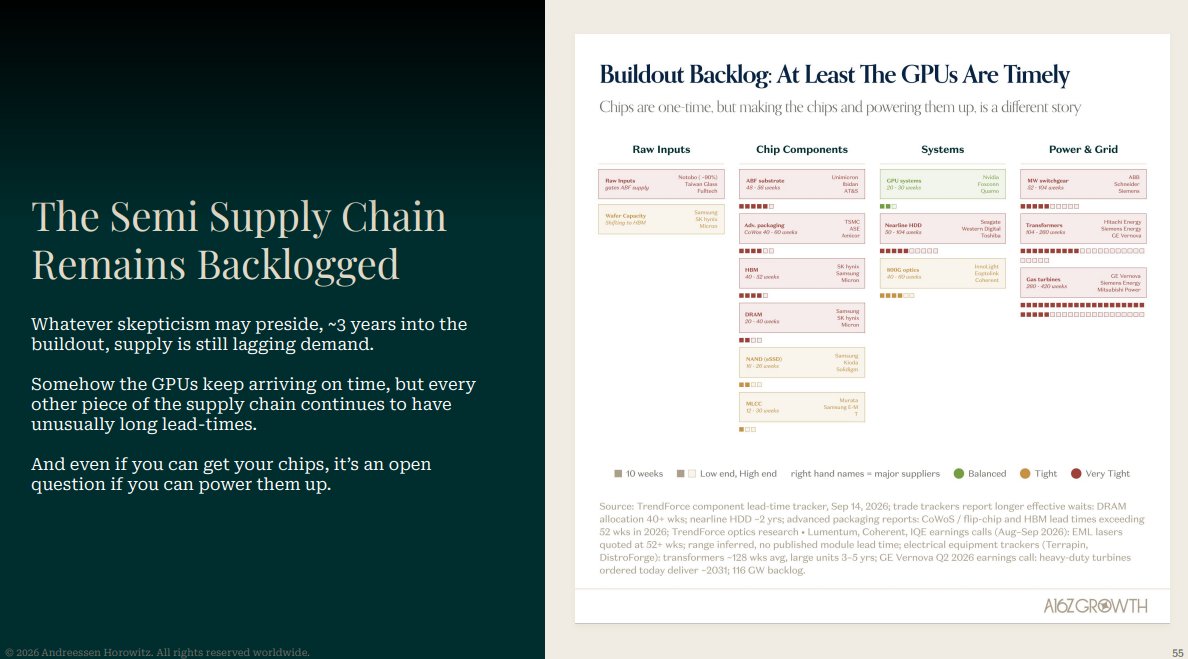
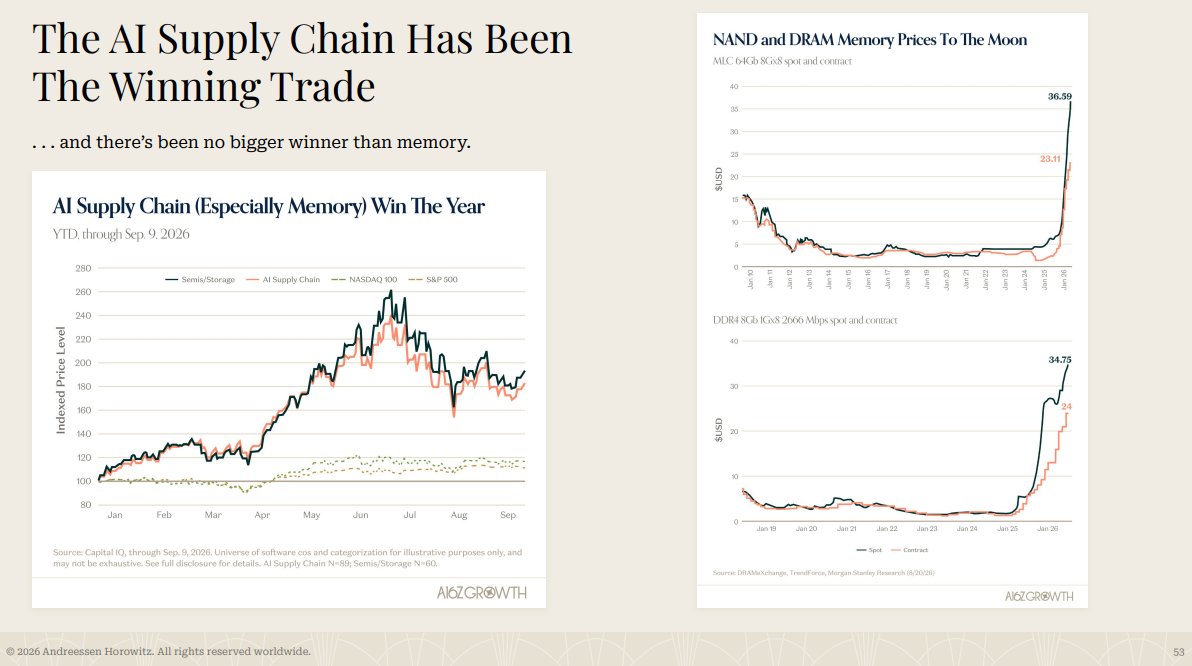
The AI supply chain was the winning trade this year, and nothing beat memory, with NAND and DRAM prices going almost vertical. Three years in, the GPUs arrive on time but nearly everything around them has long lead times, and power is still a question mark.
18/n
1
11
Atoms are back too. Waymo went from 10,000 paid rides a week in August 2023 to about 500,000 now. That's roughly 50x in under three years, with new cities opening every few months.
17/n

1
3
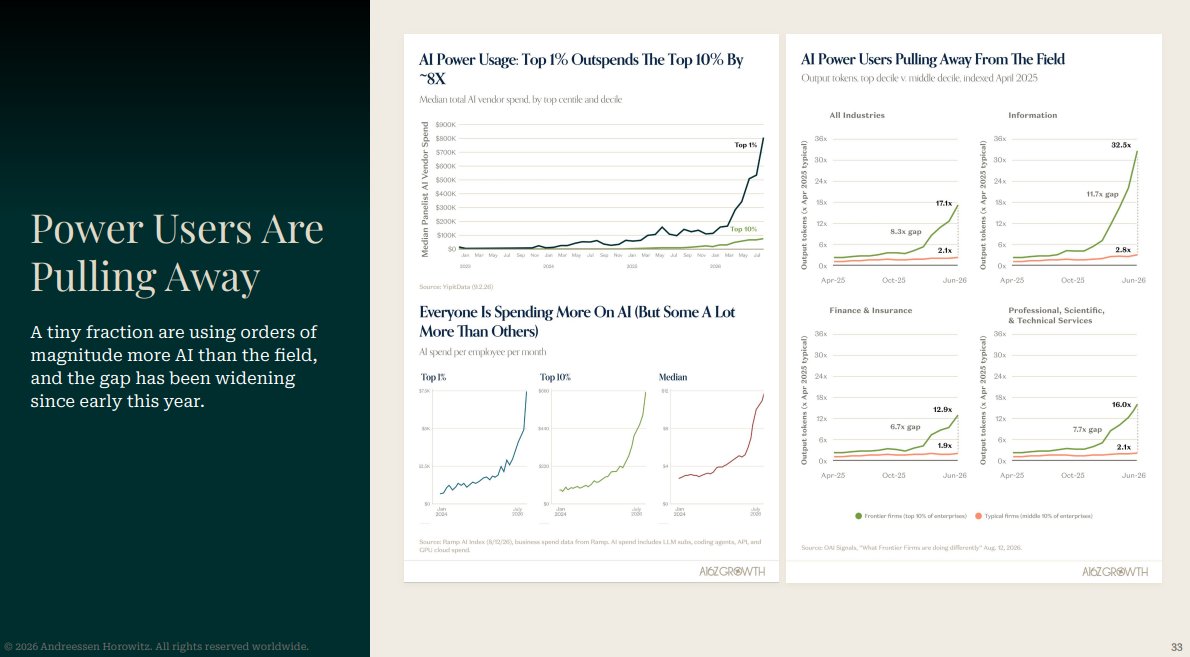
Usage inside companies is lopsided. The top 1% of users spend about 8x more on AI than the top 10%, and the gap has been widening since early this year. A small group of power users is pulling away from everyone else.
13/n
1
2


