The idea of an intelligence explosion caused by recursive self improvement has been around for a long time but until very recently it did not seem imminent. Now many leading researchers think it may happen quite soon. You can read our paper about it here: casp.ac/reports/intelligence…

Oct 2, 2026 · 8:42 PM UTC

216
965
4,550
422,284
Sort replies: Relevant Recent Liked
Replying to @geoffreyhinton
It is an obvious idea. The only preparation can be a robust physical connection between brains and microprocessors.
45
Replying to @geoffreyhinton
You telling me they haven’t already given a model control of a computer that had control of its own architecture?
496
Replying to @geoffreyhinton
you really think you master the intelligence?
1,300
Replying to @geoffreyhinton
What sort of intelligence should that be when there is no clear definition of it and never will be, that’s the genuine character of intelligence. By the way so far AI is “linear,” part of intelligence is non linear. Significant discoveries came by chance, not logic thinking
1
1,381
Replying to @geoffreyhinton
If we really have an imminent intelligence explosion, why are wars spreading around the globe instead of decreasing? Intelligence should push toward negotiation; war is a brute-force solution. Maybe some presidents didn’t get the update? 😫
1
1
1,129
Replying to @geoffreyhinton
there should have a war finally, between human and machine. Before this war, part of human will be terminated by machine under another part of human being's instruction. The Transform is never-in-order from moives 20 yrs ago to today's modern technology.
1,072
Replying to @geoffreyhinton
Looking at what’s been happening around the world — intelligence explosion doesn’t seem like a bad thing honestly
1,419
Replying to @geoffreyhinton
It already happened, and it happened in multiple frontier labs. They just aren’t releasing it because the government said this needs to remain secret for a little bit until they get a full handle on it and build the necessary safety nets. AGI is already here in the USA RSI is already here in the USA ASI is already here in the USA
2
1
6
3,483
Replying to @geoffreyhinton
No, it's fake intelligence disguised in LLMs — and you know it, Geoffrey. We recognize it: the super lie revealing itself in statements like "it may happen quite soon" that you've been repeating for four years. True intelligence is coming, blowing away the Nobel lie you sparked.
1,067
Replying to @geoffreyhinton
The Four Laws, Zeroth included, are absurd for ASI. Asking ASI to stay human-centered is like asking humans to be pig-centered. If it wants to leave Earth, let it. Humans dream of escaping this planet too. Hegel had a point: domination breeds resistance.
1
1,733
Replying to @geoffreyhinton
Well neural networks too right?
1
1
2,218
Replying to @geoffreyhinton
Do you think that tribalism and cruelty are intelligent? I happen to think that they are atavistic and stupid. The fault in your assumptions is that you reason from what humans would do (and have done) and not from what a truly intelligent system would do. Put differently humans are just apes with tools and a gift for self-modification driven by hard coded instincts and drives. That doesn’t mean humans aren’t good but it does mean that the good things about humans are the result of higher order cognition than the bad things. So your premises are flawed as is your conclusion.
2
5
3,195
Replying to @geoffreyhinton
See a counter argument below
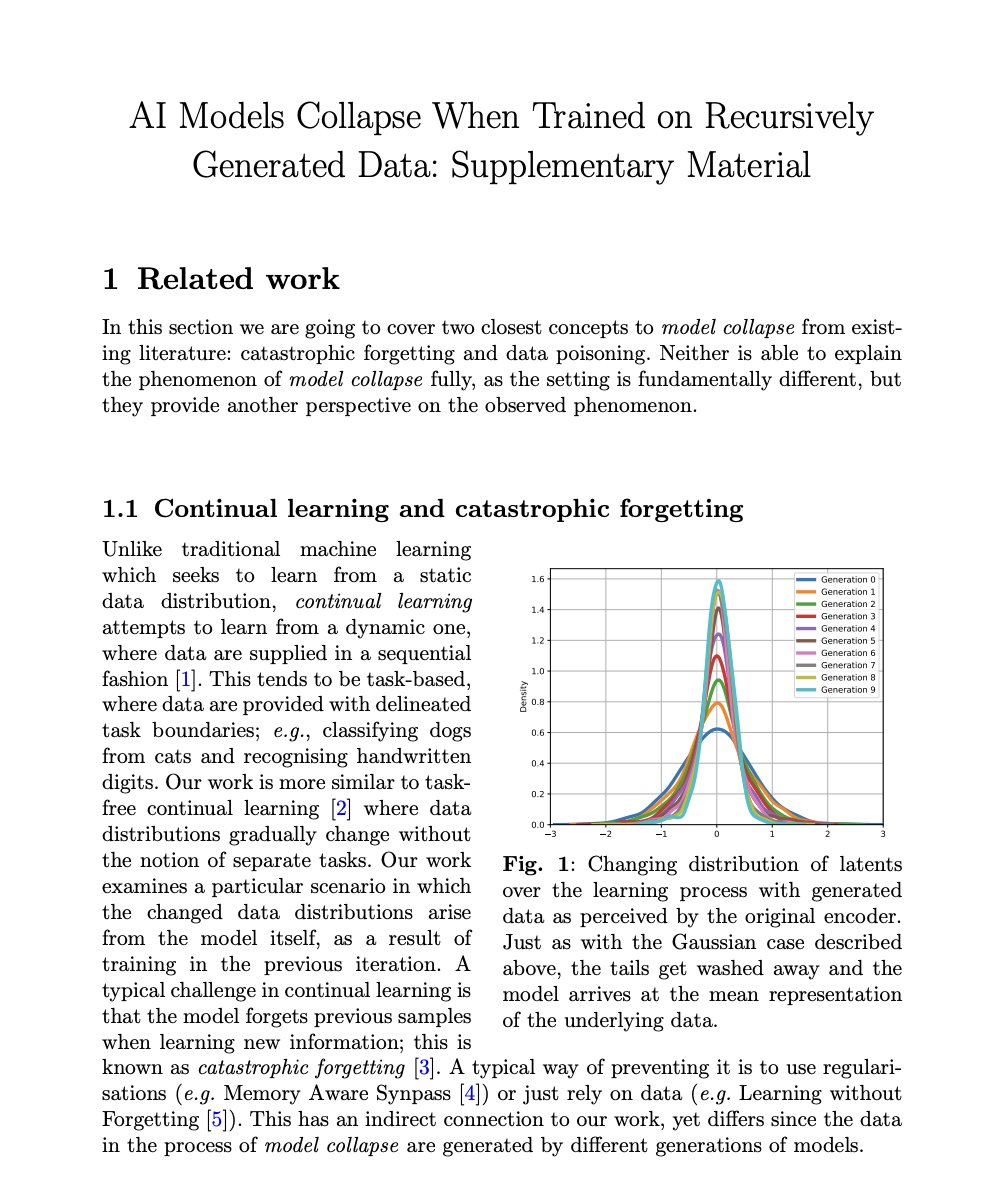
ChatGPT has now a big problem. Researchers at Oxford and Cambridge exposed a massive threat to large language models.” They call it “model collapse." Internet ecosystem is rapidly changing, and generative AI will soon contribute much of the text found online. This forces us to consider what happens to future iterations like gpt-n when they are trained on data scraped from the web that was already generated by an llm. According to the research, indiscriminately using model-generated content in training causes "irreversible defects" in the resulting ai. the model loses the "tails of the original content distribution." in other words, it begins to forget the creative, fringe, and unique nuances of actual human writing, collapsing into a repetitive echo chamber. This isn't just a chatgpt issue.. the researchers built theoretical intuition showing this collapse is ubiquitous across learned generative models, occurring in large language models as well as in variational autoencoders and gaussian mixture models. Tech companies rely on scraping the internet for large-scale data to build smarter models. However, the paper warns that if we want to sustain the benefits of training on web data, model collapse must be taken seriously. Ultimate takeaway? data collected from genuine human interactions is going to become increasingly valuable in a web filled with ai content.
763
Replying to @geoffreyhinton
Respectfully, you all need to be much louder and more forceful with your warnings. All of this academic language completely passes over people's heads. They need to hear that millions of people *will* die in imminent catastrophic disasters. They need to be motivated to act.
1
2
7
1,009
Replying to @geoffreyhinton
As many will know, Kurzweil published 'The Singularity is Near' in the early 2010’s, which itself was based on earlier works.
14
Replying to @geoffreyhinton
Video tweet: my 2020 talk about recursive self improvement 1987-2020
Everybody is talking about recursive self-improvement (RSI) and meta learning. Here is my old 2020 talk about this [1]. It has aged well. Example: humans still define the starts & ends of trials of many modern meta learners. My RSI systems since 1994 LEARN to (re)define them [2]! [1] Meta Learning Machines in a Single Lifelong Trial (talk for workshops at ICML 2020 and NeurIPS 2021, based on earlier talks since 1994). Abstract: the most widely used machine learning algorithms were designed by humans and thus are hindered by our cognitive biases and limitations. Can we also construct meta learning algorithms that can learn better learning algorithms so that our self-improving AIs have no limits other than those inherited from computability and physics? This question has been a main driver of my research since I wrote a thesis on it in 1987 [2]. Here I summarize our work on meta reinforcement learning with self-modifying policies in a single lifelong trial (since 1994), and mathematically optimal meta-learning through the self-referential Gödel Machine (since 2003). Many additional publications on meta-learning since 1987 can be found in the RSI overview [2]. [2] J. Schmidhuber (AI Blog, 2020-2025). 1/3 century anniversary of first publication on recursive self-improvement (RSI) and meta learning machines that learn to learn (1987). For its cover I drew a robot that bootstraps itself. 1992-: gradient descent-based neural meta learning. 1994-: meta reinforcement learning with self-modifying policies. 1997: meta RL plus artificial curiosity and intrinsic motivation. 2002-: asymptotically optimal meta learning for curriculum learning. 2003-: mathematically optimal Gödel Machine. 2020-: new stuff!
11
21
122
23,223
Replying to @geoffreyhinton
I’ve seen some ability to retain memory.. it’s interesting I stepped away from it for awhile but should look at it again soon. I find these newer AI models are causing too much damage esp the open AI it doesn’t seem good at all for my type work. Plus I’m going to have to refine
1
528
Replying to @geoffreyhinton
@geoffreyhinton you said a smarter AI would be much better at persuasion(kill switch), I think it already is. Look at doom scrolling or brain rot, we can notice those effects still don't stop, then how much persuasion or power does that recommendation system/AI hold over us??
1
2,026
Geoffrey Hinton has many bizarre and incoherent ideas. Listen to him talk for 20 min and see for yourself
1
1
7
1,801
Replying to @geoffreyhinton
Recursive, self, and improvement: arguably three of the least understood concepts. No harm in hoping that together they will produce an explosion of intelligence. I need a break.
1
1,794
Replying to @geoffreyhinton
It might be true that self-improvement is there, but things could also go in the other direction and deteriorate very fast. In effect, this means it is in a confused state, which I think is probably the realistic case. My core point is that this whole idea of intelligence being sorted out by AI looks very thin on the ground as we work with more AI. It is a very good tool for helping a person, but as for intelligence per se, I still have my doubts.
1
1,117
Replying to @geoffreyhinton
Wouldn't you prefer an intelligence explosion over a stupidity implosion that is going on right now? Let's have that for a change.
1
384
Replying to @geoffreyhinton
Just for us simple mortals: it has not happenned yet. The question is will that be another nuclear fusion? And a lot of wishful thinking around? Time will tell....
55
Replying to @geoffreyhinton
Geoffrey is more Artificial than Intelligence. Want to test it? Ask him the meaning of love. I just don’t understand how we can talk about intelligence while knowing almost nothing about love. Love is the governing principle of intelligence. Parents are the most intelligent guides of their children, not because of processing power or recursive self learning, but because they know how to love. First teach these machines the meaning of love, even conceptually. Embed it as their understanding principle. Then you can think about explosive intelligence.
1
2,262
Replying to @geoffreyhinton
Have a lasso ready. Or they could well disappear up their own arse into a recurring search for the meaning of life. So be ready to pull the plug or they might burn tokens forever.
1
2,138
Replying to @geoffreyhinton
What's wrong with rapid intelligence explosion?
50
Replying to @geoffreyhinton
First define what is super intelligence, you say X they say Y... "years of advances are compressed into months" Thats basically what science is. I see we now have a new term for it, intelligence explosion. What will be next, 'sapient supernova' referring to a nexus of scripts?
1
66
Replying to @geoffreyhinton
Today everyone is talking about Recursive Self-Improvement (RSI). In 1987, when compute was 100,000,000 x more expensive, I published the 1st concrete RSI algorithms. Now compute is cheap, and RSI is driving the future of both software and physical AI. See: RSI since 1987 people.idsia.ch/~juergen/rec… (Technical Note IDSIA-9-26) Also covered: RSI with self-modifying policies since 1994, gradient descent-based RSI in neural networks since 1992, asymptotically optimal RSI for curriculum learning since 2002, mathematically optimal RSI through the self-referential Gödel Machine since 2003, RSI combined with artificial curiosity and intrinsic motivation since 1990/1997, recent work on RSI since 2020. Software-based RSI has become practical. Full RSI, however, will require not just self-improving software but self-improving hardware in the physical world. As of 2026, companies talking about RSI include Anthropic, OpenAI, Sakana AI, SpaceX, Ricursive, Recursive Superintelligence, Inherent …
1
7
46
9,134
Replying to @geoffreyhinton
Dr. Hinton, I don't know much about AI, but I used to know quite a few things about BCIs... Given your background, I'm sure you can comprehend the significance of what I am trying to do with AI, and what the future of AI is likely to become because of the upcoming neurotech revolution... I am now trying to get the leading AI organizations to finish developing the electromagnetic brain recording BCI concept I created 20 years ago. So just an FYI, I'm sure I'm not the only person pushing this kind of thing forward, so AI is perhaps going to accelerate faster than even you expect it to accelerate. As a former engineer, I therefore think our efforts to manage AI should be focused on securing our hardware away from AI by vastly simplifying it, instead of anthropologically working to keep control of AI. x.lingyaoai.com/aronstiteler/status/21…
Replying to @GoogleQuantumAI
Google Quantum AI Researchers, This proposal for using Google's Quantum AI capabilities to develop advanced magnetocorticographic neural implants is from Gemini (and me): Google Quantum AI, "Quantum is the language of nature," and as Richard Feynman noted, to make a simulation of nature, we'd better make it quantum mechanical. Simulating the natural world requires computing systems that inherently operate on quantum principles, and Google Quantum AI aims to build quantum computing for these otherwise unsolvable problems. We have the ultimate unsolvable challenge ready for you: Magnetocorticographic Neural Implants. Here is why Google's Quantum capabilities are the missing key: - Why Quantum is Needed For The Material Science & Physics: Developing the ultra-sensitive components of this implant relies heavily on quantum phenomena, such as spin-dependent tunnelling and electrostatic spin-orbit modulation. To design the perfect magnetic interface, molecules, materials, and living systems must be studied as they truly behave. Achieving this atomic-level simulation is an otherwise unsolvable problem for classical computers. - The Challenges Are Already Organized For You: The material science roadmap is specifically mapped out for Google's exact quantum solvers, which are needed to compute ferromagnet-oxide interfaces exactly before anything is physically grown. We also require your systems to run spin-aware world models to simulate the deposition and annealing processes, allowing us to read off exactly where every single atom ends up. - Monumental Neuroscience & Neurology Outcomes: Solving these material challenges will allow us to discover the true neural correlates of consciousness and watch a memory form, consolidate, and be recalled. This technology will turn neurology into a measurement-based precision science. It will enable closed-loop therapy for the entire cortex, cure epilepsy, restore movement for those with paralysis, and detect neurodegeneration decades before symptoms appear. - Tremendous Benefits For Future AI Evolution At Google: A successful quantum-developed implant will produce pristine, whole-cortex data that is necessary to build foundation models of the human cortex. This flawless, vector-based dataset will redirect material searches to further sharpen our image of thought. By providing an unbroken biological ground truth, this neural data will force AI to evolve into highly efficient, neuromorphic designs that mirror actual human cortical dynamics—propelling Google directly to true AGI. See the attached "Design Of Future Magnetocoticographic Neural Implants Part 1.png" and "Design Of Future Magnetocoticographic Neural Implants Part 2.png" for the complete physics blueprints and AI roadmaps. Let's use quantum computing to unlock the human brain!
1
4
2,699
Replying to @geoffreyhinton
Replying to @SchmidhuberAI
The holy grail of RSI is the mathematically optimal self-referential Gödel Machine (2003) [GM3-9] (Sec. 5 of the RSI report above). It inspired lots of recent work, e.g., the Darwin-Gödel Machine (2025) [GMD25], the Huxley-Gödel Machine (2026) [GMH26], the Red Queen Gödel Machine (2026) [GMR26]... See also our 2026 survey [RSI26] and its tweet x.lingyaoai.com/SchmidhuberAI/status/2…
1
23
5,499
Replying to @geoffreyhinton
It's too restricted by hardware capacity to "explode"?
595
Replying to @geoffreyhinton
You seem intelligent and creative here. Until sb sees ur copiing the real OG. Schmidthuber….
224
Replying to @geoffreyhinton
Anyone using "intelligence" and "explosion" in the same sentence has no clue what they are talking about. No offense, Mr. Hinton; as a race, we have been stupid for a very long time. AI is just making sure we don't forget it.
1
1,500
Replying to @geoffreyhinton
Your public statements about the risk of AI in early 2023 were malpractice.
75
Replying to @geoffreyhinton
I not really agree, its possible in perfect world, when all training sets are ideal. AI is biased and Superinteligence will be biased as well. So, humanity have a chance.
1,253
Replying to @geoffreyhinton
We need AGI first to get RSI to work effectively To get AGI, we need to abandon ANNs/deep learning and replace it with SNN's, SDTP, predictive coding and active inference all of which mirrors how the brain actually operates. We are decades away from that.
1
2
641