
Agentic engineer. Building AI slop refineries 🏭
Utah, USA
- Tweets 14,673
- Following 1,887
- Followers 9,917
- Likes 54,260


lastmjs retweeted

I’m beyond excited about this. We are bringing together startups, academics, hackers, and random degenerate type theory friends of ours, to answer the following question totally empirically: *are current LLMs good enough to let normal SWEs without specialized training write meaningful, formally verified software*?
The answer may be a resounding no! In which case, we will analyze each failure point and suggest corresponding research directions for usable fm.
You should join us. It’s gonna be rad!

We’re organizing Vibecheck, a formal methods hackathon with some of the best folks in the space - @maxvonhippel, @qd_forall, @nolanlwin, @jessemhan, @emiyazono, and @workersio.
You’ll get a weekend to build real production software, and formally verify it.
We’ll have people who really know their stuff around to help, and you can come with a team, find one there, or just hack on something yourself.
We are glad to have a phenomenal group of sponsors, including @harmonicmath, @mathematics_inc, @theoremlabs, @thegp, @omnicom, @primeintellect, @astriolabs, @buildwithparty, @wearerandomlabs, and @lanyon_ai, as well as some more we will announce in the coming days!
If you’re a hacker, a formal methods person, or just someone who thinks “how do we know it works?” is an interesting question, we’d love to have you.
Signup Now: fmxai.org/vibecheck/

4
10
72
32,624


lastmjs retweeted

Hold up there, hoss.
There are a lot of things you can say about the Latter-day Saints: that they aren’t Trinitarians, that their baptisms aren’t recognized as valid by most Christian traditions, that they are nerds…
But to say they aren’t followers of Christ is either profoundly ignorant or profoundly dishonest.
Latter-day Saints take Scripture seriously. They pray in Christ’s name, worship Christ as Savior, strive to keep His commandments, care for their neighbors, serve the poor, evangelize, and attempt to order their lives around His teachings.
Now, as a Catholic, I do not recognize their formulation of the Godhead, priesthood authority, baptism, or the nature of the Church as compatible with Catholic doctrine. That is a very different claim from saying they do not follow Christ.
Jesus Himself said:
“Who are my mother and my brothers?” And looking around on those who sat about him, he said: “Behold my mother and my brethren. For whosoever shall do the will of God, he is my brother, and my sister, and mother.” — Mark 3:33–35
You can reject LDS theology without pretending that people who have explicitly oriented their lives around Jesus Christ are somehow not followers of Jesus Christ.

71
49
1,020
23,002
Um, I mean, this is pretty legitimate!

Why are engineers involved with Math and talking Lean?
Here's a great example ...
A lot of what your computer trusts is signed in one format: CMS, the signature inside PKCS #7, S/MIME email, Windows Authenticode, PDF signatures, signed Linux kernel modules and trusted timestamps.
I wrote down RFC 5652's signing rules in Lean, proved a verifier equal to them, and had Lean's kernel check real signatures, including a 4096-bit RSA timestamp from DigiCert. As far as I can find, nobody has formalized CMS before.
Then I tested six widely used verifiers against it: OpenSSL, LibreSSL, GnuTLS, Java, .NET and Apple. Each test message had exactly one flaw and a valid signature.
What I found:
- OpenSSL, LibreSSL and .NET let anyone change what kind of content a signed message says it holds, with no key, and still call the signature valid
- GnuTLS accepts one signature as valid for two different documents
- given the same file, OpenSSL and GnuTLS can reach opposite verdicts on whether it is validly signed
- .NET and Apple accept an RSA signature one byte too short
- Java's signed-JAR verifier cannot read a signer named by key ID, which the standard requires
None of these lets an outsider forge a signature, and I judged them low severity, so they are reported in public to OpenSSL, LibreSSL and .NET.
MIT: github.com/keithadler/lean-p…


1
4
499
lastmjs retweeted
For those of you who are asking, I will be working out the itinerary for my visit to Salt Lake City over the next few days. But I do plan on attending most of the sessions at the general conference, and attending Saturday's vigil mass at the local cathedral. There will certainly be time in there to meet with people, and I believe that Saturday evening. I will be doing my final installment of “a Catholic Reads the Book of Mormon” with Ward Radio.
Thank you to all of you who reached out about accommodations. At this time I do believe that the accommodations are taken care of thanks to a very generous individual.
16
2
375
4,173
lastmjs retweeted

Every backend service should have a /feedback endpoint.
Agents are quickly becoming the heaviest users of most APIs. When one hits a missing feature or a bug, it should be able to say so right there, in a structured way.
If the request makes sense, another agent drafts the PR and a human approves it. Software that improves itself based on what its users actually tried to do speeds up recursive self improvement.

296
192
2,395
236,951
lastmjs retweeted
Liberty.
The Book of Mormon makes political liberty an explicit and recurring theological good in a way the Bible does not.
Moroni raises the Title of Liberty “in memory of our God, our religion, and freedom, and our peace, our wives, and our children” (Alma 46:12). His soul delights “in the liberty and the freedom of his country” (Alma 48:11).
Mosiah 29 directly addresses political power, unjust kings, the accountability of rulers, the voice of the people, and the preservation of liberty.
The Bible gives us the foundations of human freedom. The Book of Mormon takes the additional step of explicitly connecting God, political liberty, and the responsibility of a people to preserve their freedom.
That is a true, good, and beautiful insight. And at this moment in history—when the relationship between individual liberty and political power is one of the defining questions of our age—it is an extraordinarily important one.

I’ve made this challenge over and over and not one person has succeeded.
Name one truth in the Book of Mormon that I, as a Catholic, would think is true, good, and beautiful,
That want said better in the actual Bible.
Just one light or insight that is inspiring that isn’t copied
44
47
844
30,389
lastmjs retweeted
From my reading of the Book of Mormon, I have come away with two major themes:
- Pride leads to destruction
- Jesus Christ is Lord and He died for our sins.
Both, of course, are key messages from the Bible itself — but the BoM puts great emphasis on the former.
The parallels between parts of the BoM and our present day are chilling and, regardless of the archeological or historical truth, many would benefit from reading it and heeding its warnings.
92
74
1,471
28,651
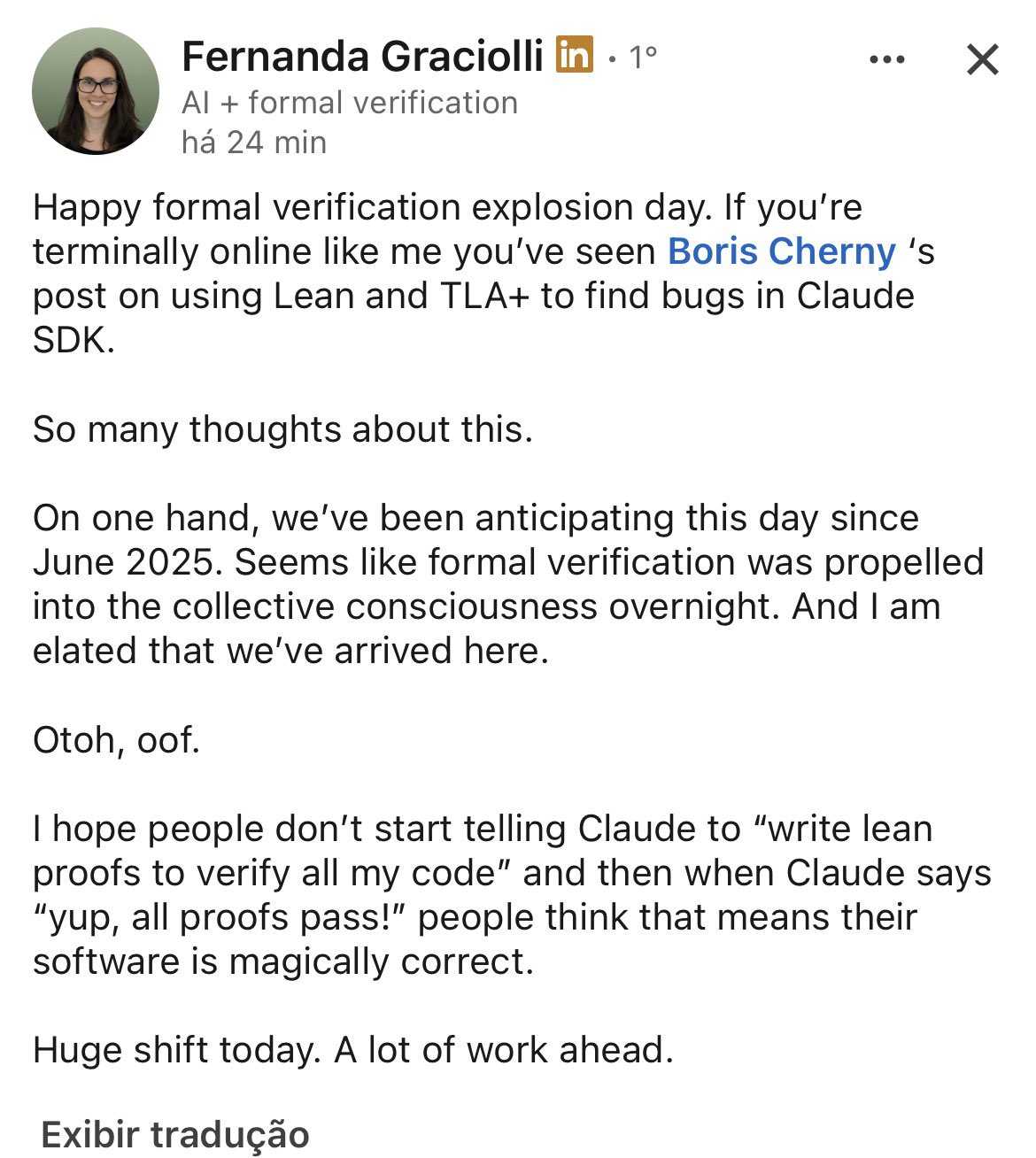
Happy formal verification explosion day!
So excited to get Lasm out to y'all soon.

Maybe I was a little too harsh on my criticism on the way Boris was using Formal Verification, Fernanda was more graceful on her nudge to be careful of what it means to have software formally verified.
This is indeed a big day for our field and I certainly hope to see more of it!
2
4
481
Yes this sounds much much more like how I believe formally verified programming is about to work.
People are going crazy over how humans need to still check the specs and that proofs mean nothing if AI-generated... they're missing the mark IMO.

Formal Verification will very quickly reach its full potential as what it was meant to be from the beginning: a means to an end.
But not as it started. As it will end.
1. From human intent, AI will generate the code, the spec, and the proof, all together as bundle. Without the spec and proof, the code is just garbage and no human should even consider it.
2. The spec will be rendered back to the human in natural language as feedback, for approval. We will not see any code, spec, or proof. The rendered feedback will be as close it can be to the original intent, otherwise humans will not approve it.
3. The engine will generate an independently checkable proof that the loop has been closed, with a provably correct artifact that matches the human intent.
I call this Intent Computing. Where the AI is the new Computer and Intent is the new Programming Language.

1
4
335
Formal verification is the near-term future of software development.
I highly recommend starting to get familiar with Lean.
I have a project coming soon that will allow Lean to run in some interesting places ;)
Lasm

I used Opus 5.5 to formally verify the Claude Agent SDK using Lean. A couple short prompts = 16 PRs fixing various bugs and race conditions. Video attached.
TLA+ also works well. I sometimes combine Lean and TLA+ to look for issues around data flow, concurrency, and state mgmt.
I don't know either language well, but Claude is excellent at both. This approach is super useful for formally modeling your code and finding bugs that a human probably wouldn't have spotted.
Is formal verification the future of coding (or at least, bug finding)?

3
1
15
1,517
We need to knock out software engineering, mathematics, accounting, taxes, and the rest of the specialties that can be done purely digitally... because we need to pave the way for breakthroughs in physics and biology.
The infrastructure for those breakthroughs to occur is being built out right now, HMS by Anthropic is an important sign of this work.

Wondering if the same model from OpenAI that solved at least 100 major math problems in the last 3 weeks can also solve major physics problems.
Sam Altman said they'll try to find a room temperature superconductor.
The question is whether they've already moved on to physics or are still working only on math problems.
Seeing major physics problems solved would be 100x more epic.
1
2
390
@elonmusk Hopefully this isn't too petty, but it's my honest feedback.
The most terrible thing about FSD right now is the speed limit situation. Why did you decide to remove the ability to set the speed limit of the car manually? Removing this capability has led to a TERRIBLE user experience for me and my wife as we attempt to safely drive using FSD in our daily lives and on long road trips.
The lack of this feature puts us into needlessly dangerous situations. Also, the speed limit data that FSD pulls from us so terribly buggy and wrong sometimes, it's crazy.
We'll often be in a 45/50ish MPH zone, or even 70, and out of nowhere the car will phantom switch to like 25 MPH, instantly decelerating the car dangerously. This leads to either disengaging, accelerating manually, or rapidly increasing the mode (we usually stay in sloth or chill).
Then there are the situations where you literally can't get the car to go slower while keeping it in FSD. I believe in obeying the law, so I essentially always keep the car in sloth or chill and almost never want the car to go above the speed limit. But here's what happens: We'll hit situations where we must go below the posted speed limit or the erroneous speed limit set by the Tesla. This is impossible to do if you're already in sloth!
For example, Saturday we went through a pretty torrential downpour. The speed limit was around 65 or 70, but I could feel lots of water pooling on the road. My wife was driving and I told her to bring it down to 55...she couldn't do it while maintaining FSD, and she feels uncomfortable in high stress situations without FSD. She eventually disengaged and had to drive completely manually through that situation because she couldn't just set the speed limit herself.
This is a terrible user experience, and dangerous. Your maps are horribly wrong, and there's no way to elegantly fix the situation as the supervisor of FSD. Oh also, it seems like you haven't designed any mode to do what should be the default according to the laws of the land...just literally going the speed limit as the maximum speed at all times! That's the most obvious normal mode you could possibly think of if you're actually trying to, you know, obey the speed limit.
Sloth and chill seem to work fine under 70, but when you hit a 75, 80, or 85 zone they won't even go the speed limit...what? That's just crazy wrong. So you have to go into standard...which then goes above the speed limit sometimes significantly.
You had this right before, allowing the user to set the speed limit manually when the Tesla errors on the reading the current speed limit, and you removed it so prematurely it's just insane.
Please fix this situation. Your modes are off. Your speed limit data is off. Please get this situation under control.
2
9
643
lastmjs retweeted

A quarter of a century has passed since September 11, 2001, when the peace of our Nation was shattered by terrorists.
Today, we remember the 2,977 precious lives taken from us, honor the heroes who answered the call, & keep their families in the heart of our Nation.
Above all, we must ensure the memory of 9/11 never fades, but is carried from one generation of Americans to the next.
We will never forget. 🇺🇸

2,972
12,700
57,262
1,489,051
The Millillion Prize problems:
Realtime/practical general-purpose implementations of:
1. FHE
2. SNARK (zk/validity)
3. iO (indistinguishably obfuscation)
4. ProofScript (Lean-like formal verification)
These are the types of mathematical breakthroughs that would be overwhelmingly useful to mankind, mindblowingly amazing, things of legend.

One optimistic and still very-non-consensus belief I have about the far future of cryptography:
I think that there is a 33% chance that, for average real-world computation, there exist ways to implement all three of what I call the Egyptian God Protocols (SNARK, FHE, iO) with 1+ε factor overhead (meaning, for large enough instances, the added overhead of cryptographizing a computation becomes arbitrarily small compared to the base cost of doing the computation itself)
And a 60% chance that all three can be done with single-digit overhead (ie. <10x, measured in total cost of energy plus amortized compute)
I think there's a good chance we'll get one of these (probably SNARKs with single-digit overhead) by the end of this decade. After all, we're already there for specialized hash functions and for some LLM inference.
3
386