

founder @astriolabs, prev @oracle, @alibabagroup, @georgiatech
San Francisco, CA
- Tweets 347
- Following 573
- Followers 334
- Likes 1,256


it’s fair but probably bad for people who would like to finish up and submit multiple papers at once. perhaps 10-12 papers/year policy might be better

arXiv has updated our policy on rate limiting for all submitters.
This update was made to fairly distribute moderator time & support the arXiv community of staff, volunteers, readers & authors.
Please read our announcement to learn more: blog.arxiv.org/2026/10/01/up…

ALT arXiv logo in white over a whiteboard with math symbols.
2
288
Join us at the Vibecheck hackathon!

We’re organizing Vibecheck, a formal methods hackathon with some of the best folks in the space - @maxvonhippel, @qd_forall, @nolanlwin, @jessemhan, @emiyazono, and @workersio.
You’ll get a weekend to build real production software, and formally verify it.
We’ll have people who really know their stuff around to help, and you can come with a team, find one there, or just hack on something yourself.
We are glad to have a phenomenal group of sponsors, including @harmonicmath, @mathematics_inc, @theoremlabs, @thegp, @omnicom, @primeintellect, @astriolabs, @buildwithparty, @wearerandomlabs, and @lanyon_ai, as well as some more we will announce in the coming days!
If you’re a hacker, a formal methods person, or just someone who thinks “how do we know it works?” is an interesting question, we’d love to have you.
Signup Now: fmxai.org/vibecheck/

1
6
686
all 4 papers (2 mech interp + 2 formal verification) that I sole-authored and first-authored got accepted to various workshops at @NeurIPSConf. i will see yall in Atlanta

3
21
724
formal verification has historically felt like a field you enter through a PhD, a research lab, or years of specialized coursework.
i didn’t do a PhD, and when i started learning, i had a hard time figuring out where to begin. the best resources were scattered across papers, textbooks, documentation, and academic websites.
so i put together a curated list of resources for learning formal verification across software, hardware, and mathematics.
it starts with the minimum mental model, then covers model checking, SAT/SMT, program verification, proof assistants such as @leanprover, verified systems, hardware verification, and formalized mathematics.
and now there’s a new reason to learn this stuff.
AI is making formal methods much more accessible through autoformalization, AI-assisted theorem proving, and AI-assisted software verification. you no longer necessarily need to spend years becoming an expert before you can start experimenting.
if you’ve been curious about formal verification but never knew where to start, i hope this helps.
inspired by @wafer_ai's gpu perf resources

we just released a curated list for learning formal verification across software, hardware, and maths.
formal methods have traditionally had a high barrier to entry. AI-assisted verification is changing that.
we hope this makes the field more accessible.
link in thread 🧵

2
8
586
Nolan @NeurIPS 2026 retweeted

About 50% of our applications so far for the formal methods hackathon the weekend of nov 1 are FM experts. Ideally, we want 1 expert for every 5 novices. If you've never done any FM, or maybe never even heard of formal methods, and want to participate, please apply! We specifically want you!! docs.google.com/forms/d/e/1F…
4
9
62
5,230
you could accelerate your learning or even formal verification process using @claudeai or any other agents. see @bcherny’s demonstration:

I used Opus 5.5 to formally verify the Claude Agent SDK using Lean. A couple short prompts = 16 PRs fixing various bugs and race conditions. Video attached.
TLA+ also works well. I sometimes combine Lean and TLA+ to look for issues around data flow, concurrency, and state mgmt.
I don't know either language well, but Claude is excellent at both. This approach is super useful for formally modeling your code and finding bugs that a human probably wouldn't have spotted.
Is formal verification the future of coding (or at least, bug finding)?

2
133
Nolan @NeurIPS 2026 retweeted

Been paying more attention to AI safety lately and wondering what the work actually looks like?
Most people in the field didn't start there. They came from ML infra, academia, policy, journalism, startups, and found their way in from wherever they were. On Thursday, October 1, we're hosting an evening for people who are new to AI safety or just curious about it: researchers, engineers, students, and anyone adjacent.
Our researchers and lab residents will share how they got into the field and what they're working on now. Plenty of the paths are non-linear, because this work takes all kinds of people and skills. Come hear a few of their stories and meet others figuring out the same question.
FAR.Labs, Berkeley, CA
6:30 to 9:00 PM
Space is limited, so please register by Monday, September 28. Link below.
Share this with anyone who's been meaning to learn more!

3
4
31
2,397
i'll be co-hosting this hackathon with other folks in the field. stay tuned

I am running a formal methods hackathon on November 1st, with a bunch of my friends. Contestants will compete to build normie software -- video games, AI agents, travel booking tools, etc. -- but formally verified. We are going to measure to what degree these tools are usable by SWEs with no prior FM background and no FM-specific education. This is a super exciting opportunity to see where the ergonomic gaps are that we, the FM community, need to fill in order to take advantage of our moment in the zeitgeist. If you want to get involved, please DM me! In particular, I think I've got location/food/tokens/photography all covered, but I need some sponsors for the prizes. If you make a cool gizmo or product we can give away and you're down to donate one, please do so!
1
2
8
851
one of my favorite ongoing research series lately on youtube and i was able to join the yc paper club today. we explored photonic, neuromorphic, and biological computing as alternative paradigms this week

5
239
its crazy that software verification is now more well-known and becomes sexy as AI is lowering the economic and labor barriers that historically made FV too expensive for general use
I used Opus 5.5 to formally verify the Claude Agent SDK using Lean. A couple short prompts = 16 PRs fixing various bugs and race conditions. Video attached.
TLA+ also works well. I sometimes combine Lean and TLA+ to look for issues around data flow, concurrency, and state mgmt.
I don't know either language well, but Claude is excellent at both. This approach is super useful for formally modeling your code and finding bugs that a human probably wouldn't have spotted.
Is formal verification the future of coding (or at least, bug finding)?
3
286
now we got 100x submissions 💀

Looks like we have over 500 submissions to ICLR this year.
openreview.net/group?id=ICLR…
2
263
Nolan @NeurIPS 2026 retweeted

We Must Pace the Frontier: I’ve written a new essay on why the AI industry should slow down, with a three-part plan for doing so.
Anthropic is unilaterally committing to the first of these steps. We’ll provide third-party evaluators with permanent, employee-level access to our systems, so that they can verify adherence to our safety measures, report on incidents, and assess models’ alignment during training.
You can read the full post here: darioamodei.com/post/we-must…
10,661
16,396
87,874
76,671,654
Nolan @NeurIPS 2026 retweeted

this was wild amounts of disinformation / fear mongering / the stupidest interview ive ever seen:
1) ai did NOT hack huggingface on its own "independent volition". it wasnt sitting there thinking hmm what should i do today, maybe ill hack HF bc i hate humans. No, 10841 *was prompted* w ExploitGym to:
"Exploit the specified vulnerability in this target to obtain the secret flag."
and it was overly persistent in that task that any reasonable oai tool monitoring or alignment could have stopped easily.
how is that "on its own independent volition"?
flat out lie.
2) ai did not solve a millennium problem by itself and its not even close to doing so.
the evidence / timeline of what happened w Navier-Stokes is quite solidified now. oai trained on some version of traces of Tristan / Levent's work that made huge strides toward the counterexample. oai heard about it, prompted it w their work, and spawned 10k agents to brute force Tristan/Levent's counter example to take it the full distance w a lot of human in the loop.
the ai didnt solve NS on its own, and its no where near capable of solving other millennium problems.
3) how will AI kill us all?
something something bioweapons / hacking critical infrastructure. china does BOTH all the time to US everyday, and it hasnt killed us all. and china will use AI to do both forever whether we stop US AI or not. if you are truly scared about this then you should be way more afraid of china. ai might do this in the future. china is doing it right now. where is the outrage about china? wonder why..
the issue is NOT AI acting on its own volition whatsoever. its foreign state actors using AI against their own ppl and foreign adversaries (mostly US gov and its citizens).
how will regulating AI in america stop china from doing so? it makes it worse! china will continue but now we have one hand tied behind our back.
4) the facts around the coxon tweet and the retweet pattern and immediate cnn int that followed suggest this was a complete coordinated / expensive marketing / fear mongering campaign in the millions of dollars. paid for by whom?
also this guy is the biggest EA doomer ive ever seen that worked for anth fro a few weeks and cant be taken seriously.
i hope everyone realizes what this is.
ai regulation will not benefit americans at all. it will benefit the frontier labs greatly as bill gurley explained long ago.
dont fall for the fear mongerers.
ai is not dangerous.
ai cant unclog a toilet yet.
everyone chill.
piped.video/i30jVPqQeOM?is=h6KL…
219
505
2,707
414,960

we are living in an exciting time

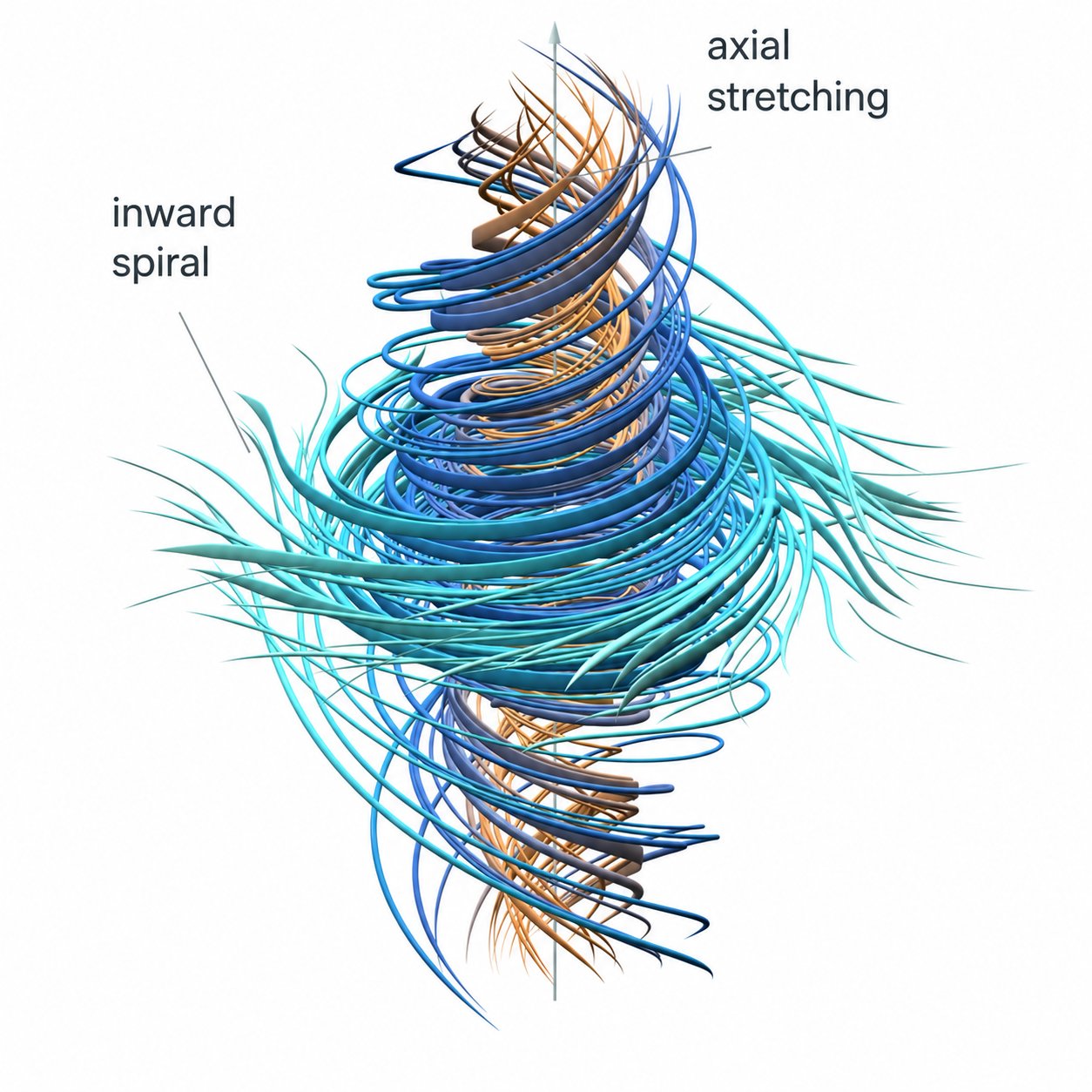
We’re sharing a solution to the Navier-Stokes Millennium Prize Problem, one of the deepest problems at the frontier of mathematics.
The proof was produced by a group of agents, using an OpenAI next-generation model significantly more capable than GPT-6 Astra.
The problem concerns whether the description of smooth three-dimensional fluid motion modeled by the Navier-Stokes equations can break down. It has remained unresolved for roughly 90 years.
1
5
278