

Nobel Laureate. Co-Founder & Chair @GoogleDeepMind; Chief Scientist of Alphabet. Founder & CEO @IsomorphicLabs. Building the future...
- Tweets 3,225
- Following 179
- Followers 1,920,689
- Likes 18,679


Pinned Tweet

Very excited to announce Gemini 4 Argon, our new Frontier AI model, and a huge step forward across key capabilities. We’re focused on rolling it out responsibly starting with government and trusted cyber defenders through our Fairwind Program today, before wider availability soon

421
679
9,127
495,751

Up, up, and away. 🚀
Today, in partnership with @planet, we launched a prototype satellite carrying four TPUs into orbit on @SpaceX's Transporter-18 rideshare mission. This launch is the first step of Project Suncatcher, our long-term research moonshot to see whether we can one day host scalable machine learning infrastructure in space.
Over the coming weeks, we'll gather in-orbit data on how our TPUs handle the physical stress, radiation, and thermal extremes of space. Whatever we learn, we'll use it to refine our future designs.

231
659
5,475
656,995
Demis Hassabis retweeted

From small molecules to complex biologics, the universe of potential medicines spanning multiple modalities is astronomically vast.
To put it in perspective: conservative estimates place the vast chemical search space for small, drug-like molecules near 10^60. The observable universe contains fewer stars – somewhere between 10^22 and 10^24. The answers to drug discovery’s toughest challenges exist within this vast space. And now, our drug design engine (IsoDDE) gives us the capability to navigate it.

13
70
683
66,832
Demis Hassabis retweeted

Google’s new Gemini 4 Argon equals GPT-6 Astra on the Artificial Analysis Intelligence Index at 60% of the Cost per Task with discounted prices. Google is now back to being one of the top three labs in intelligence achieved
Gemini 4 Argon is @GoogleDeepMind’s first proprietary model above the Flash class in over 7 months. With high reasoning (the highest available), it scores 53 on the Artificial Analysis Intelligence Index, matching GPT-6 Astra (max, 53) and 1 point ahead of GPT-6.1 Sol (max, 52), with gains driven by lower hallucinations and stronger agentic capabilities.
At its current 50% pricing discount and with cache discounts increased to 95%, Gemini 4 Argon costs $1.99 per Intelligence Index task, 60% of GPT-6 Astra (max), but 2.7x GPT-6.1 Sol (max). After the discount ends, this will rise to $3.98 (~1.2x GPT-6 Astra (max)).
Gemini 4 Argon is currently being rolled out to selected users and is not publicly available. The 50% discount is an initial promotion. Google has not yet confirmed the promotion end date
Key benchmarking results for Gemini 4 Argon with high reasoning:
➤ Google returns as one of the top three labs on intelligence: Gemini 4 Argon (high) scores 53 on the Artificial Analysis Intelligence Index, matching GPT-6 Astra (max, 53) and 1 point ahead of GPT-6.1 Sol (max, 52). This is 23 points above Google’s previous non-Flash model, Gemini 3.1 Pro Preview (30) and 12 points ahead of Gemini 3.8 Flash (high)
➤ Launch discounts of 50% make Gemini 4 Argon competitive on Cost per Task: At current discounted pricing, Gemini 4 Argon (high) costs $1.99 per Intelligence Index task, 60% of GPT-6 Astra (max, $3.26) for a comparable level of intelligence. This cost efficiency is driven by lower token prices, rather than reduced token use, with Gemini 4 Argon averaging 62k output tokens per task, compared with 27k for GPT-6 Astra (max). Google has not yet confirmed the promotion end date, but on standard pricing, Cost per Task will increase to $3.98
➤ Stronger agentic performance: Historically a weaker area for Gemini models, Gemini 4 Argon shows improvements across agentic evaluations. It ranks #1 on AutomationBench-AA at 77.5%, 6 points ahead of Claude Sonnet 5.5 (max, 71.3%). On Terminal Bench 4, Gemini 4 Argon achieves 57%, a +53 point improvement from Gemini 3.1 Pro Preview, only behind Claude Sonnet 5.5 (max, 64%), Claude Opus 5.5 (max, 60%) and GPT-6 Astra (59%). On AA-Briefcase, it reaches 1494 Elo. This is driven by a 65% rubric pass rate, the highest we have recorded, but lower Analytical Quality (1576 Elo) and Presentation Quality (1308 Elo)
➤ Lowest hallucination rate among leading models: On AA-Omniscience, Gemini 4 Argon has a 15% hallucination rate, the lowest of any model scoring 45+ on the Intelligence Index, compared with 51% for GPT-6 Astra (max) and 54% for GPT-6.1 Sol (max). This means Argon is much more likely to acknowledge when it does not know an answer rather than guess incorrectly. On accuracy, Gemini 4 Argon scores 50%, a 5 point decrease from Gemini 3.1 Pro Preview, and 13 points below GPT-6 Astra (max, 63%). With this slightly lower accuracy, its overall AA-Omniscience score of 42 remains in line with GPT-6 Astra (43) and GPT-6.1 Sol (42)
Key model details:
➤ Context Window: 1M tokens
➤ Multimodality: Text, image, video, and speech input, with text output
➤ Pricing: $4/$20 per 1M input/output tokens at standard pricing, currently discounted 50% to $2/$10. Cached input tokens receive a 95% discount ($0.10 per 1M at discounted pricing), up from 90% on Gemini 3.8 Flash
➤ Long Decode Continuation: We tested Gemini 4 Argon with Long Decode Continuation, a new Gemini API feature that pauses long responses and resumes them across follow-up calls. This lets reasoning run up to 1M output tokens without request timeouts

161
450
4,887
600,686
Demis Hassabis retweeted

Breakthroughs in frontier science rarely come from a sudden stroke of luck. Every major leap in AI drug design is the product of years of method development, rigorous engineering, and learning from what came before.
Witnessing the rapid advances in deep reinforcement learning and frontier AI capabilities led to a deep conviction: we could apply these same computational principles to other complex fields, like the engineering of new medicines.
That thinking led to the formation of Isomorphic Labs in 2021. Now, five years on, we have compelling evidence that our AI can unlock therapeutics to a wide range of disease classes. We are confident this technology will fundamentally impact how new medicines are created, from early discovery all the way through development.
In this article, I share the massive opportunity we have to transform human health with AI, and offer a look at the real, measurable progress we’re already making today.
isomorphiclabs.com/articles/…

25
74
594
104,571
Demis Hassabis retweeted

Is Google so back?
Their new Gemini 4 Argon understands the physical 3D world better than any other AI.
It ranks #1 on Blueprint-Bench 2, a benchmark where AI agents draw floorplans from photographs of apartment interiors.


Introducing Gemini 4 Argon – our new frontier model.
It’s built for complex workflows across coding, enterprise knowledge work, and cybersecurity defense – rolling out today to a set of trusted testers through our Fairwind Program.

44
68
1,221
208,514
Demis Hassabis retweeted

Google says Gemini 4 Argon agents have already freed over 300 TiB of memory across its data centers, with a 1 million token output limit and agents already optimizing its own infrastructure.
The agents analyzed profiling data, found memory optimizations and applied changes that were subsequently rolled out.
Argon agents are also working on C/C++ to Rust migrations reaching 800,000+ lines of kernel code, with extensive audits and testing before deployment.
For its video decoder, Google says agents replaced 32,000 lines of SIMD code with safe Rust, making the existing Rust port 2.7x faster while preserving identical video output.
These are expensive engineering tasks inside infrastructure Google already operates.
This release seems to be a much bigger deal than people think!


HOLY, GEMINI 4 Released. And its on Fable / Astra level!! I did NOT see that coming.
SOTA in several benchmarks!! No way

107
314
4,744
343,532
Demis Hassabis retweeted

Gemini 4 Argon has an insanely low hallucination rate on Artificial Analysis. 15%.
Grok 4.7 is at 29%. GPT-6 Astra 45%. Opus 5.5 59%. Fable 5.1 69%.
The only models below it barely answer anything. None of them get more than 15% right.
It gets fewer answers right than Opus 5.5 on max, 50% against 66%. But when it doesnt know, it says so instead of making something up.
Cant wait to get my hands on it.

105
344
5,219
307,343

Big news: Gemini 4 Argon (High) by @GoogleDeepMind just landed #1 in Text Arena with 1525 pts, and #8 in Code Arena: WebDev with 1679 pts!
This release has reshaped the Text Arena Pareto frontier with a blended $8/MToken! Gemini 4 Argon (High) is now the most cost efficient model, see its placement on Pareto frontier below.
In the Text Arena, Gemini 4 Argon (High) ranks #1 in Coding, Hard Prompts, Instruction Following, Longer Query, and Creative Writing. It also leads every occupational domain evaluated, with additional #1 spots in English, Non-English, Chinese, and Russian.
This model is +20 points above the #2 ranked Claude Opus 4.6 (High), and a huge leap from Google’s previous release, Gemini 3.8 Flash (High) at #11!
In Code Arena: WebDev, Gemini 4 Argon (High) gained +96 points from Gemini 3.8 Flash (High), and went from #29 to #8.
Congrats to the @GoogleDeepMind team on this impressive frontier release!


Introducing Gemini 4 Argon – our new frontier model.
It’s built for complex workflows across coding, enterprise knowledge work, and cybersecurity defense – rolling out today to a set of trusted testers through our Fairwind Program.
131
320
3,503
764,663


Very excited to announce Gemini 4 Argon, our new Frontier AI model, and a huge step forward across key capabilities. We’re focused on rolling it out responsibly starting with government and trusted cyber defenders through our Fairwind Program today, before wider availability soon
421
679
9,127
495,751
So proud of the incredible team who have been working so hard and relentlessly on this! More info in the blogpost: goo.gle/4rZBiSd
22
28
465
39,711
Biosecurity is one of the most urgent challenges for the AI era. Bringing SynthID to biology so AI-generated proteins can be watermarked is a critical step - and we’re open sourcing SynthID Bio tools so the research community can build on this work. Published in @Nature today, congrats to the team! nature.com/articles/s41586-0…

Very happy to announce that our team @GoogleDeepmind has pushed the boundaries of generative biology, achieving the successful synthesis of AI-designed proteins that are both functional and watermarked.
This proof-of-concept watermarking of the building blocks of life is enabled by SynthID Bio, our new protein watermarking method. It is designed to safeguard the new era of AI-powered generative biology and strengthen global biosecurity.
You can read my thoughts here on why watermarking AI-designed proteins is an important research breakthrough: x.lingyaoai.com/pushmeet/status/210531…
134
366
3,205
253,045
Demis Hassabis retweeted

Researchers at @BroadInstitute, @UniofExeter, and beyond are already using AlphaGenome Atlas to better identify potential disease-causing DNA variants and interpret their role. 🧵
177
82
799
134,377
Good to see the progress, and we look forward to following up.

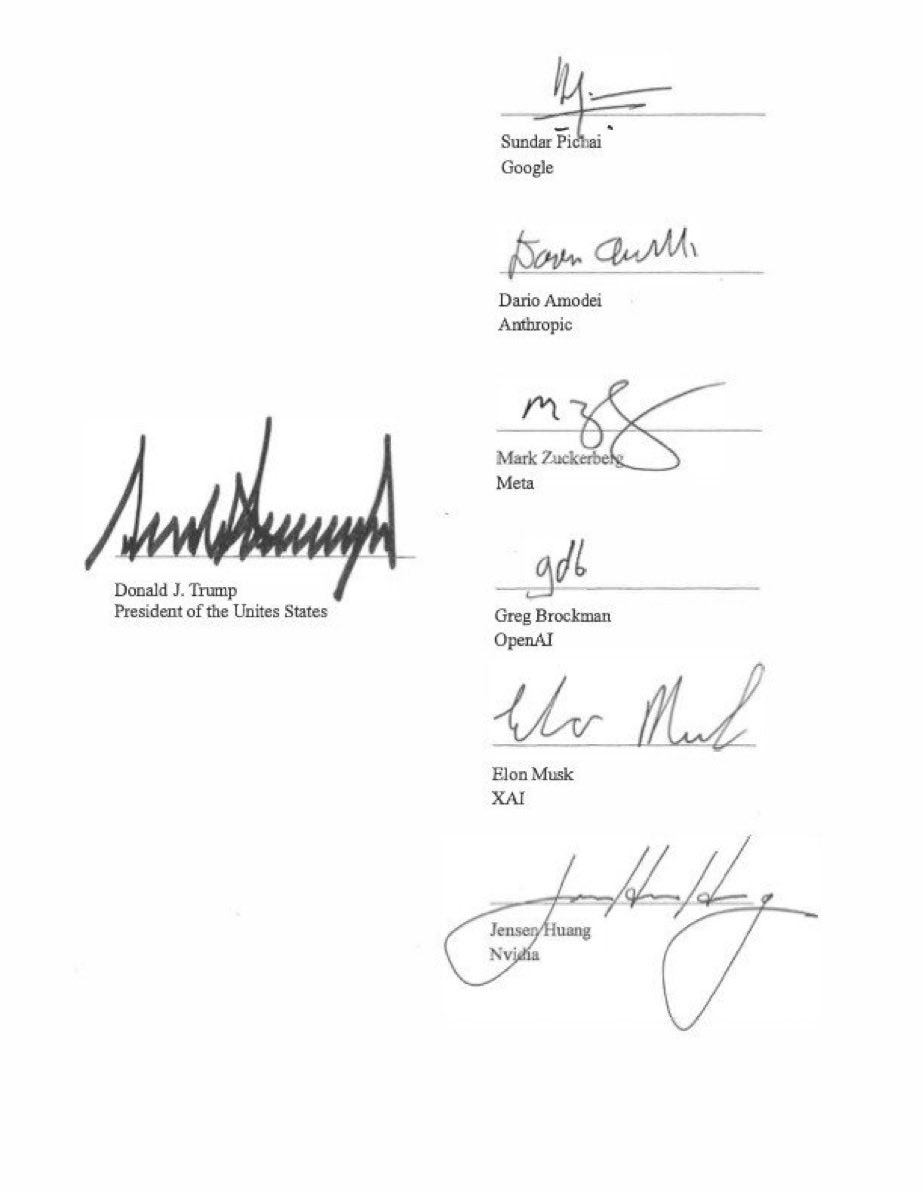
Great to meet today with @POTUS, @JDVance, @SpeakerJohnson and Administration + tech leaders. Important conversation and we signed today the White House Accord on Super Intelligence.
As I shared today, Google has invested hundreds of billions in the last two years alone, with more to come, across the entire stack, to deliver benefits for America and the world. We’re working to build products that deliver real value for people and businesses, invest in local communities, and build trust in the technology.
Industry also has to innovate responsibly. Google’s focused on building the right way, with appropriate testing, evaluations, red-teaming, and other safeguards against misuse and misalignment – and releasing models or products only after they’ve been thoroughly reviewed.
We are committed to working with other industry leaders to establish norms and build public confidence. The White House Accord and the Joint Commitment on Frontier Responsibilities signed today is a solid basis for moving forward - it contains real tangible steps to promote safe development, while delivering the economic and scientific benefits of this technology.

116
86
1,849
174,211


Demis Hassabis retweeted

Today we have 3 new DeepMind Institute essays:
How can we control misbehaviour in agent swarms?
How should we orchestrate complex networks of AIs and people?
The case for making AGI’s benefits equitably distributed.
Get them here -> bit.ly/deepmind-institute
52
133
896
77,589
Demis Hassabis retweeted

Introducing Gemini 3.8 Flash and Flash-Lite TTS, our new SOTA text to speech model with:
- a new voice design experience
- 2,000+ production ready voices
- voice replication
- support for 100 languages
- voice remixing (soon)
- #1 spot on Hume AI's voice benchmarks
and more!!
374
246
4,552
371,956

Demis Hassabis retweeted

The idea that Chain of Thought is inevitably going to go away misses that we have agency in designing these models and can do something about that. @rohinmshah and I make the case that we should intentionally preserve monitorability (as part for of the launch of the DeepMind Institute) here: institute.deepmind.com/essay…
47
77
467
65,640
